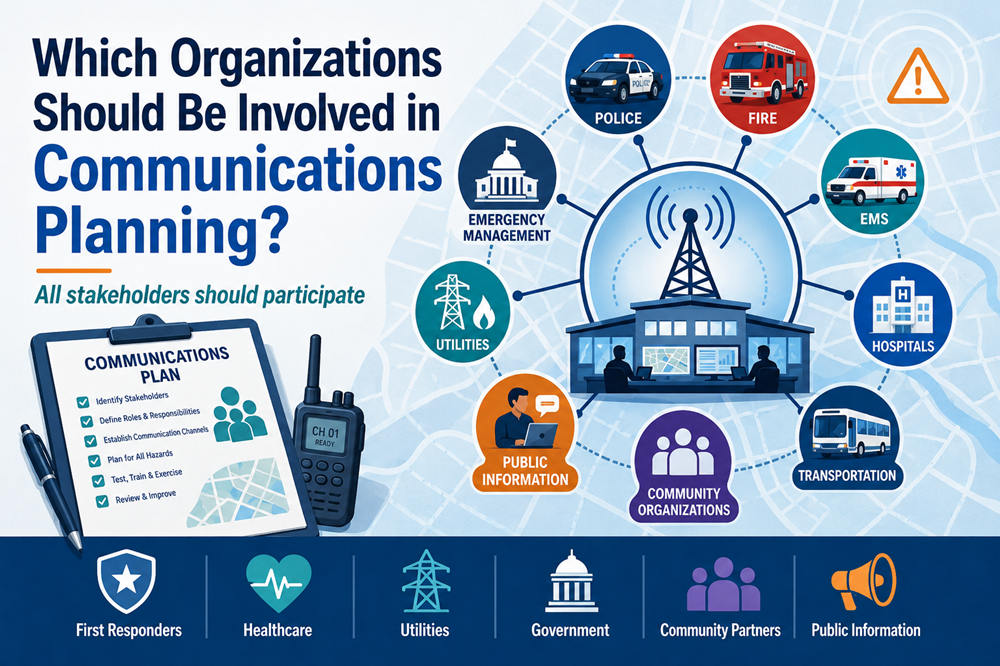
Which Organizations Should Be Involved in Communications Planning for Effective Emergency Response?
All stakeholders should be involved in communications planning. This includes every organization that may respond to an incident, provide resources, maintain essential services, or share emergency information with the public.
This approach reflects the National Incident Management System, which helps government agencies, nonprofit organizations, and private-sector partners work together during incidents. When these groups plan before a crisis, they can agree on responsibilities, communication channels, terminology, and backup methods. That preparation saves valuable time and reduces confusion when an emergency occurs.
What Does “All Stakeholders” Mean?
A stakeholder is any agency, department, business, nonprofit, or community group that could play a role during an incident.
The term does not refer only to police departments, fire departments, and emergency management agencies. A major emergency may also involve hospitals, utility companies, transportation departments, schools, telecommunications providers, private contractors, charities, and public information teams.
Each organization sees a different part of the situation. A hospital knows its available treatment capacity. A utility provider understands the extent of a power outage. A transportation department can identify closed roads, while a community organization may know which residents need language assistance or accessible transportation.
The exact mix of stakeholders depends on the community and the hazards being considered. Coastal areas may need marine and flood-response partners, while communities near chemical facilities may need environmental agencies and hazardous-material specialists.
The important point is that any organization expected to send, receive, or act on emergency information should participate in planning. FEMA’s emergency planning guides also emphasize involving community organizations and other partners before disasters happen.
Organizations That Should Participate in Communications Planning
Emergency Management and First Responders
Emergency management agencies often bring the planning group together. They identify likely hazards, maintain contact lists, coordinate exercises, and connect local departments with regional, state, tribal, territorial, or federal partners.
Police departments, fire departments, emergency medical services, and dispatch centers provide the field perspective. They know what information responders need, how quickly they need it, and which communication problems commonly occur during operations.
These agencies should agree on radio channels, dispatch procedures, resource requests, situation reports, and mutual-aid communications. They should also test equipment in places where coverage may be weak, including tunnels, rural areas, high-rise buildings, and large industrial sites.
Healthcare and Public Health Organizations
Hospitals, clinics, ambulance services, nursing facilities, public health departments, and medical suppliers may all have emergency responsibilities.
During a mass-casualty incident, hospitals need early information about the number and condition of incoming patients. Responders may need updates about available beds, emergency-room capacity, blood supplies, staffing shortages, or access to specialized treatment.
Public health agencies become especially important during disease outbreaks, contaminated water events, hazardous-material releases, and extreme weather. They help develop health warnings and explain what residents should do to protect themselves.
The CDC’s Crisis and Emergency Risk Communication program provides guidance for health officials, emergency responders, and organizational leaders responsible for communicating risks during emergencies.
Including healthcare partners also prevents avoidable problems, such as sending too many patients to one hospital while other facilities still have capacity.
Infrastructure, Transportation, and Utility Providers
Emergency operations depend on electricity, water, fuel, roads, public transportation, telephone service, and internet access.
Public works departments may report flooding, fallen trees, damaged bridges, blocked roads, broken water lines, or sewage problems. Transportation agencies may provide evacuation buses, adjust traffic routes, close unsafe roads, or explain disruptions to public transit.
Utility and telecommunications providers can report:
- Power, water, gas, or network outages
- Damaged infrastructure
- Unsafe electrical or gas conditions
- Areas without reliable phone or internet service
- Expected restoration times
This information helps emergency leaders choose safe evacuation routes, place shelters, protect response crews, and decide which services must be restored first.
Government and Private-Sector Partners
Many government departments have emergency duties even though they are not traditional response agencies.
Schools may serve as shelters or reunification sites. Social-service agencies may help displaced families. Housing departments may identify temporary accommodation, while parks and recreation departments may provide facilities, vehicles, or staff.
Public officials also need a clear process for approving emergency declarations, evacuation orders, and public warnings.
Private companies should participate when they control resources or services that may be needed during an incident. Relevant partners can include:
- Fuel and food distributors
- Construction and debris-removal contractors
- Hotels and property managers
- Security firms
- Technology providers
- Delivery and transportation companies
- Critical-infrastructure operators
Involving these businesses early makes it easier to understand what they can provide, who can authorize assistance, and how they should be contacted outside normal business hours.
Community and Nonprofit Organizations
Community organizations often have trusted relationships with residents who may be difficult to reach through standard government alerts.
Faith-based groups, charities, food banks, neighborhood associations, volunteer organizations, and disability-support groups may operate shelters, distribute supplies, translate messages, or identify residents who need additional help.
Their participation can reveal practical communication barriers. Some people may not have internet access, understand English well, own a vehicle, or be able to hear a siren. Others may need messages in accessible formats or information delivered through a caregiver or trusted local leader.
A plan that ignores these needs may work well for agencies but fail the people it is meant to protect. FEMA’s whole-community approach encourages emergency managers to involve faith-based, nonprofit, private-sector, and community organizations in preparedness efforts.
Communications and Public Information Teams
Dispatchers, radio technicians, information technology employees, cybersecurity specialists, and telecommunications professionals should help build the technical side of the plan.
They can identify weak radio coverage, incompatible systems, network security risks, equipment limitations, and insufficient backup power. They can also prepare alternatives for damaged towers, cyberattacks, internet outages, or overloaded mobile networks.
CISA’s emergency communications planning guidance covers voice, video, and data interoperability, along with the personnel, equipment, and training needed to maintain reliable communication.
Public information officers focus on messages sent to residents and the media. They may prepare evacuation notices, shelter updates, emergency alerts, safety instructions, press briefings, and social media posts.
When several agencies are involved, these messages should be coordinated. Residents should not receive one instruction from a police department and a conflicting message from a city office. FEMA’s Joint Information System Toolkit provides resources for coordinating public information across participating organizations.
Why All Stakeholders Need to Participate
Different Systems Must Work Together
Organizations may use different radios, software platforms, terminology, and reporting procedures. These differences are difficult to fix in the middle of an emergency.
Joint planning allows participants to identify compatibility problems, choose shared channels, and establish alternate ways to exchange information. CISA’s Interoperability Continuum helps emergency response agencies evaluate the policies, procedures, technology, training, and governance needed for reliable voice and data communications.
Responsibilities Must Be Clear
A communication task can be missed when everyone assumes another agency is handling it.
The plan should identify who issues public alerts, reports field conditions, contacts outside agencies, requests resources, and approves official statements. Clear assignments reduce delays and duplicated work.
Decision-Makers Need Complete Information
Emergency leaders rarely get everything they need from one source.
They may need road conditions from public works, hospital capacity from healthcare partners, outage information from utilities, and shelter updates from nonprofit organizations. Including these groups creates a fuller picture of the incident.
Public Instructions Must Be Consistent
Conflicting messages can cause panic, delay evacuations, or send people into unsafe areas.
Agencies need an agreed process for verifying information and approving public instructions. A coordinated message is easier for residents to understand and trust.
Communication Must Reach the Whole Community
Emergency information is only useful when people can receive and understand it.
Community partners help planners account for language differences, disabilities, limited internet access, transportation needs, and other barriers. Their involvement makes alerts more accessible and practical.
Normal Systems May Fail
Power outages, damaged towers, cyberattacks, and overloaded mobile networks can interrupt the communication tools people use every day.
Planning partners should establish backup methods before they are needed. These may include alternate radio channels, satellite phones, mobile communication units, amateur radio support, or in-person message delivery.
What Should Stakeholders Plan Together?
A good communications plan should show who shares information, which systems they use, and what happens when those systems fail.
Stakeholders should decide:
- Who can release official information
- Which radio channels and communication platforms will be used
- How urgent messages will be prioritized
- How field updates and resource requests will be submitted
- Which terms and reporting formats agencies will use
- How confidential information will be protected
- How alerts will reach residents
- Which backup systems are available
- Who maintains and repairs equipment
- How after-hours contacts will be reached
- How often the plan will be tested
The plan should also separate operational information from public information. Patient records, law-enforcement details, and security-sensitive data should not be shared through public channels.
Contact lists, radio assignments, and staff responsibilities must be reviewed regularly. Even a well-written plan becomes unreliable when it contains outdated information.
Common Communications Planning Mistakes
A frequent mistake is inviting only emergency management personnel and first responders. Those agencies may lead the response, but they often depend on hospitals, utilities, contractors, transportation providers, and community groups.
Another mistake is treating communications planning as an equipment project. New radios or software will not fix unclear responsibilities, poor training, or missing contact information.
Other common problems include:
- Depending on one communication system
- Failing to test equipment in realistic conditions
- Using outdated phone numbers or contact lists
- Ignoring translation and accessibility needs
- Leaving private-sector partners out of exercises
- Failing to provide backup power
- Using inconsistent terminology
- Neglecting cybersecurity risks
These weaknesses are much easier to correct during a drill than during a real emergency.
How to Test and Update the Plan
Communications plans should be tested through tabletop exercises, drills, and full-scale emergency exercises.
A tabletop exercise allows participants to talk through a realistic scenario and explain how they would communicate. A functional or full-scale exercise goes further by testing equipment, dispatch procedures, public warnings, and coordination between field personnel.
After each exercise or real incident, stakeholders should review what happened. They should look for delayed messages, failed equipment, unclear responsibilities, and information that did not reach the correct person.
The plan should then be updated to reflect new employees, equipment, hazards, and partnerships. Communications planning is an ongoing process, not a document that can be written once and forgotten.
Final Answer
In FEMA and NIMS communications planning, the correct answer is all stakeholders. Every organization that may respond, provide resources, maintain essential services, or communicate emergency information should help create and test the plan.