Communication Boards for Adults: Practical Types, Uses, and Everyday Communication Tips
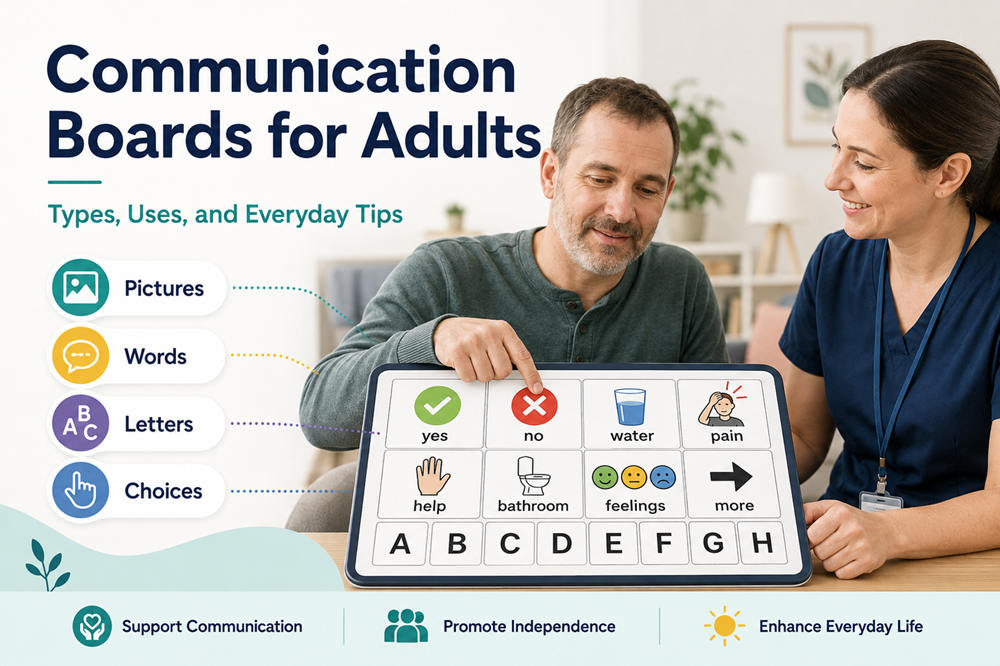
Communication boards for adults give people another way to express needs, choices, feelings, and thoughts when speaking is difficult. A person can point to pictures, words, letters, or phrases to communicate with family members, caregivers, and healthcare professionals.
Some adults need a board temporarily after surgery, illness, or injury. Others use one as an ongoing communication aid. The most effective board is usually simple, easy to access, and designed around what the person actually wants and needs to say.
What Are Communication Boards for Adults?
A communication board is a tool that helps someone communicate without depending completely on spoken words. The user typically points to a picture, symbol, written word, letter, number, or short phrase that represents what they want to say.
Communication boards are part of augmentative and alternative communication (AAC). AAC includes different methods that support or replace speech when a person has trouble communicating verbally.
A very basic adult communication board might contain choices such as:
- Yes
- No
- Help
- Water
- Food
- Bathroom
- Pain
- Hot
- Cold
- Tired
- Stop
- More
Other boards provide a much larger vocabulary for feelings, activities, medical needs, people, places, and everyday conversations.
The format can also vary. Some boards are printed and laminated, while others are available on tablets or dedicated AAC devices. Alphabet boards let users spell messages letter by letter when the words they need are not already displayed.
The best format depends on the individual. Someone who reads comfortably may prefer written words and phrases, while another person may communicate more easily through photographs or clear symbols.
A board can also support someone who still has some speech. For example, a person may use spoken words when possible and point to the board when a particular word is difficult to produce.
Who Can Benefit From Communication Boards?
Communication difficulties can happen for many reasons, so communication boards are used in homes, hospitals, rehabilitation centers, care facilities, and other settings.
Adults Recovering From a Stroke
A stroke can affect communication and a person’s ability to speak or use language. Someone may know what they want but have trouble finding or producing the right words.
A board can provide a quicker way to express immediate needs such as hunger, thirst, pain, tiredness, or needing the bathroom while communication abilities are recovering.
People With Aphasia
Aphasia affects language and often occurs after a stroke or brain injury. The symptoms vary from person to person.
Someone with aphasia may struggle to find words, form sentences, read, write, or understand certain language. A carefully designed board can provide pictures, familiar words, and other choices that support communication.
Adults With ALS
ALS can cause changes in speech and communication as the condition affects the muscles involved in speaking.
As speech becomes harder, some adults use printed boards, alphabet boards, or electronic AAC systems. Depending on their movement abilities, they may select items using a hand, pointer, eye movements, switches, or other access methods.
Autistic Adults and Adults With Developmental Disabilities
Some autistic adults and adults with developmental disabilities use communication aids regularly, either alongside speech or as their main way of communicating.
Boards can help a person:
- Make choices
- Ask for something
- Express discomfort
- Identify emotions
- Request a break
- Tell someone to stop
- Participate in everyday activities
Materials designed for adults should use age-appropriate language, images, and topics rather than childish-looking symbols.
Hospital and Medical Patients
Some patients temporarily lose the ability to speak because of surgery, breathing tubes, neurological problems, serious illness, or weakness.
A bedside board can allow a patient to quickly communicate important needs such as:
- I am in pain.
- I cannot breathe comfortably.
- I am thirsty.
- I need the bathroom.
- I am too hot.
- I am too cold.
- I need to change position.
- Please call my family.
- I don’t understand.
Even a simple board can give someone more control when speaking is temporarily impossible.
Common Types of Communication Boards for Adults
Different communication needs call for different types of boards. Some people use one type, while others combine several.
Picture Communication Boards
Picture boards use photographs, drawings, or symbols to represent objects, activities, feelings, and requests.
For example, a glass can represent a drink, while a bed can represent sleep or rest.
These boards can be useful when reading written words is difficult. Clear, familiar images generally work better than complicated or abstract symbols.
Word and Phrase Boards
These boards use written words and short phrases such as:
- I need help.
- I am uncomfortable.
- Please wait.
- I need the bathroom.
- Please speak slowly.
- I don’t understand.
- Say that again.
- I want to rest.
- Please call my family.
Complete phrases can make communication faster because users do not need to build every sentence word by word.
Alphabet Boards
An alphabet board contains the letters A through Z and usually numbers or a few common words.
The person points to letters one at a time to spell a message. This gives users freedom to communicate words and ideas that are not already included elsewhere on the board.
Spelling can be slower, so alphabet boards often work well when combined with commonly used words and phrases.
Medical Communication Boards
Medical boards focus on health, comfort, symptoms, and care needs.
They may include:
- Pain
- Nausea
- Dizziness
- Breathing difficulty
- Medication
- Hunger
- Thirst
- Bathroom
- Sleep
- Position changes
- Anxiety
- Temperature
A medical board may also include a body diagram. The person can point to the part of the body where they feel pain or discomfort.
A simple pain scale can help them communicate how severe the pain feels.
Digital Communication Boards
Phones, tablets, and dedicated AAC devices can provide digital versions of communication boards.
Users select words, symbols, or phrases on the screen. Some devices speak the selected message aloud.
Digital tools can store a large vocabulary and organize words into categories such as:
- People
- Food
- Activities
- Feelings
- Places
- Healthcare
- Personal interests
Printed boards are still useful because they are inexpensive, easy to carry, and do not depend on charging or electronic equipment.
What Should Be Included on an Adult Communication Board?
There is no need to fill a board with every possible word. Too many choices can make it difficult to find the important ones.
Start with information the person uses regularly and add more as needed.
Yes and No
Yes and no should be large, clear, and easy to locate.
These two options are especially useful when the person has limited energy or movement because they allow many questions to be answered quickly.
Basic Needs
Common choices can include:
- Food
- Water
- Bathroom
- Help
- Sleep
- Sit up
- Lie down
- Stop
- More
- Finished
- Too hot
- Too cold
The vocabulary should reflect the person’s daily routine rather than following a generic list.
Pain and Physical Comfort
A person needs a clear way to indicate when something is wrong.
Useful options may include:
- Pain
- Headache
- Nausea
- Dizzy
- Itchy
- Uncomfortable
- Trouble breathing
A numbered pain scale and simple body diagram can provide additional information about where something hurts and how severe it feels.
Feelings
Communication is about more than requesting food, water, or medical care.
An adult may also want to say:
- Happy
- Sad
- Angry
- Scared
- Worried
- Frustrated
- Lonely
- Confused
- Calm
- Excited
- Tired
Including emotions gives the person a better way to communicate how they are feeling rather than forcing others to guess.
Important People
Names, words, or photographs of important people may also be useful.
These could include:
- Partner
- Husband
- Wife
- Son
- Daughter
- Parent
- Friend
- Doctor
- Nurse
- Caregiver
Personal names are often more useful than general labels when the board belongs to one specific person.
Common Requests and Conversation Phrases
Some communication needs cannot be represented by a single object.
Useful phrases include:
- Please help me.
- Give me a minute.
- I don’t understand.
- Please say that again.
- Please speak slowly.
- I want some privacy.
- I want to go outside.
- I want to watch TV.
- I want to rest.
- Please call someone.
Personal interests can also be included. Someone may want vocabulary related to music, sports, pets, television, hobbies, faith, work, or family.
Communication should allow the person to express personality and preferences, not just basic physical needs.
Letters and Numbers
An alphabet gives users a backup when the exact word they want is missing.
Numbers can also help with time, dates, phone numbers, quantities, pain levels, and other everyday information.
How to Use a Communication Board Effectively
A well-designed board only works if the person can comfortably access and understand it.
Keep It Visible and Easy to Reach
Place the board where the user can reach or see it whenever communication may be needed.
For someone in bed, this may mean keeping it on the bedside table or positioning it directly in front of them.
The text and pictures should also be large enough to see clearly. Adequate space between choices can help people who have difficulty pointing accurately.
Give the Person Enough Time
Using a communication aid often takes longer than speaking.
Ask the question, then allow the person time to look over the options and make a choice. Avoid immediately guessing what they are trying to say or finishing their message for them.
Rushing can make communication more frustrating.
Confirm Important Selections
If there is any doubt about what the person selected, confirm it.
For example:
“You pointed to water. Do you want a drink?”
This simple check can prevent misunderstandings, especially when several symbols are close together. Similar strategies, including using pictures and confirming messages, are also recommended for communicating with people who have aphasia.
Customize the Board
Personalized boards are usually more useful than generic ones.
Include the words and topics the individual actually uses. A person may want to talk about family, a favorite sports team, television shows, pets, work, music, hobbies, or plans for the day.
The board can also be updated as needs change.
Match the Board to the Person’s Physical Abilities
Pointing with a finger is not the only way to use a board.
Depending on the person’s abilities, they may communicate through:
- Eye pointing
- Head movements
- Hand movements
- A pointer
- Partner-assisted scanning
- Switch controls
- Touchscreens
Someone with significant communication or physical challenges may benefit from working with a speech-language pathologist to find an AAC method that matches their abilities.
Communication boards for adults do not need to be complicated. A useful board gives the person quick access to the words, choices, and ideas that matter in everyday life. The best communication board is one that fits the individual’s abilities, needs, and preferred way of communicating.