
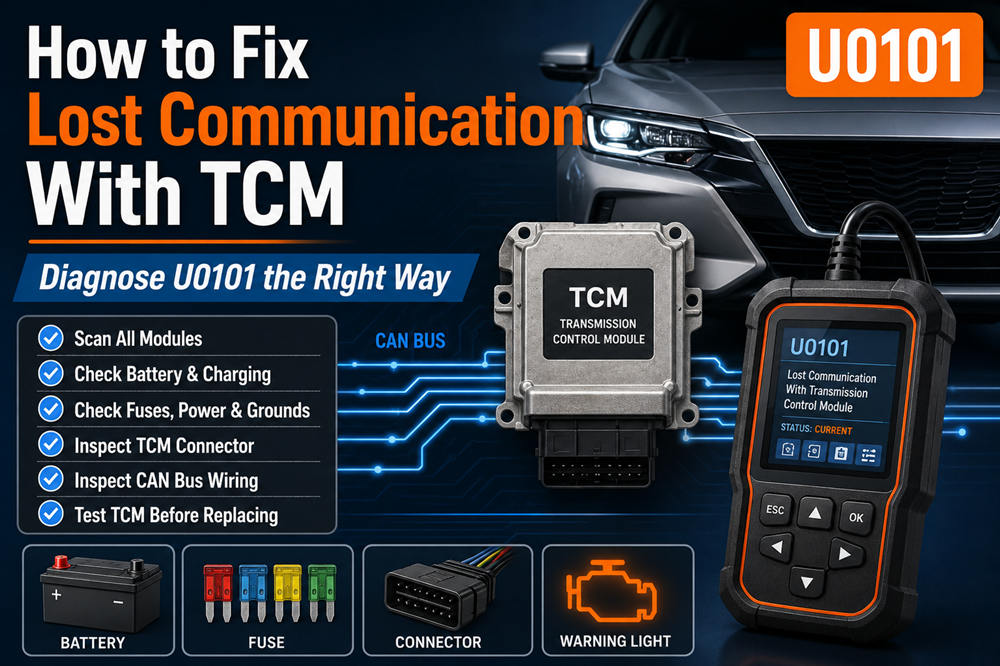
How to Fix Lost Communication With TCM and Diagnose U0101 Problems Correctly
A “lost communication with TCM” warning usually points to diagnostic trouble code U0101, which means the vehicle’s other control modules are no longer communicating properly with the Transmission Control Module. Modern vehicles use on-board diagnostic systems to identify and store faults that can help technicians narrow down problems.
The fix is not always a new TCM. Start by scanning the vehicle, checking the battery and TCM power supply, inspecting grounds and connectors, and checking CAN-bus wiring. Replace or reprogram the TCM only after testing shows the module itself is the problem.
What Does Lost Communication With TCM Mean?
The Transmission Control Module (TCM) is an electronic controller that helps manage automatic transmission operation. Depending on the vehicle, it may control or monitor shift timing, gear selection, transmission pressure, sensor signals, and other transmission functions.
Modern vehicles use a communication network that allows control modules to exchange information. This network commonly uses a Controller Area Network (CAN bus).
When another module repeatedly tries to communicate with the TCM but receives no response, the vehicle may store U0101 — Lost Communication With Transmission Control Module.
The code tells you communication has been lost. It does not identify the failed component by itself.
Common Symptoms of Lost Communication With the TCM
A TCM communication problem can affect vehicles differently. Common symptoms include:
- Check Engine light
- Transmission warning light
- U0101 trouble code
- Transmission stuck in one gear
- Limp mode
- Harsh shifting
- Delayed gear changes
- Transmission failing to shift normally
- Incorrect gear-position display
- Multiple communication-related codes
- Scan tool unable to communicate with the TCM
A vehicle may sometimes store U0101 without obvious transmission symptoms. In other cases, the transmission may immediately enter a protective mode.
What Causes Lost Communication With the TCM?
Finding the cause requires checking the TCM and the circuits that allow it to operate and communicate.
Weak Battery or Low Voltage
Electronic control modules need stable electrical voltage.
A weak battery, corroded battery terminal, loose cable, or charging-system problem can cause modules to shut down temporarily or communicate incorrectly.
Because battery problems are relatively easy to check, voltage should be one of the first things you inspect.
Blown TCM Fuse
If a fuse supplying the TCM blows, the module may lose power completely.
Other modules can then store U0101 because they no longer receive a response from the TCM.
If a replacement fuse immediately blows again, do not continue replacing it. The circuit may have a short or another electrical fault that needs diagnosis.
Missing TCM Power or Ground
A fuse can be good while the TCM still receives no power.
Broken wires, damaged terminals, corrosion, loose ground points, and excessive resistance can interrupt the module’s electrical supply.
Power and ground should therefore be tested at the appropriate TCM circuits rather than assumed to be good.
Damaged or Corroded TCM Connector
Inspect the TCM connector for:
- Corrosion
- Moisture
- Bent terminals
- Pushed-back pins
- Loose connections
- Broken locking tabs
- Damaged wiring near the connector
Even minor corrosion can interfere with a low-voltage communication circuit.
Damaged CAN Bus Wiring
The CAN bus carries messages between the vehicle’s electronic modules. The underlying CAN standards define how devices exchange information across the network.
Communication may stop if its wiring becomes:
- Broken
- Shorted
- Pinched
- Chafed
- Melted
- Corroded
Pay particular attention to wiring near the transmission, engine, battery, fuse boxes, sharp brackets, and areas where previous repairs have been performed.
Faulty Transmission Control Module
The TCM itself can fail because of internal electronics, heat, moisture, electrical damage, or age.
However, a module should not be replaced simply because a scan tool cannot communicate with it. Loss of power, ground, or network communication can make a working TCM appear dead.
Software or Programming Problems
Some vehicles may experience communication or transmission-control problems related to module software or configuration.
Depending on the vehicle, repair may involve a software update, programming, coding, adaptation, or transmission relearn procedure. Checking available manufacturer communications and Technical Service Bulletins can also help identify known vehicle-specific problems.
How to Fix Lost Communication With TCM
The most effective approach is to diagnose the problem in a logical order rather than replacing parts based on the U0101 code alone.
1. Scan All Vehicle Modules
Start with a scan tool capable of reading more than basic engine codes.
Perform a complete vehicle scan and record all stored trouble codes.
Look for codes related to:
- System voltage
- CAN communication
- Transmission circuits
- Engine control module
- ABS module
- Body control module
- Other electronic modules
Then try communicating directly with the TCM.
If most modules respond but the TCM does not, concentrate on the TCM’s power, grounds, connector, and communication circuits.
If several modules are offline, the problem may involve a wider network fault.
2. Check the Battery and Charging System
Inspect the battery terminals and cables for looseness, damage, or corrosion.
Test the condition of the battery and confirm the charging system is operating correctly.
If low or unstable voltage is present, correct that problem first. Then clear the trouble codes and rescan the vehicle to see what returns.
3. Check TCM Fuses and Power-Supply Circuits
Use the correct fuse diagram or wiring information for your vehicle.
Identify the circuits supplying power to the TCM and check the related fuses. Some vehicles may also use additional power-control circuits or relays.
Do not assume a fuse is good simply because it looks intact. Test it when possible.
If a fuse repeatedly fails, locate the electrical fault before installing another one.
4. Verify TCM Power and Grounds
If the fuses are good, confirm that proper power actually reaches the TCM.
This usually requires:
- Digital multimeter
- Wiring diagram
- Correct connector pin information
Check all required power feeds because some modules use more than one.
Ground circuits should also be inspected and tested. A loose or corroded ground can prevent the TCM from operating even when battery voltage is available.
Repair missing power or poor grounds before moving deeper into network diagnosis.
5. Inspect the TCM Connector
Locate the TCM using information for the exact vehicle.
Depending on the design, it may be located:
- In the engine compartment
- Near the transmission
- Inside the passenger compartment
- Mounted on the transmission
- Integrated with another control unit
Inspect the connector and nearby wiring carefully.
Look for water intrusion, corrosion, bent pins, loose terminals, overheated plastic, and damaged wires.
Follow the manufacturer’s procedures when disconnecting electronic modules.
6. Inspect CAN Bus Wiring
If power and ground are correct but the TCM remains offline, inspect the communication wiring.
Look for obvious damage such as:
- Exposed copper
- Crushed wiring
- Melted insulation
- Loose connectors
- Damaged splices
- Poor previous repairs
- Rodent damage
Think about when the problem started.
If U0101 appeared shortly after transmission work, engine repairs, collision repairs, battery replacement, or aftermarket electrical work, inspect the areas that were disturbed first.
7. Test the Communication Network
If visual inspection does not reveal the problem, further CAN-network testing may be necessary.
A technician may use:
- Advanced scan tool
- Digital multimeter
- Oscilloscope
- Vehicle-specific wiring diagrams
- Manufacturer diagnostic software
One wiring fault or malfunctioning device can sometimes interfere with communication elsewhere on the network.
Because CAN systems vary between vehicles, use specifications and test procedures for the exact year, make, and model rather than relying on universal values. The EPA also addresses access to vehicle diagnostic information, tools, and software used to repair modern vehicles.
8. Repair Any Wiring or Connector Faults
If testing reveals a problem, repair the fault before replacing electronic modules.
Possible repairs include:
- Repairing broken wiring
- Replacing damaged terminals
- Correcting poor grounds
- Repairing CAN wiring
- Cleaning appropriate electrical connections
- Replacing damaged connectors
- Correcting short circuits
After the repair, clear the codes and scan the vehicle again.
Confirm that the scan tool can communicate normally with the TCM and check whether U0101 returns.
9. Test the TCM
If the TCM has proper power and ground and its communication circuits test correctly, the module itself becomes a stronger suspect.
At this stage, follow manufacturer-specific testing procedures when available.
The goal is to confirm TCM failure before spending money on a replacement.
10. Replace or Reprogram the TCM If Necessary
If testing confirms an internal TCM failure, replacement may be required.
Modern control modules often need additional setup after installation, including:
- Programming
- Coding
- Vehicle configuration
- Module synchronization
- Transmission adaptation
- Shift relearn
- Software updates
A used TCM is not always a plug-and-play replacement. Compatibility and programming requirements vary by vehicle, so use service information for the exact model.
Does U0101 Mean the TCM Is Bad?
No. Code U0101 does not prove that the TCM has failed.
It only tells you that communication with the module has been lost.
The actual cause could be:
- Blown fuse
- Missing TCM power
- Poor ground
- Damaged connector
- Corroded terminal
- CAN-bus wiring fault
- Low system voltage
- Failed TCM
This is why electrical checks should come before module replacement.
Can a Bad Battery Cause U0101?
Yes. A weak battery or unstable system voltage can contribute to module communication problems.
Control modules require adequate voltage during startup and operation. If voltage drops too low, a module can temporarily stop responding and leave communication codes stored elsewhere in the vehicle.
A bad battery is not the only possible cause of U0101, but checking the battery early can save considerable diagnostic time.
Can You Drive With a Lost Communication With TCM Code?
It depends on how the vehicle is behaving.
If the vehicle shifts normally, U0101 may not always require an immediate tow, but the communication fault should still be diagnosed promptly.
Stop driving and arrange proper diagnosis if you notice serious symptoms such as:
- Transmission will not engage
- Vehicle is stuck in one gear
- Severe or unpredictable shifting
- Loss of drive
- Repeated limp mode
- Several major electrical warnings
The code itself also does not prove that the mechanical transmission has failed.
When Should You Take the Vehicle to a Mechanic?
A loose battery terminal, damaged connector, or blown fuse may be relatively straightforward to find. A CAN-network fault can be much harder to diagnose.
Professional diagnosis is a good choice when:
- Your scan tool cannot access the TCM
- Multiple modules show communication codes
- TCM power and grounds are good but communication is still lost
- No visible wiring damage can be found
- CAN-bus testing is required
- The TCM needs programming or coding
- The vehicle repeatedly enters limp mode
- The transmission will not engage or shift correctly
An advanced diagnostic scan tool can also provide information that a basic OBD-II code reader cannot access.
Quick Diagnostic Order for Lost TCM Communication
When you are trying to fix lost communication with the TCM, follow this order:
- Scan all vehicle modules.
- Check the battery and charging system.
- Check TCM fuses and power circuits.
- Verify TCM power and grounds.
- Inspect the TCM connector.
- Inspect CAN-bus wiring.
- Test the communication network if necessary.
- Repair any wiring or connection problems.
- Test the TCM itself.
- Replace and program the TCM only if failure is confirmed.
Following this order helps you find common electrical problems first and reduces the chance of replacing an expensive TCM that was never faulty.