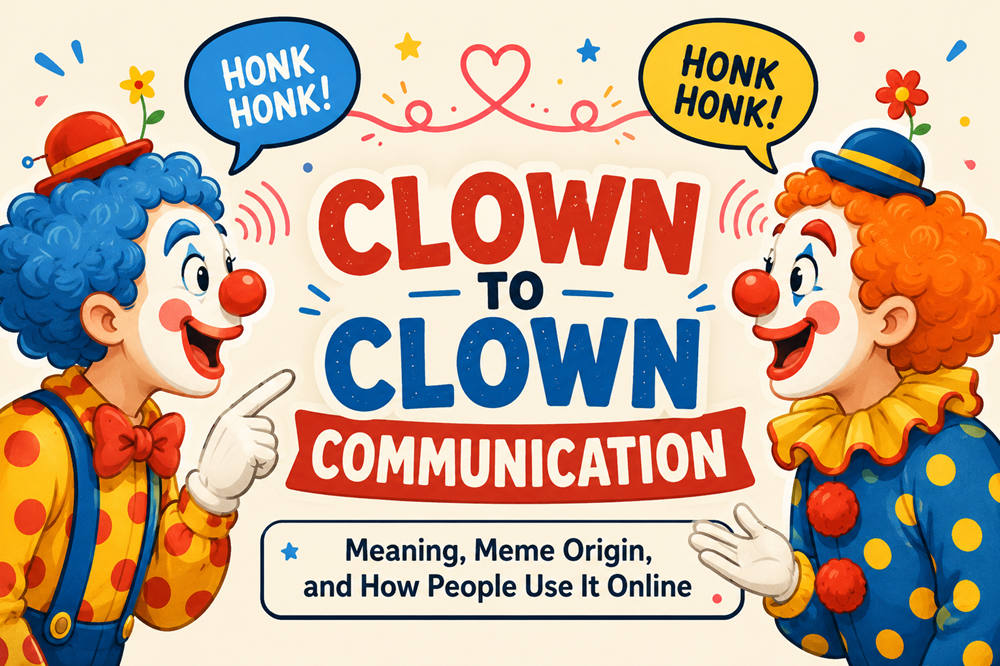
Clown to Clown Communication Meaning, Meme Origin, and How People Use It Online
Clown to clown communication is an internet meme used when two people are having an equally ridiculous, misguided, or unserious conversation. Instead of calling one person foolish, the joke suggests that both people are “clowns” who somehow understand each other perfectly.
You’ll often see the phrase under screenshots of bad advice, strange arguments, confidently wrong opinions, or friends encouraging each other to make questionable decisions.
What Does Clown to Clown Communication Mean?
Clown to clown communication means two foolish or chaotic people communicating with each other on the same wavelength.
Online, calling someone a “clown” usually means they are behaving foolishly, embarrassing themselves, or saying something that makes little sense. When both people in a conversation fit that description, someone may jokingly label the exchange “clown to clown communication.”
For example:
Person 1: “I haven’t started my assignment, but I can probably finish it at 2 a.m.”
Person 2: “Definitely. You’ll work better under pressure.”
Someone watching that exchange might respond:
“Clown to clown communication.”
The joke is that neither person is offering sensible advice, yet they completely understand and encourage each other.
The phrase can describe:
- Friends supporting each other’s bad ideas
- Two people confidently sharing incorrect information
- An argument where neither side makes much sense
- Friends giving questionable dating advice
- Two people making the same silly mistake
- Friends intentionally acting ridiculous together
You may also see “clown to clown conversation.” It means essentially the same thing and comes from the wording commonly associated with the meme.
Clown to Clown Communication Meme Origin
The clown to clown communication meme appears to have developed from an older illustration showing two people facing each other and communicating telepathically.
Internet users later edited the figures to look like clowns, turning what looked like a serious illustration of mind-to-mind communication into an absurd reaction image. Know Your Meme traces the underlying ESP-style graphic to 2012 and the earliest known clown version to 2019.
The edited meme became associated with the wording:
“Clown to clown communication, clown to clown conversation.”
By the late 2010s, versions of the meme were circulating across social media and meme communities. As the image became more recognizable, people began using the phrase without the original picture.
Today, simply commenting “clown to clown communication” is usually enough for people familiar with internet slang to understand the joke.
How People Use the Clown to Clown Communication Meme
The meme works best when both people are contributing to the ridiculousness. It usually isn’t about one sensible person talking to someone foolish. The humor comes from both sides matching each other’s energy.
Friends Encouraging Bad Decisions
This is one of the most common uses of the phrase.
Imagine a friend asking:
“Should I text my ex again?”
The other friend replies:
“Yes, and send another message if they don’t answer.”
That is exactly the type of exchange people might call clown to clown communication.
The phrase jokingly points out that the person asking for advice may have chosen someone equally unqualified to provide it.
This type of usage is especially common between close friends who enjoy making fun of themselves.
Confidently Wrong Conversations
The meme also fits conversations where two people confidently agree about something that is incorrect.
For example:
Person 1: “I’m pretty sure the moon makes its own light.”
Person 2: “Yeah, that’s why it’s bright at night.”
A third person could reply with the clown meme because both participants are reinforcing the same misunderstanding.
The confidence makes the joke work even better. Neither person realizes anything is wrong.
Ridiculous Online Arguments
Clown to clown communication is also frequently used as a reaction to social media arguments.
Two people might spend dozens of comments arguing while misunderstanding each other’s points or making equally weak claims.
Instead of joining either side, another user might post:
“Clown to clown communication happening in the replies.”
In this context, the phrase means the observer thinks neither side of the argument is particularly convincing.
Self-Deprecating Jokes Between Friends
Not every use of the meme is meant as an insult.
Friends often use clown to clown communication to describe their own conversations.
Two people might spend half an hour discussing a ridiculous hypothetical question, make an overly complicated plan that will obviously fail, or encourage each other to buy something unnecessary.
One of them might screenshot the conversation and caption it:
“Daily clown to clown communication with my best friend.”
Here, “clown” is playful. The joke is basically, “We are both ridiculous, and that’s why we get along.”
Why Is Clown to Clown Communication Funny?
Part of the humor comes from how formal the phrase sounds.
“Clown to clown communication” could almost be the name of a technical communication system. Instead, it describes two people exchanging terrible ideas.
That contrast turns a simple insult into a more creative reaction.
Compare:
“You two are being stupid.”
with:
“Clown to clown communication detected.”
Both express roughly the same opinion, but the second sounds intentionally over-serious about something completely unserious.
The visual version of the meme adds another layer because the two clown figures appear to be establishing some kind of mental connection. It suggests that their shared foolishness is so strong they barely need words.
Is Clown to Clown Communication an Insult?
It can be, depending on the context.
If you post the meme underneath a serious conversation between strangers, you are essentially saying that you think both people look foolish.
That can easily come across as mocking or insulting.
Between friends, however, it is often harmless.
A person might describe themselves and a friend as having clown to clown communication because they both know they are making a silly decision.
For example:
“Us deciding to start a new TV series at midnight even though we work tomorrow. Clown to clown communication.”
In that situation, nobody is seriously being attacked.
Like many internet expressions, the tone depends on who is using it and who they are talking about.
Popular Variations of the Meme
The original format is easy to modify, so internet users have created many variations. The broader culture of internet memes commonly involves remixing, parodying, and adapting familiar formats into new contexts.
A common structure is:
“___ to ___ communication.”
The word “clown” can be replaced with characters, animals, fandom references, professions, or inside jokes.
People also redraw the original meme using characters from:
- Movies
- TV shows
- Anime
- Video games
- Cartoons
- Internet communities
The specific characters change, but the joke usually stays the same: two people have such similar chaotic thinking that they seem to have their own private communication system.
Some versions are insulting, while others celebrate two friends or fictional characters who share the same unusual personality.
When Does the Meme Work Best?
Clown to clown communication works best when both people are responsible for making the conversation ridiculous.
Good examples include two friends encouraging an obviously bad plan, two people agreeing on something clearly incorrect, or two users having an argument where neither side seems to know what is going on.
It can also work as a playful caption for your own conversations.
For example:
“Me and my friend planning a vacation when neither of us has checked our bank accounts.”
Clown to clown communication.
The phrase is less appropriate when one person is genuinely asking for help or when someone is being intentionally deceived. The joke works because the foolishness is shared.
Why the Meme Still Works
Clown to clown communication has remained useful because the situation it describes is extremely common online.
Social media constantly puts conversations between strangers, friends, creators, celebrities, and commenters in front of you. Sometimes both people appear completely convinced by an idea that makes little sense to everyone else.
Other times, the meme simply captures the fun of having a friend who matches your chaotic sense of humor.
That gives the phrase two different uses. You can use it to mock a ridiculous conversation, or you can use it affectionately to laugh at yourself and a friend.
Either way, the basic meaning stays simple: two clowns, one wavelength.