Communication Styles in Relationships and How They Affect Your Connection With Your Partner
The way you talk to your partner can shape everything from everyday decisions to serious disagreements. Communication styles in relationships affect how you express your needs, respond to problems, set boundaries, and understand each other. Research has long examined the connection between couples’ communication and relationship outcomes.
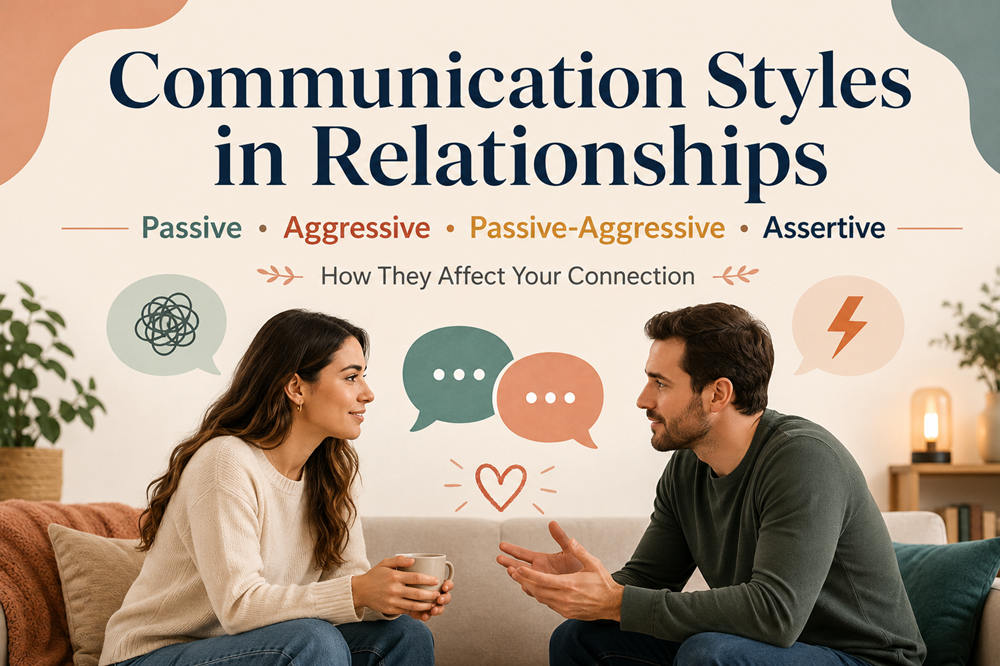
Four common styles are passive, aggressive, passive-aggressive, and assertive communication. Learning the differences can help you spot habits that create tension and replace them with clearer, healthier conversations.
What Are Communication Styles in Relationships?
A communication style is the way you usually express your thoughts, feelings, needs, and boundaries around another person.
These patterns often become easier to notice when emotions are involved. You might communicate comfortably about everyday plans but struggle to speak clearly when discussing money, family, trust, responsibilities, or another sensitive subject.
Your communication habits may be influenced by:
- How conflict was handled in your family growing up
- Previous relationships
- Fear of disagreement
- Confidence and self-esteem
- Stress
- Personality
- Cultural expectations
- Past experiences with criticism or rejection
Rather than labeling yourself as one type, it is more useful to notice which patterns appear most often in your relationship. The American Psychological Association’s relationship resources also explore how communication and interaction shape close relationships.
The Four Main Communication Styles in Relationships
The four main communication styles are passive, aggressive, passive-aggressive, and assertive. The biggest difference between them is how they balance your needs with your partner’s needs.
1. Passive Communication
Passive communication happens when you regularly hold back what you really think, want, or feel.
Instead of risking disagreement, you may stay quiet, agree with your partner, or allow their preferences to take priority.
Common passive responses include:
- “Whatever you want is fine.”
- “It doesn’t matter.”
- “I’m okay,” even when you are upset.
- “Don’t worry about it.”
- “I don’t want to make a big deal out of this.”
Suppose your partner repeatedly makes weekend plans without checking with you. You are bothered by it, but every time they ask, you say, “That’s fine.”
The disagreement disappears for the moment, but your frustration does not.
How Passive Communication Affects Relationships
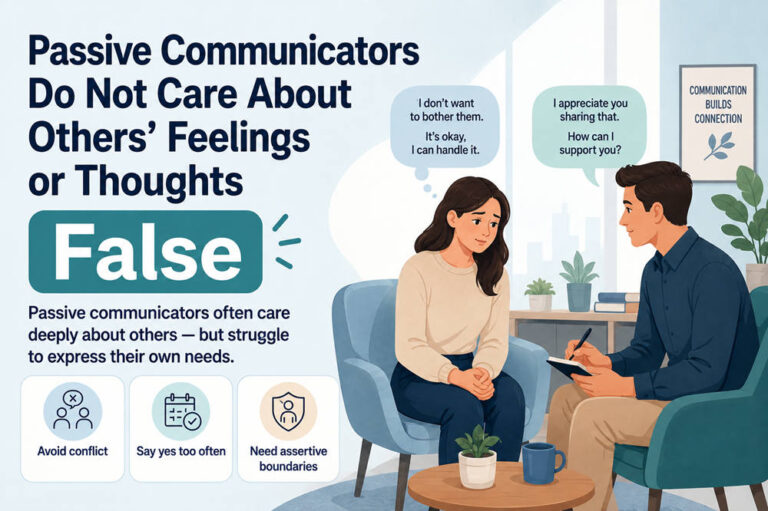
Passive communication can leave you feeling overlooked because your partner may not know what you actually need.
Over time, you might experience:
- Resentment
- Frustration
- Emotional distance
- Difficulty setting boundaries
- A feeling that your preferences do not matter
Your partner may also become confused if you eventually become upset about something you previously appeared to accept.
The problem is not caring too much about your partner. It is repeatedly leaving your own thoughts and needs out of the conversation.
2. Aggressive Communication
Aggressive communication happens when your own feelings or goals are expressed with little respect for your partner’s boundaries or point of view.
It can involve:
- Shouting
- Insults
- Threats
- Blaming
- Interrupting
- Controlling language
- Personal attacks
- Demanding agreement
Aggressive statements might sound like:
“You never listen to me.”
“You always ruin everything.”
“Just do what I said.”
“This is completely your fault.”
Having a strong opinion is not aggressive by itself. You can disagree firmly without insulting or intimidating your partner.
The problem begins when the goal becomes winning, controlling, or hurting rather than explaining the issue and finding a solution.
How Aggressive Communication Affects Relationships
Repeated aggressive communication can make honest conversations difficult.
Your partner may become defensive, stop bringing up concerns, or avoid certain topics because they expect an angry reaction.
Over time, this can contribute to:
- Frequent arguments
- Emotional distance
- Resentment
- Fear
- Loss of trust
- Difficulty solving problems together
When every disagreement becomes a battle, both people can lose sight of the problem they were originally trying to solve.
3. Passive-Aggressive Communication
Passive-aggressive communication expresses frustration indirectly instead of saying clearly what is wrong. Cleveland Clinic describes passive-aggressive behavior as indirectly expressing negative feelings rather than addressing them openly.
It may appear through:
- Sarcasm
- Silent treatment
- Indirect insults
- Saying “I’m fine” when you are clearly upset
- Deliberately ignoring a request
- Agreeing to something but intentionally not doing it
- Withholding attention or affection as punishment
For example, imagine your partner forgets an important date.
Instead of saying:
“I felt hurt when you forgot.”
you might respond:
“Don’t worry. I didn’t expect you to remember anyway.”
The second response communicates disappointment, but the real concern remains hidden behind sarcasm.
Why Passive-Aggressive Communication Creates Confusion
Passive-aggressive communication forces your partner to guess what you really mean. Instead of dealing with the original problem, the conversation can become focused on sarcasm, silence, tone, and hidden messages.
When this happens regularly, it becomes harder for either person to know whether words match actual feelings.
4. Assertive Communication
Assertive communication is usually the healthiest approach in a relationship. Mayo Clinic describes assertiveness as direct communication built around mutual respect rather than passivity or aggression.
It means expressing your feelings, needs, preferences, and boundaries clearly while allowing your partner to do the same.
Assertiveness does not mean getting your way every time. It means being direct without becoming disrespectful.
For example:
“I’d like us to make weekend plans together instead of deciding separately.”
“I felt hurt by what happened yesterday, and I’d like to talk about it.”
“I understand that you’re frustrated, but I’m not comfortable being shouted at.”
“I can’t do that tonight, but I can help tomorrow.”
Assertive communication makes it easier for both partners to be honest without turning a disagreement into a power struggle. You can set a boundary, ask for something, or disagree while still respecting the other person’s perspective.
That does not guarantee that every problem will be solved immediately. It simply gives both people a better chance of understanding what the other actually thinks and needs.
Passive vs. Aggressive vs. Passive-Aggressive vs. Assertive Communication
The four communication styles differ mainly in how directly you express yourself and how much respect you give to both people’s needs.
| Communication Style | Your Needs | Partner’s Needs | Typical Approach |
|---|---|---|---|
| Passive | Minimized | Prioritized | Avoid the issue |
| Aggressive | Prioritized | Minimized | Control the discussion |
| Passive-aggressive | Expressed indirectly | Addressed indirectly | Hide the real issue |
| Assertive | Respected | Respected | Discuss the issue directly |
Assertiveness does not require you and your partner to agree.
You can have different opinions while still listening, explaining your position, and working toward a solution without attacking each other.
Why Communication Styles Matter in Relationships
Relationship conflicts are often shaped as much by how something is said as by the issue itself. Research on communication during relationship conflict has found that the effects of different communication behaviors can depend on the situation and the problem a couple is facing.
Suppose one partner feels overwhelmed by household responsibilities.
An assertive approach might be:
“I’ve been feeling overwhelmed with chores lately. Can we divide them differently?”
An aggressive version could be:
“You never do anything around here.”
A passive response might be:
“It’s fine. I’ll just do everything.”
A passive-aggressive response could be:
“Must be nice having someone clean up after you.”
The underlying issue is the same, but each style sends a different message and encourages a different response.
Assertive communication makes the actual problem easier to identify. The other styles can add blame, hidden resentment, or confusion before the couple even begins discussing a solution.
How to Improve Communication in Your Relationship
Better communication usually comes from practicing a few simple habits consistently. You do not have to handle every conversation perfectly to make meaningful improvements.
Say What You Actually Need
Being honest about your needs gives your partner a chance to understand what is happening.
Instead of:
“You clearly don’t care.”
try:
“I’ve been feeling disconnected lately, and I’d like us to spend more time together.”
The second statement communicates the actual concern rather than forcing your partner to guess what is behind the accusation.
Use “I” Statements
“I” statements can help you describe your experience without immediately placing your partner on the defensive.
For example:
“I feel stressed when plans change at the last minute.”
is clearer than:
“You always mess up our plans.”
You do not need to force every sentence into an “I feel” formula. The point is to describe the problem without automatically turning it into a personal attack.
Listen Before Preparing Your Response
Listening is difficult when you are already thinking about how to defend yourself.
Try to understand your partner’s point before deciding how you will respond.
If something is unclear, briefly check your understanding:
“So you felt ignored when I changed the plans without asking you?”
Your partner can then confirm or correct what you heard.
Address One Problem at a Time
Arguments become harder to resolve when several unrelated complaints appear at once.
If you are talking about spending, try not to turn the discussion into an argument about chores, relatives, vacations, and something that happened months ago.
Staying focused gives both of you a better chance of reaching a useful decision.
Take a Break When the Conversation Gets Too Heated
Sometimes continuing a conversation while both people are angry only makes the situation worse. Mayo Clinic’s guidance on managing anger includes taking time to think clearly before expressing frustration in an assertive, nonconfrontational way.
Taking a break can help, but disappearing without explanation may feel dismissive.
You could say:
“I’m getting too frustrated to talk about this clearly right now. Can we take a break and come back to it later?”
The important part is returning to the issue once both people are calmer.
Practice Saying No Respectfully
Boundaries are part of healthy communication.
You should be able to disagree with a request without turning the situation into an argument or feeling pressured to give a long explanation. Learning to say no clearly can be part of setting healthier limits instead of agreeing and expressing resentment later.
For example:
“I understand why you’d like me to come, but I can’t make it tonight.”
Clear and respectful is usually enough.
Ask for a Specific Change
Being honest about your feelings is important, but sometimes your partner also needs to know what action would help.
Instead of:
“You don’t help enough.”
try:
“Could you handle dinner on Tuesdays and Thursdays?”
A specific request gives both of you something concrete to discuss. Your partner may agree, suggest an alternative, or explain why the request will not work, but at least the conversation has a clear starting point.
Final Thoughts
Understanding communication styles in relationships can help you recognize why certain conversations become frustrating. Passive communication can hide what you need, aggressive communication can overpower your partner, and passive-aggressive communication often leaves the real issue unclear.
Assertive communication offers a healthier balance. The more clearly and respectfully you communicate, the easier it becomes to handle everyday decisions, boundaries, and disagreements together.