Passive Communicators Do Not Care About Others’ Feelings or Thoughts: True or False?
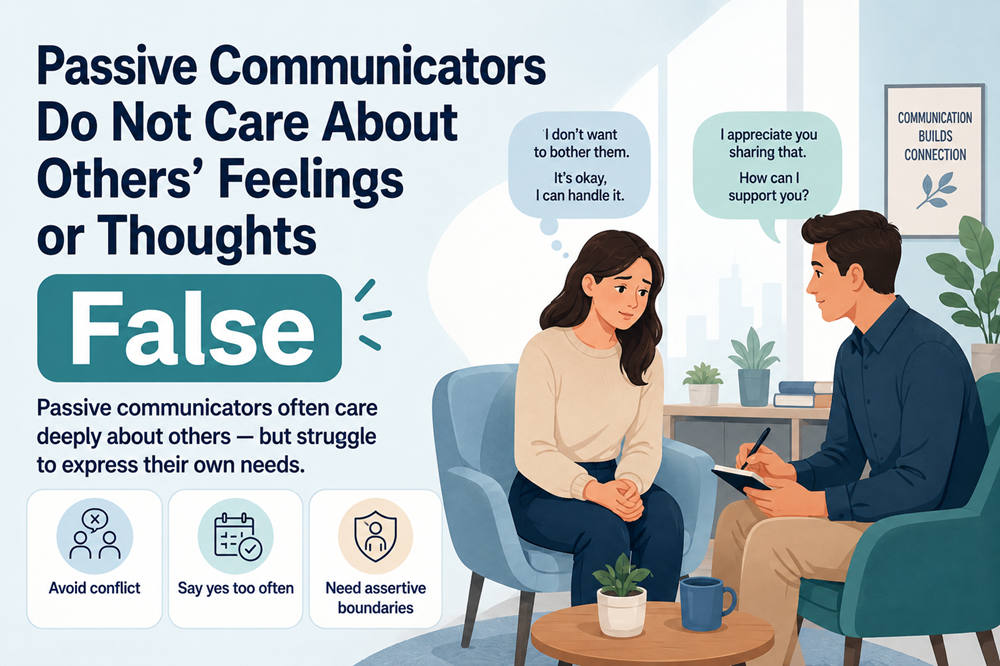
The statement “Passive communicators do not care about others’ feelings or thoughts” is false. Passive communicators often care deeply about how other people feel and may even put those feelings ahead of their own.
The main issue with passive communication is not a lack of concern for others. It is difficulty expressing personal needs, opinions, feelings, and boundaries clearly.
What Is Passive Communication?
Passive communication is a style in which you hold back what you really think, feel, or want. Instead of speaking directly, you may stay quiet, agree with others, or avoid a difficult conversation.
A passive communicator may worry about upsetting someone, creating conflict, being judged, or appearing selfish. Because of those concerns, they may let other people make decisions even when they have a different preference.
For example, imagine a coworker asks you to take on another assignment when you are already overloaded.
A passive response might be:
“Sure, I can do it.”
You may agree even though you want to say no. In this situation, you are not ignoring the coworker’s feelings. You are failing to give your own needs equal importance.
Common Characteristics of Passive Communicators
Passive communication does not always look the same, but several patterns are common.
Difficulty Saying No
Passive communicators often agree to requests they would rather decline.
You might say yes because you are afraid the other person will be disappointed, annoyed, or upset. Difficulty saying no can also be connected with low confidence or feeling that you need to please other people.
Over time, this can leave you with more responsibilities than you can comfortably handle.
Avoiding Conflict
Disagreements can feel uncomfortable, so a passive communicator may stay silent instead of addressing a problem.
Avoiding conflict might keep things peaceful in the moment, but the original issue usually remains. In some situations, communicating calmly and directly can prevent smaller disagreements from turning into larger problems.
Keeping Opinions to Themselves
You may have a clear opinion but hesitate to share it.
In a group discussion, for example, you might agree with everyone else even when you think another approach would work better.
When this happens regularly, other people may have difficulty knowing what you actually think.
Putting Other People’s Needs First
Considering other people is healthy. Constantly putting their needs ahead of your own is different.
Passive communicators may change plans, accept unwanted responsibilities, or tolerate behavior that bothers them simply to keep someone else happy. Learning to establish healthy boundaries can help you respect other people’s needs without automatically sacrificing your own.
Apologizing Too Often
Passive communicators sometimes apologize for reasonable requests or opinions.
You might say, “Sorry to bother you,” before asking a normal question or apologize simply because you disagree with someone.
Frequent unnecessary apologies can make ordinary communication sound as though you are asking permission to have needs of your own.
Passive vs. Aggressive vs. Assertive Communication
Passive communication is sometimes misunderstood because people confuse different communication styles.
Passive communication tends to minimize your own needs.
Aggressive communication tends to prioritize your needs while overlooking the feelings, rights, or needs of others.
Assertive communication respects both sides. It allows you to communicate your own feelings and needs directly while still respecting other people.
Consider a friend who repeatedly arrives 30 minutes late.
A passive response might be:
“It’s fine. Don’t worry about it.”
Even though you are frustrated.
An aggressive response might be:
“You’re always late. You clearly don’t respect my time.”
An assertive response could be:
“When you’re this late, it makes planning difficult for me. Could you let me know when you’re running behind?”
The assertive response communicates the problem without attacking the other person.
| Communication Style | Your Needs | Other People’s Needs |
|---|---|---|
| Passive | Often minimized | Often prioritized |
| Aggressive | Often prioritized | Often minimized |
| Assertive | Respected | Respected |
Assertiveness does not mean becoming louder or more confrontational. It means being honest about your own needs while treating other people respectfully. NHS guidance similarly describes assertiveness as a middle ground between passive and aggressive ways of communicating.
Why People Communicate Passively
Passive communication can develop for several reasons, and the cause may be different from one person or situation to another.
Fear of Conflict
Some people associate disagreement with arguments, rejection, or damaged relationships.
Remaining quiet can feel safer than risking an uncomfortable response.
The problem is that avoiding every disagreement can make it harder to communicate your needs when something genuinely matters.
Wanting Approval
A strong desire to be liked can make it difficult to disagree or say no.
You may accept something you do not want because you are worried that setting a boundary will change how another person sees you.
Wanting to maintain good relationships is normal. The problem begins when gaining approval consistently requires you to ignore your own limits.
Low Confidence
If you doubt your own judgment, you may assume other people’s opinions are more important or more correct.
This can make it difficult to contribute ideas, challenge decisions, or speak up when something feels wrong.
Developing confidence does not mean believing you are always right. It means becoming comfortable enough to express your viewpoint and allow others to respond.
Learned Behavior
Communication habits can develop through past experiences.
Someone who grew up in an environment where disagreement was discouraged may learn that staying quiet is the safest way to handle tension.
Over time, that response can become automatic, even in situations where expressing an opinion would be perfectly reasonable.
Unequal Power
Passive communication is not always a personality trait.
A person may communicate confidently with friends but become much more passive around a manager, teacher, authority figure, or someone who controls an important outcome.
The situation and power balance can strongly influence how comfortable someone feels speaking openly.
Problems Passive Communication Can Cause
Staying quiet may prevent an argument today, but repeated passive communication can create bigger problems later.
Resentment
Constantly agreeing when you really want to say no can become frustrating.
You may eventually feel that people are taking advantage of you, even though they may not realize you are uncomfortable.
Unmet Needs
Other people cannot always guess what you need.
If you regularly say that everything is fine, people may believe you.
Expressing your needs clearly gives others a chance to understand and respond to them.
Unbalanced Relationships
Relationships can become one-sided when one person regularly makes the decisions and the other continually gives in.
Healthy friendships, family relationships, and partnerships require room for both people to express preferences and concerns.
Increased Stress
Holding back frustration does not necessarily make it disappear.
You may avoid an uncomfortable conversation but continue thinking about it afterward, creating more stress than a respectful discussion might have caused. Learning to communicate assertively can help you express your needs more directly while maintaining respect for the other person.
Unresolved Problems
Problems are difficult to solve when they are never discussed.
A small disagreement at work or at home can become more serious when concerns remain unspoken for too long.
How to Become More Assertive
Moving away from passive communication does not mean becoming aggressive. You can speak more clearly while still being considerate.
Express Small Preferences
Start with everyday decisions.
Instead of saying:
“Whatever you want is fine.”
Try:
“I’d prefer the Italian restaurant tonight.”
Expressing small preferences makes it easier to speak up when more important issues arise.
Practice Saying No
You do not need a long explanation every time you decline something.
Try simple responses such as:
“I can’t take that on today.”
“I’m not available Friday.”
“Thanks for asking, but I won’t be able to.”
A respectful no is a normal part of healthy communication.
Use “I” Statements
“I” statements help you describe your experience without immediately blaming the other person.
For example:
“I feel overwhelmed when extra work is added without notice.”
This is clearer and more productive than staying silent until frustration builds.
Give Yourself Time to Answer
If you tend to automatically say yes, create a little space before responding.
You can say:
“Let me check my schedule.”
“I’ll think about it and get back to you.”
That pause gives you time to decide what you actually want instead of responding from pressure or habit.
Accept That Disagreement Is Normal
Being assertive does not mean everyone will agree with you.
Two people can have different opinions without being disrespectful. You can care about another person’s feelings while still saying no, setting a boundary, or expressing a different point of view.
The statement “Passive communicators do not care about others’ feelings or thoughts” is therefore false. Passive communicators often pay close attention to other people’s feelings. Their challenge is usually learning to give their own thoughts, needs, and boundaries an equal place in the conversation.