Exponential Growth vs. Decay: Understanding the Differences, Formulas, Graphs, and Examples
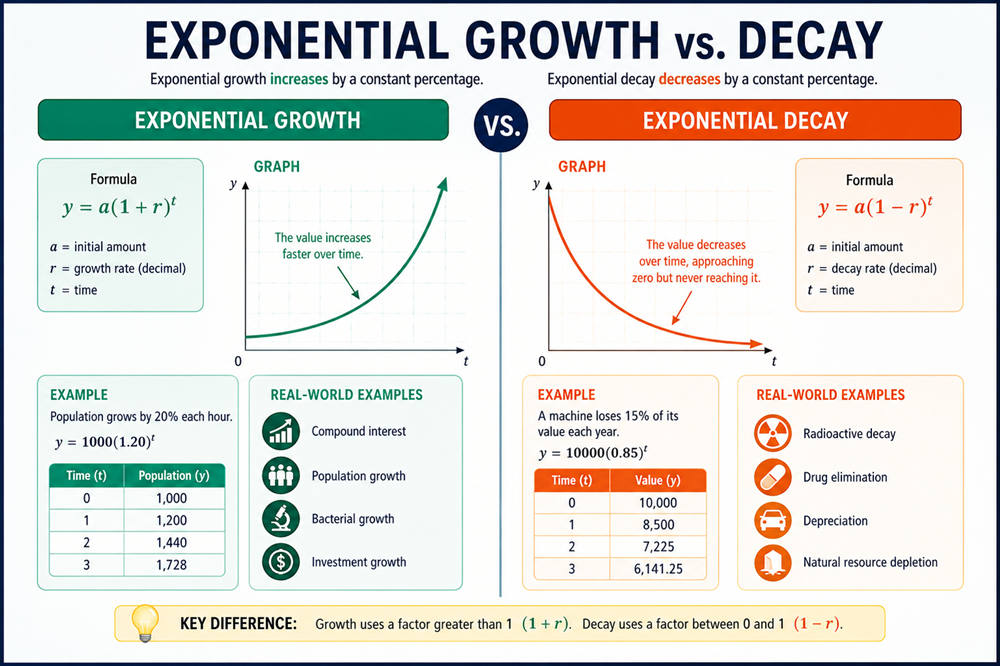
Exponential growth and exponential decay describe changes that happen by a consistent percentage or multiplying factor over time. The key difference is simple: exponential growth increases a quantity, while exponential decay decreases it.
You can recognize the difference by looking at the equation, the multiplying factor, and the shape of the graph.
What Is Exponential Growth?
Exponential growth happens when a quantity increases by the same percentage or factor over equal time periods.
A common formula is:
y = a(1 + r)^t
Where:
- y = final value
- a = starting value
- r = growth rate as a decimal
- t = number of time periods
Suppose a population starts at 1,000 and grows by 20% each hour.
The equation is:
y = 1,000(1.20)^t
The values would be:
- After 1 hour: 1,200
- After 2 hours: 1,440
- After 3 hours: 1,728
The increase gets larger because each new 20% increase is based on the current value, not the original 1,000.
Exponential growth can appear in situations involving population growth, compound interest, bacterial reproduction, and investment growth.
What Is Exponential Decay?
Exponential decay happens when a quantity decreases by the same percentage or factor over equal time periods.
A common formula is:
y = a(1 – r)^t
Suppose a machine worth $10,000 loses 15% of its value each year.
The equation is:
y = 10,000(0.85)^t
The factor is 0.85 because 85% of the value remains after each year.
The values would be:
- After 1 year: $8,500
- After 2 years: $7,225
- After 3 years: $6,141.25
The value keeps falling, but the dollar amount lost becomes smaller because the percentage is applied to a smaller remaining value each year.
Exponential decay is commonly used to describe depreciation, radioactive decay, drug elimination, and other processes where a fixed proportion disappears over time.
Exponential Growth vs. Decay: Key Differences
The easiest way to compare exponential growth and decay is by looking at what happens to the multiplying factor.
| Feature | Exponential Growth | Exponential Decay |
|---|---|---|
| Direction | Increases | Decreases |
| Multiplying factor | Greater than 1 | Between 0 and 1 |
| Percentage change | Percentage is added | Percentage is removed |
| Graph | Rises | Falls |
| Long-term behavior | Grows larger | Approaches zero |
| Example | Compound interest | Depreciation |
Both are exponential because the change is based on repeated multiplication.
How to Identify Growth or Decay From an Equation
The general form of an exponential function is:
y = ab^x
Here:
- a is the starting value.
- b is the multiplying factor.
- x represents the changing variable, often time.
The value of b tells you whether the function shows growth or decay.
Exponential Growth
If:
b > 1
the function represents exponential growth.
For example:
y = 5(2)^x
The values are repeatedly multiplied by 2:
- 5
- 10
- 20
- 40
- 80
Exponential Decay
If:
0 < b < 1
the function represents exponential decay.
For example:
y = 100(0.5)^x
The values become:
- 100
- 50
- 25
- 12.5
- 6.25
Each value is half the previous one.
Converting a Percentage Into a Factor
When a percentage is given, you can convert it into the exponential factor.
For 8% growth:
1 + 0.08 = 1.08
For 8% decay:
1 – 0.08 = 0.92
So a growth rate produces a factor above 1, while a decay rate produces a factor between 0 and 1.
Exponential Growth and Decay Graphs
Growth and decay graphs have different shapes even though they come from the same type of mathematical function.
Exponential Growth Graph
An exponential growth graph rises as x increases.
At first, the curve may appear relatively flat. It then becomes steeper because the same multiplying factor is being applied to increasingly large values.
For example:
y = 2^x
produces a curve that rises faster and faster.
Exponential Decay Graph
An exponential decay graph falls as x increases.
It usually drops quickly at first and then becomes flatter as the values get closer to zero.
For example:
y = (1/2)^x
produces values such as:
- 1
- 0.5
- 0.25
- 0.125
- 0.0625
For the standard exponential decay function, the value gets closer and closer to zero without reaching it.
Horizontal Asymptote
For basic exponential functions without a vertical shift, y = 0 is the horizontal asymptote.
That means the graph can approach the x-axis indefinitely without touching it in the basic model.
A shifted exponential function can have a different horizontal asymptote. For example:
y = 2^x + 3
has a horizontal asymptote at:
y = 3
Exponential Growth and Decay Examples
Simple examples make the difference easier to see.
Growth Example
Suppose you deposit $2,000 into an account that grows by 5% per year.
The equation is:
y = 2,000(1.05)^t
The balance would be approximately:
- Year 1: $2,100
- Year 2: $2,205
- Year 3: $2,315.25
The account grows because each year’s increase is calculated from the updated balance. This is the basic idea behind compound interest, where interest can be earned on both the original principal and accumulated interest.
Decay Example
Now suppose a vehicle worth $20,000 loses 10% of its value each year.
The equation is:
y = 20,000(0.90)^t
Its value would be:
- Year 1: $18,000
- Year 2: $16,200
- Year 3: $14,580
Here, 90% of the previous value remains after every year.
Exponential vs. Linear Change
One of the easiest ways to understand exponential change is to compare it with linear change.
A linear pattern changes by the same amount each time.
For example:
100, 120, 140, 160, 180
The value increases by 20 each step.
An exponential pattern changes by the same percentage or factor.
For example, increasing by 20% produces:
100, 120, 144, 172.8, 207.36
The amount added is not constant. It grows because 20% is applied to a larger number each time.
So the distinction is:
- Linear change: same amount
- Exponential change: same percentage or multiplying factor
Real-World Uses of Exponential Growth and Decay
Exponential models are useful in many fields, although real-world conditions often make them approximations rather than perfect descriptions.
Finance
Compound interest can produce exponential growth because interest is earned on both the original principal and previous interest.
Population Studies
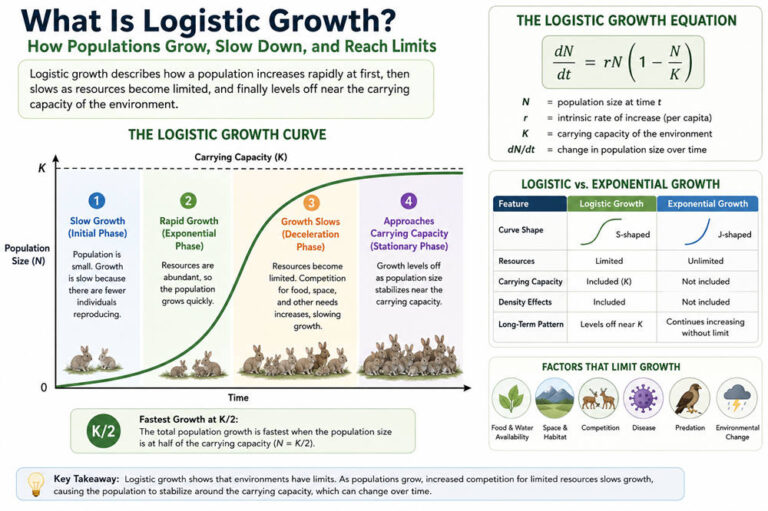
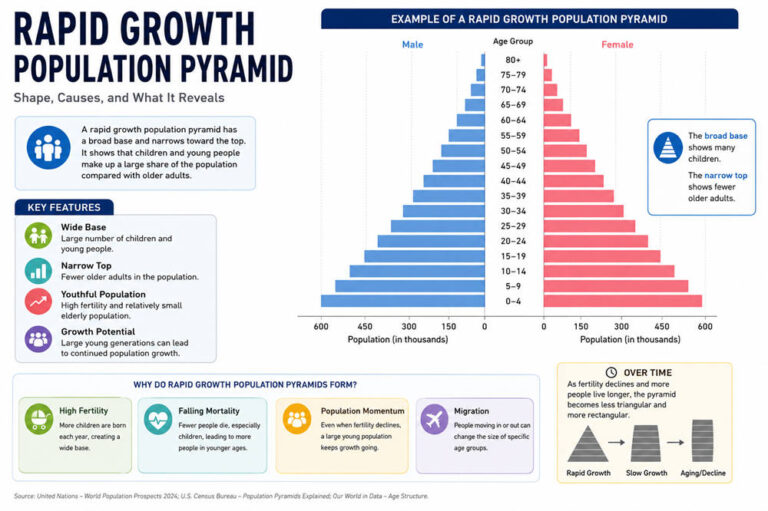
Population growth may follow an exponential pattern for a period when resources are abundant.
In reality, exponential population growth usually cannot continue forever. Food, space, competition, disease, and other limits eventually slow growth. Population models often account for these resource limits by moving beyond unrestricted exponential growth.
Biology
Bacteria can grow exponentially under favorable conditions when cells divide at regular intervals.
A population that doubles repeatedly follows a classic exponential growth pattern.
Radioactive Decay
Radioactive materials follow exponential decay because a consistent fraction of unstable atoms decays over time.
This process is often described using half-life, which is the time required for half of the atoms of a particular radioisotope to decay.
Medicine
The amount of some medications in the body can decline exponentially when a consistent proportion is eliminated during each time interval.
This type of behavior is associated with first-order elimination kinetics, in which a constant fraction of a drug is eliminated per unit of time. Not every drug follows this pattern under every condition.
Depreciation
Cars, equipment, and other assets may be modeled with exponential decay when they lose a percentage of their remaining value each year.
Final Takeaway
The easiest way to understand exponential growth vs. decay is to look at the multiplying factor.
If the factor is greater than 1, the quantity grows.
If the factor is between 0 and 1, the quantity decays.
Unlike linear change, which adds or subtracts a fixed amount, exponential change repeatedly applies the same percentage or factor. Once you understand that difference, identifying exponential growth and decay becomes much easier.