Human Growth and Development Class: What You Learn and What to Expect
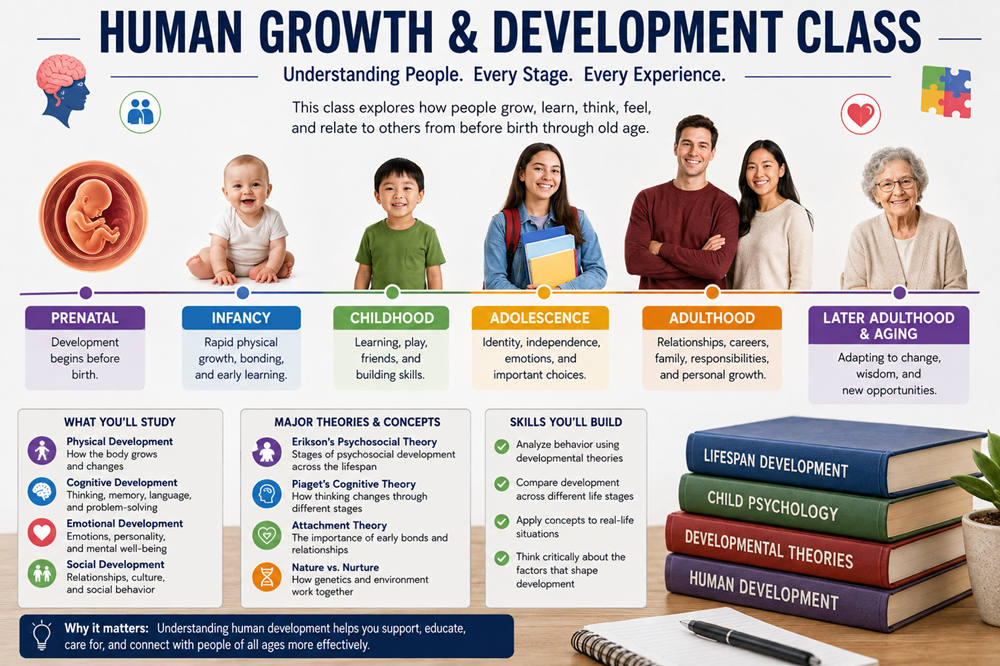
A human growth and development class looks at how people change from before birth through old age. You study physical growth, thinking and learning, emotions, relationships, personality, and the social and cultural influences that shape development.
The subject can sound broad at first, but it follows a fairly logical path through the human lifespan. A typical human growth and development course covers development from the prenatal period to the end of life, with attention to physical, cognitive, emotional, and social change.
What Is a Human Growth and Development Class?
Human growth and development is usually a lifespan-development course. Instead of concentrating on one age group, it follows people through major stages of life.
You may begin with genetics, pregnancy, and prenatal development before moving into infancy, childhood, adolescence, adulthood, aging, and death.
The course usually looks at several parts of development at the same time:
- Physical development: changes in the body, brain, movement, health, and biological functioning
- Cognitive development: changes in thinking, memory, language, learning, and problem-solving
- Social development: relationships with family, friends, partners, and other people
- Emotional development: emotions, identity, self-control, and psychological well-being
- Environmental and cultural influences: how family, culture, education, socioeconomic conditions, and surroundings affect development
These overlapping areas are central to the study of lifespan development. A current Columbia lifespan-development course, for example, also emphasizes the relationship between biology and environment.
The class may appear in psychology, nursing, education, social work, family studies, or related programs. Some health-profession programs also use it as a prerequisite course.
What Topics Are Covered in Human Growth and Development?
The exact syllabus depends on your college and instructor, but the course commonly moves through life in chronological order.
Prenatal Development and Infancy
The first part of the class may cover conception, genetics, pregnancy, prenatal development, childbirth, infancy, and the first years of life.
You may learn how both biology and environment influence early development. This includes topics such as brain development, movement, language, attachment, learning, and early relationships.
Developmental milestones can also appear in this part of the course. These are age-related skills and behaviors used to understand how young children are developing. The CDC’s developmental milestones cover areas such as how children play, learn, speak, act, and move.
Rather than memorizing every age and behavior, focus on the larger patterns. For example, think about how movement, communication, thinking, and social interaction gradually become more complex.
Childhood
Childhood usually brings more attention to learning, language, personality, school, family relationships, and friendships.
You may study how children’s thinking changes as they grow and why a young child may understand a problem very differently from an older child or adult.
Other topics can include:
- Language development
- Emotional regulation
- Parenting and family relationships
- Peer relationships
- School experiences
- Self-esteem
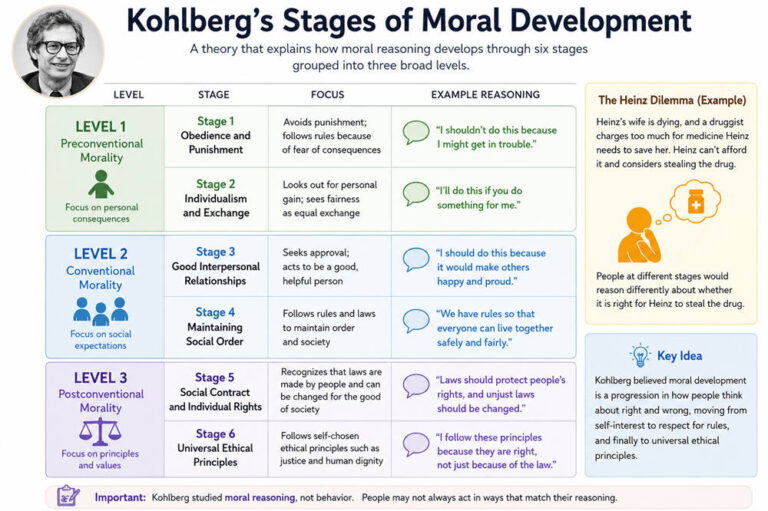
- Moral development
- Social skills
This stage also gives you plenty of opportunities to connect theories with everyday behavior.
Adolescence
Adolescence involves much more than puberty.
You may examine physical maturation alongside changes in identity, independence, emotions, relationships, judgment, and thinking.
Common topics include:
- Puberty
- Brain development
- Identity formation
- Friendships and peer influence
- Family relationships
- Independence
- Decision-making
- Emotional development
Many students find this part of the class easier to relate to because the situations and developmental changes are familiar.
Adulthood and Aging
A human growth and development class does not end with adolescence.
You may study early adulthood through middle and late adulthood, including relationships, careers, parenting, health, cognitive change, retirement, aging, and changing family roles.
Later adulthood may introduce topics such as:
- Physical aging
- Memory and cognition
- Retirement
- Relationships and social support
- Independence
- Loss and grief
- Life satisfaction
- Death and dying
One useful lesson from this part of the course is that aging is not simply a steady decline. Different abilities and areas of life can change in different ways. The study of lifespan development looks at growth, change, and stability across the entire lifespan.
Major Theories and Concepts You May Study
Human development includes several theories that try to explain why people think, behave, and change as they do.
You do not need to treat every theory as a list of facts to memorize. It is usually easier to understand what question each theory is trying to answer.
Erikson’s Psychosocial Theory
Erik Erikson proposed a theory that divides life into stages involving different psychosocial challenges.
For example, early childhood involves increasing independence, adolescence focuses heavily on identity, and adulthood introduces challenges connected with relationships, contribution, and later reflection on life.
Erikson’s framework is especially relevant to a lifespan course because it addresses development from infancy through older adulthood. You can see his stages alongside other major developmental theories and theorists.
When studying Erikson, focus on the basic conflict or task associated with each life stage and what successful development might look like.
Piaget’s Cognitive Development Theory
Jean Piaget focused on how thinking develops.
His work is particularly important for understanding why children at different ages may reason about the same situation in very different ways.
Instead of assuming that children simply know less than adults, Piaget proposed that the way they think changes as their cognitive abilities develop. His cognitive stage theory remains one of the major frameworks discussed in developmental psychology.
A useful way to study Piaget is to connect each stage with a simple example rather than memorizing the stage name alone.
Attachment Theory
Attachment theory focuses on emotionally important bonds, especially the bond between a young child and caregiver.
John Bowlby played a major role in developing attachment theory, while later research helped researchers study different patterns of attachment and children’s responses to caregivers. You can explore the basic elements of attachment and early social development in more detail through OpenStax.
Attachment is a good example of why human development classes connect early experiences with later relationships without assuming that childhood completely determines a person’s future.
Nature and Nurture
You will probably also encounter the long-running question of nature versus nurture.
Nature refers broadly to biological and genetic influences. Nurture refers to environmental influences such as family, education, culture, relationships, and life experiences.
Modern developmental study does not simply choose one side. Researchers examine how the two work together, and the interaction between nature and nurture remains an important theme throughout developmental psychology.
What Assignments Can You Expect?
Assignments vary considerably from one college and instructor to another, so your syllabus should always be your main guide.
A human growth and development class may include a mixture of:
- Chapter readings
- Quizzes
- Exams
- Discussion posts
- Short written responses
- Case studies
- Observation activities
- Research papers
- Presentations or projects
The important difference from simple memorization courses is that you may sometimes need to apply developmental concepts.
For example, an assignment might describe a child’s behavior and ask you to explain it using a developmental theory. Another could ask you to compare development during adolescence and adulthood.
Discussion Posts
Online classes may use weekly or periodic discussions.
A good discussion response usually does three things: answers the question directly, explains the relevant developmental concept, and connects the concept with an appropriate example.
Avoid spending half the response defining terms if the assignment is really asking you to apply them.
Case Studies and Observations
Case studies can involve a fictional or real-life developmental situation.
You might be asked to identify what stage a person is in, describe relevant developmental changes, or decide which theory helps explain the behavior.
These assignments become easier when you understand theories rather than memorizing definitions.
Papers and Projects
Research assignments may focus on topics such as childhood development, attachment, adolescence, parenting, cognition, aging, relationships, or cultural influences on development.
Follow the assignment instructions carefully because paper length, research requirements, and citation style can differ significantly between classes.
Is Human Growth and Development Class Hard?
A human growth and development class is not automatically an easy or difficult course. Difficulty depends on the instructor, course level, workload, grading system, and how comfortable you are with psychology-related material.
The main challenge is often the amount of information.
You may need to keep track of:
- Developmental stages
- Major theorists
- Important terms
- Physical changes
- Cognitive changes
- Social and emotional development
- Differences between theories
Trying to memorize every term separately can quickly become confusing.
A better approach is to organize information by life stage and understand how the concepts connect. Once you understand what Piaget, Erikson, or attachment theory is trying to explain, remembering the details becomes easier.
Also check the prerequisite requirements before registering. They are not the same everywhere.
How to Do Well in a Human Growth and Development Class
You usually do not need an elaborate study method. You need a system that keeps the many stages and theories organized.
Build a Lifespan Timeline
Create one timeline that runs from prenatal development through late adulthood.
Under each stage, add important information about:
- Physical development
- Cognitive development
- Emotional development
- Social relationships
Continue adding to the timeline throughout the semester.
By exam time, you will have one study guide showing the whole lifespan rather than disconnected pages of notes.
Connect Theories With Examples
Do not memorize:
Erikson = psychosocial development
and stop there.
Think about what the theory looks like in real life.
For example, identity development becomes easier to understand when you picture a teenager exploring friendships, values, goals, and possible careers.
Examples make abstract theories much easier to remember.
Make Comparison Charts
Comparison charts are particularly helpful when several theories start blending together.
You can compare:
- Erikson and Piaget
- Physical and cognitive development
- Childhood and adolescence
- Early and late adulthood
- Nature and nurture
Focus on differences that could appear in an exam question or assignment.
Review a Little at a Time
The material builds throughout the course.
If you forget everything from infancy by the time you reach adulthood, studying for the final becomes much harder.
Brief reviews each week can keep earlier theories and stages familiar.
Learn the Meaning Before Memorizing the Term
If you understand an idea clearly, the vocabulary is easier to remember.
Ask yourself:
“Could I explain this concept to someone without using the textbook definition?”
If you can, you probably understand it.
Why Human Growth and Development Is Useful
The class can be useful well beyond the exam.
It helps you understand why expectations should differ for a toddler, teenager, young adult, middle-aged adult, and older person.
That knowledge has obvious value in professions involving people. The Johns Hopkins lifespan-development course connects developmental theories with biological, environmental, social, and cultural factors, while developmental psychology is also relevant to education, healthcare, social work, counseling, and other people-focused fields.
The subject can be especially relevant in:
- Nursing and healthcare
- Psychology
- Education
- Childcare
- Counseling
- Social work
- Family services
It can also change the way you understand everyday behavior. Instead of looking at someone’s actions in isolation, you begin thinking about age, relationships, environment, culture, previous experiences, and the developmental challenges they may be facing.
Final Takeaway
A human growth and development class takes you through the human lifespan while examining physical, cognitive, emotional, and social change. You can expect to encounter major developmental theories, different stages of life, and assignments that ask you to understand or apply what you are learning.
The easiest way to approach the class is to keep the lifespan organized. Build a timeline, connect theories with real examples, compare similar concepts, and review regularly. Once the stages start fitting together, the subject becomes much easier to follow and much more practical.