Business Development Job Description With Duties, Skills, Qualifications, and Career Expectations Explained
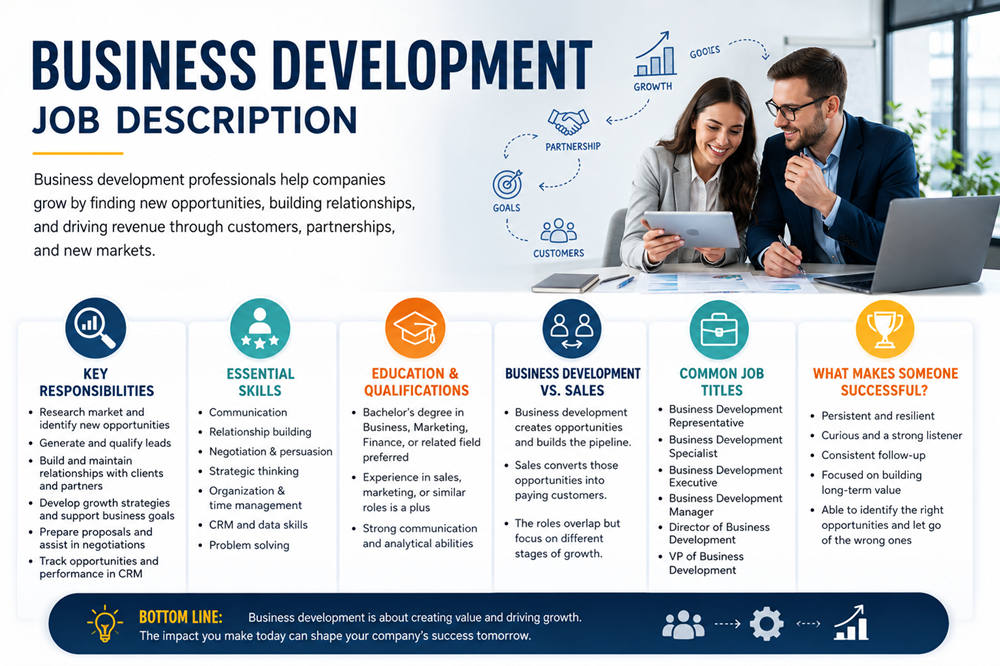
A business development professional helps a company find and pursue new ways to grow. That might mean identifying potential customers, developing partnerships, researching new markets, qualifying leads, or helping move promising opportunities toward a deal.
A typical business development job description includes prospecting, market research, relationship building, lead qualification, proposals, negotiations, and tracking opportunities. The exact mix depends heavily on the company and the seniority of the position.
What Does a Business Development Professional Do?
Business development professionals look for opportunities that can bring new customers, revenue, partnerships, or markets to a company.
In an entry-level Business Development Representative role, you may spend much of your day researching companies, contacting potential customers, qualifying leads, and arranging meetings. More senior professionals are often involved in larger accounts, strategic partnerships, market expansion, and growth planning.
Although business development often works closely with sales, the job usually begins earlier in the process. The goal is to find opportunities worth pursuing and help move them in the right direction.
Business Development Job Responsibilities
Responsibilities vary between employers, but most business development jobs include several of the following areas.
Research New Business Opportunities
Before contacting potential customers or partners, you need to know where worthwhile opportunities exist.
Business development professionals research companies, industries, competitors, customer groups, and market conditions. The goal is not simply to collect names. It is to identify organizations or markets where the company’s product or service could realistically provide value.
Research may include looking at:
- Company size and industry
- Current products or services
- Possible business needs
- Competitors
- Market trends
- Geographic expansion opportunities
- Potential decision-makers
Good market research and competitive analysis help you focus your time on prospects that are actually worth pursuing.
Generate and Qualify Leads
Prospecting is especially important in Business Development Representative and other early-career roles.
You may find potential customers through email outreach, phone calls, referrals, professional networks, events, company databases, or social platforms. BDR roles commonly place prospect research, outbound outreach, and lead qualification at the center of the job.
Once you find a prospect, you need to determine whether there is a genuine opportunity.
Questions may include:
- Does the company have a problem your business can solve?
- Are you speaking with the right person?
- Does the prospect have a realistic budget?
- Is there genuine interest?
- When might they make a decision?
- Is the opportunity large enough to pursue?
Qualification prevents sales teams from spending too much time on prospects that are unlikely to become customers.
Build Client and Partner Relationships
Business development depends heavily on relationships.
A potential customer may not be ready to buy during the first conversation. A prospective partner may need several meetings before both companies understand how they could work together.
Your job may involve maintaining contact, learning what matters to the other organization, answering questions, and keeping opportunities moving without constantly pushing for an immediate decision.
The same skills apply to partnerships. Depending on the company, business development teams may work with distributors, technology partners, agencies, suppliers, consultants, or other organizations that can create opportunities for both sides.
Building and maintaining professional relationships is also listed among important work activities in O*NET’s occupational information for sales managers.
Develop Business Growth Strategies
More experienced business development professionals often contribute to decisions about where a company should grow next.
That might include identifying a promising customer segment, exploring another geographic market, building a referral network, finding strategic partners, or deciding which industries deserve more attention.
This part of the job usually involves working across teams.
Marketing can provide information about audiences and demand. Sales can explain which leads are converting. Product teams can share what customers are requesting. Business development uses those insights to spot new opportunities and decide where to focus.
Prepare Proposals and Support Negotiations
When an opportunity becomes serious, you may help prepare proposals, presentations, pricing information, partnership plans, or other materials.
In more senior business development roles, negotiation can also be an important responsibility.
Discussions might involve:
- Pricing
- Contract terms
- Partnership responsibilities
- Revenue sharing
- Project scope
- Distribution arrangements
- Service requirements
- Timelines
How much negotiating you do depends on the company and your level of seniority.
Some organizations expect business development managers to stay involved until an agreement is reached. Others pass qualified opportunities to an account executive or dedicated sales team.
Track Opportunities and Performance
Business development requires consistent follow-up, so keeping accurate records matters.
Many teams use customer relationship management software to record contacts, conversations, meetings, next steps, and the stage of each opportunity.
Common business development metrics include:
- Qualified leads
- Meetings booked
- Opportunities created
- Conversion rates
- Pipeline value
- New partnerships
- Revenue connected to new opportunities
Tracking these numbers can also reveal which prospecting methods, industries, or types of customers produce the best results. The U.S. Bureau of Labor Statistics notes that related sales-management work includes analyzing sales data, monitoring customer preferences, evaluating sales potential, and developing plans to acquire new customers.
Skills Needed for Business Development Jobs
You do not need to be the loudest person in the room to succeed in business development. You do, however, need to communicate well, stay organized, and be comfortable starting conversations with people you do not know.
Communication
You may communicate through email, phone calls, video meetings, presentations, and face-to-face conversations.
Clear speaking and writing matter, but listening is just as important. You need to understand what a prospect actually needs before you can decide whether there is a useful business opportunity.
Relationship Building
A large part of business development involves creating trust with people who may know very little about you or your company.
Strong relationship builders follow up when they say they will, remember important details, and focus on the other person’s business needs rather than delivering the same pitch to everyone.
Negotiation and Persuasion
You may need to explain why an opportunity makes sense, respond to objections, or find terms that work for both sides.
Skills such as negotiation, persuasion, decision-making, and problem-solving are especially useful in commercially focused roles where you regularly deal with customers, partners, and competing priorities.
Strategic Thinking
Not every lead deserves the same amount of attention.
A strong business development professional can look beyond the size of a company and decide whether an opportunity is realistic. A large prospect with no clear need may be less valuable than a smaller company that has an urgent problem your business can solve.
Organization and Time Management
You may have many conversations happening at once.
One prospect might need a follow-up next week, another may be waiting for a proposal, and a third may have requested a meeting. Good organization keeps promising opportunities from being forgotten.
CRM and Data Skills
You should also be comfortable working with CRM software and basic business data.
You may need to update prospect records, review your pipeline, track conversion rates, or identify which types of outreach are producing results. Advanced data analysis is not necessary for every position, but being comfortable with numbers is useful.
Business Development Education and Qualifications
There is no single qualification that applies to every business development job.
Many employers prefer candidates with a bachelor’s degree in areas such as:
- Business administration
- Marketing
- Communications
- Finance
- Economics
- Management
However, education requirements vary considerably by employer and seniority. The Bureau of Labor Statistics’ career profile for sales managers shows how more senior commercial roles commonly combine formal education with previous sales or related work experience.
Relevant experience can come from several areas, including:
- Sales
- Marketing
- Account management
- Customer success
- Recruiting
- Consulting
- Client services
For entry-level roles, employers may place greater weight on communication skills, motivation, organization, and the ability to research and contact prospects.
A manager or director position usually requires more experience because the person may be responsible for larger accounts, complex partnerships, market strategy, or a business development team.
Industry knowledge can also be valuable. Business development in software, healthcare, finance, manufacturing, or professional services may require a good understanding of how customers in that industry operate.
Business Development vs. Sales
Business development and sales overlap, but they are not always the same function.
A useful way to think about the difference is:
Business development creates or develops opportunities. Sales works to convert those opportunities into customers.
For example, a business development representative might research a company, identify the appropriate decision-maker, make initial contact, learn about its needs, and determine whether there is a good fit.
Once the opportunity is qualified, an account executive or salesperson may handle product demonstrations, pricing discussions, objections, contracts, and closing the deal.
That distinction is not universal.
At a smaller company, one person may handle prospecting, qualification, presentations, negotiations, and closing. At a larger company, each stage may be handled by a different team.
That is why the responsibilities listed in a job posting are often more important than the title itself.
Common Business Development Job Titles
Business development work can appear under several titles, including:
- Business Development Representative
- Business Development Specialist
- Business Development Executive
- Business Development Manager
- Senior Business Development Manager
- Director of Business Development
- VP of Business Development
The titles are not standardized. A Business Development Executive at one company might mainly prospect for customers, while someone with the same title elsewhere could handle major partnerships and contract negotiations.
Always compare the actual duties when evaluating a position.
What Makes Someone Successful in Business Development?
Persistence matters because many prospects will not respond, and others will simply say no.
The key is knowing the difference between an opportunity that needs another follow-up and one that is going nowhere. Spending weeks chasing an uninterested prospect can take attention away from better opportunities.
Curiosity is another useful trait. Good business development professionals ask questions and try to understand how another company operates instead of jumping immediately into a pitch.
Consistency matters too.
Simple habits can have a noticeable effect:
- Research prospects before contacting them.
- Keep accurate notes.
- Follow up when promised.
- Ask useful questions.
- Be clear about the next step.
- Stop pursuing opportunities that clearly are not a good fit.
Those habits may sound basic, but business development often depends on managing many small interactions well over a long period.
Final Takeaway
A business development role can focus on prospecting, partnerships, new markets, sales support, or broader growth strategy depending on the company.
Before applying for a position, look beyond the job title and read the responsibilities carefully. They will tell you whether the role is mainly about finding leads, developing relationships, negotiating partnerships, expanding markets, or helping shape the company’s overall growth.