What Does Arrested Development Mean and How Can It Affect Emotional Growth?
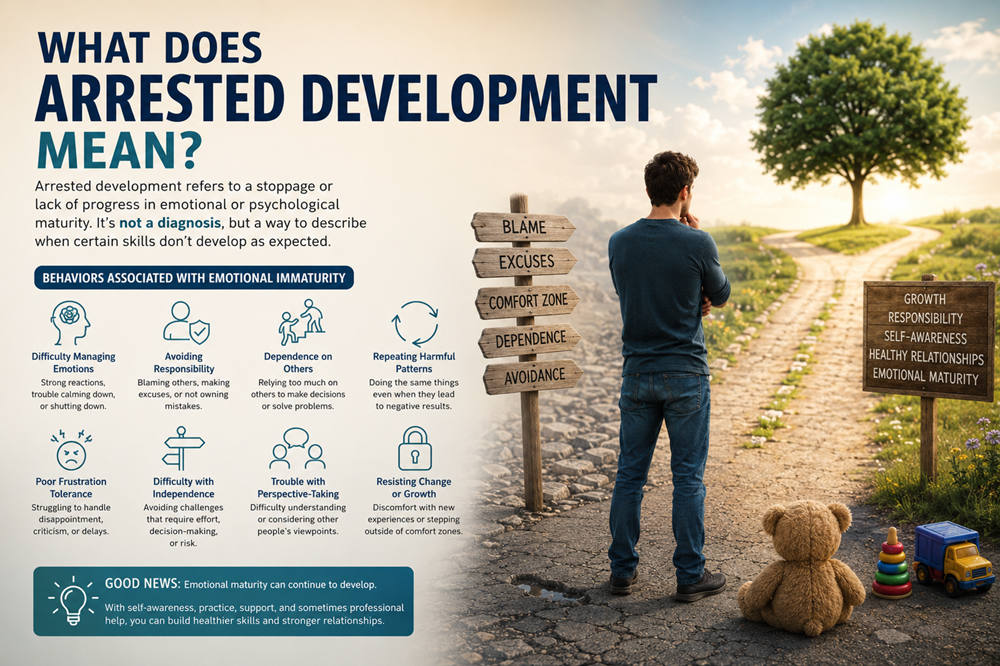
Arrested development means that some type of growth or development has stopped, slowed, or failed to move forward as expected. The word arrest can mean to stop or halt something, including its growth.
When the phrase describes a person, it usually refers informally to emotional or psychological maturity. It does not mean that someone literally stopped developing at a certain age, and it should not be treated as a mental health diagnosis.
What Does Arrested Development Mean?
The basic meaning of arrested development is simple: development has been interrupted or has not progressed normally in a particular area.
The phrase can apply to different kinds of development, but in everyday conversation, people often use it when they believe an adult still relies on emotional habits associated with a younger stage of life.
For example, someone might struggle to accept responsibility, manage disappointment, deal with criticism, or handle disagreements calmly. People may describe that behavior as emotional arrested development.
That does not mean every immature reaction points to a deeper problem. Everyone occasionally handles situations poorly. What matters more is whether the same patterns continue over time and repeatedly cause problems.
What Does Arrested Development Mean in Psychology?
In psychological conversations, arrested development is usually a descriptive phrase rather than a formal diagnosis.
The American Psychiatric Association’s DSM-5-TR classifies recognized mental disorders using defined diagnostic criteria. Those criteria are intended to be evaluated by trained professionals using clinical judgment rather than by the general public.
So calling a person “arrested” based on a few behaviors can be misleading.
A person may be mature in some areas and less developed in others. Someone could manage a demanding career successfully but struggle with close relationships. Another person might be financially responsible yet have trouble controlling anger or accepting criticism.
Emotional development is not an all-or-nothing process.
When people use the phrase arrested development, they are often trying to describe difficulties with skills such as:
- Managing strong emotions
- Taking responsibility for mistakes
- Handling disagreement
- Tolerating frustration
- Making independent decisions
- Respecting boundaries
- Considering another person’s point of view
- Changing behavior after learning from experience
These behaviors can have many explanations, so they should not be used as a checklist for diagnosing yourself or someone else.
Behaviors Sometimes Associated With Emotional Immaturity
Rather than looking for fixed “signs” of arrested development, it is more useful to look at patterns of emotional immaturity.
Difficulty Handling Frustration
Mature adults still become angry, disappointed, and frustrated. Emotional maturity does not mean staying calm every second.
The difference is usually in how you respond.
Someone who struggles with frustration may regularly have intense reactions when plans change, when another person says no, or when things do not go as expected. They may lash out, withdraw completely, or turn a minor disappointment into a major conflict.
An occasional reaction like this is normal. A repeated pattern that damages work, friendships, or relationships deserves more attention.
Avoiding Responsibility
Another common maturity issue is difficulty admitting mistakes.
A person might blame coworkers, partners, parents, circumstances, or bad luck whenever something goes wrong. They may explain why their behavior was justified instead of acknowledging how their choices affected the situation.
Taking responsibility does not mean blaming yourself for everything. It means being able to recognize your part in a problem and decide what you can do differently.
Trouble Managing Emotions
Strong feelings can make thoughtful communication difficult.
Some people respond to uncomfortable emotions by yelling, shutting down, making impulsive decisions, or refusing to discuss the issue. Others avoid difficult emotions altogether and expect someone else to solve the problem.
Emotional maturity includes learning to experience anger, embarrassment, fear, or disappointment without automatically allowing that emotion to control your next action.
Depending Too Heavily on Other People
Adults naturally depend on family, friends, and partners. Healthy relationships involve giving and receiving support.
The issue is excessive dependence.
Someone may repeatedly expect another person to make routine decisions, solve manageable problems, provide constant reassurance, or take responsibility for tasks they could reasonably handle themselves.
Independence does not mean doing everything alone. It means being able to function while still accepting support when you genuinely need it.
Repeating the Same Harmful Patterns
Experience gives us opportunities to adjust our behavior.
If someone repeatedly responds to similar situations in the same destructive way, even when the consequences are obvious, they may be struggling to develop healthier coping or communication skills.
For example, someone who cuts people off after every disagreement may never learn how to repair a relationship after conflict. Another person may repeatedly quit jobs after receiving criticism rather than learning how to deal with uncomfortable feedback.
The important part is the repeated pattern, not one isolated incident.
What Can Affect Emotional Development?
There is rarely one simple explanation for why someone struggles with emotional maturity.
Development is influenced by many experiences over time, including family relationships, stress, opportunities for independence, social experiences, and the ways a person learns to handle difficult situations.
Difficult Childhood Experiences
Childhood experiences can affect how people respond to stress and relationships later in life.
The CDC explains that adverse childhood experiences, or ACEs, can be associated with prolonged toxic stress that affects brain development and the body’s stress-response systems.
That does not mean childhood adversity automatically leads to emotional immaturity.
Two people can experience similar difficulties and respond very differently. Supportive relationships, personality, later experiences, and opportunities to learn healthier skills can all matter.
The safer way to think about childhood experiences is that they may influence emotional habits, not permanently determine them.
Learned Family Patterns
Many of the ways we handle conflict begin with what we see around us.
If disagreement was always avoided in your family, you may enter adulthood without much practice discussing problems directly. If shouting was the normal response to conflict, raised voices may feel natural even when they make communication worse.
Other people grow up in families where adults solve nearly every problem for them. Later, independent decision-making may feel unfamiliar or uncomfortable.
These patterns can be deeply established, but learned behavior can also be relearned.
Stress and Difficult Experiences
People do not always behave at their most mature when they are under significant stress.
Job loss, grief, relationship problems, financial pressure, family conflict, or other difficult experiences can affect how someone reacts emotionally. Childhood trauma, for example, can influence reactions to stress, although many people recover and thrive with appropriate support.
That is another reason to avoid judging someone’s overall maturity from one moment.
A normally calm person can become defensive during a crisis. Someone who is usually independent may temporarily need more reassurance and help.
Emotional development is better understood by looking at patterns over time.
Arrested Development vs. Regression
Arrested development and regression are not the same thing.
Arrested development suggests that development in a certain area has stalled or has not progressed as expected.
Regression refers to returning to an earlier or less mature way of functioning. The APA Dictionary of Psychology describes it as a return to a previous, lower level of cognitive, emotional, or behavioral functioning.
Imagine an adult who normally handles conflict calmly but begins sulking, shouting, or depending heavily on others during a period of extreme stress. That could be described as regression because the person’s usual level of functioning has temporarily changed.
With arrested development, the idea is that certain emotional skills may not have become well developed in the first place.
In everyday conversation, people sometimes use these terms loosely, so the distinction will not always be perfect.
Can Emotional Maturity Continue to Develop?
Yes. Emotional maturity is not something you either complete in childhood or never develop at all.
Adults continue learning how to handle relationships, responsibilities, disappointment, conflict, and change. Recognizing an immature pattern can be the beginning of changing it rather than proof that you are permanently stuck.
Take Responsibility for One Thing at a Time
If you tend to avoid responsibility, start with something manageable.
Maybe you need to stop blaming your schedule for missed commitments. Maybe you need to handle a household responsibility without waiting for someone else to remind you.
Small changes are easier to repeat, and repetition is what turns a new response into a habit.
Name What You Are Actually Feeling
People sometimes react to one emotion while believing they are experiencing another.
You may think you are angry when you are actually embarrassed. You may become defensive because criticism makes you feel rejected. You may withdraw from an argument because you are afraid of losing the relationship.
Being able to name the emotion makes it easier to decide what to do with it.
Learn to Sit With Discomfort
Maturity often requires tolerating uncomfortable moments.
You may need to hear criticism without immediately arguing back. You may need to apologize even when you feel embarrassed. You may need to accept that another person disagrees with you.
Discomfort is not automatically a sign that something is wrong.
Sometimes it is simply part of handling a difficult situation well.
Notice Your Repeating Patterns
Instead of focusing only on what other people did, pay attention to what you consistently do next.
Do you shut down whenever someone criticizes you?
Do you avoid difficult conversations until the problem becomes worse?
Do you expect someone else to make decisions when you feel uncertain?
Repeated reactions give you useful information because they show exactly where you may need to develop a different skill.
Seek Help When the Pattern Is Hard to Change
Some emotional habits are difficult to untangle on your own, especially when they are connected to trauma, anxiety, depression, family conflict, or other significant problems.
A qualified mental health professional can help you explore what drives a repeated behavior and find healthier ways to respond. The National Institute of Mental Health also recommends considering professional help when stress or anxiety becomes persistent or begins interfering with everyday life.
Formal mental health diagnoses should be based on appropriate professional assessment rather than informal labels such as “arrested development.”
What Does Arrested Development Mean Outside Psychology?
The phrase has a broader meaning outside discussions of emotional maturity.
Because arrested can simply mean stopped or halted, arrested development can describe any developmental process that has been interrupted.
The surrounding context tells you what kind of development is being discussed.
When someone says an adult seems to have “arrested development,” they are usually commenting on emotional or behavioral maturity. In another setting, the same phrase could refer to a completely different type of growth.
The key idea is straightforward: something that was expected to keep developing has not progressed in the usual way.
When the phrase is applied to a person, however, it is best used carefully. People mature at different rates, behave differently under stress, and can continue developing healthier emotional skills well into adulthood. One immature reaction does not define an entire person.