Attitude Reflects Leadership: What the Famous Quote Really Means
A team’s attitude rarely forms in isolation. It develops through daily experiences: how decisions are made, how mistakes are handled, whose concerns are heard, and which behaviors are rewarded or ignored.
That is the idea behind the line “attitude reflects leadership.” Rather than treating low morale, distrust, or poor cooperation as problems that exist only within employees, the phrase asks leaders to examine the environment their behavior has helped create.
Where Does “Attitude Reflects Leadership” Come From?
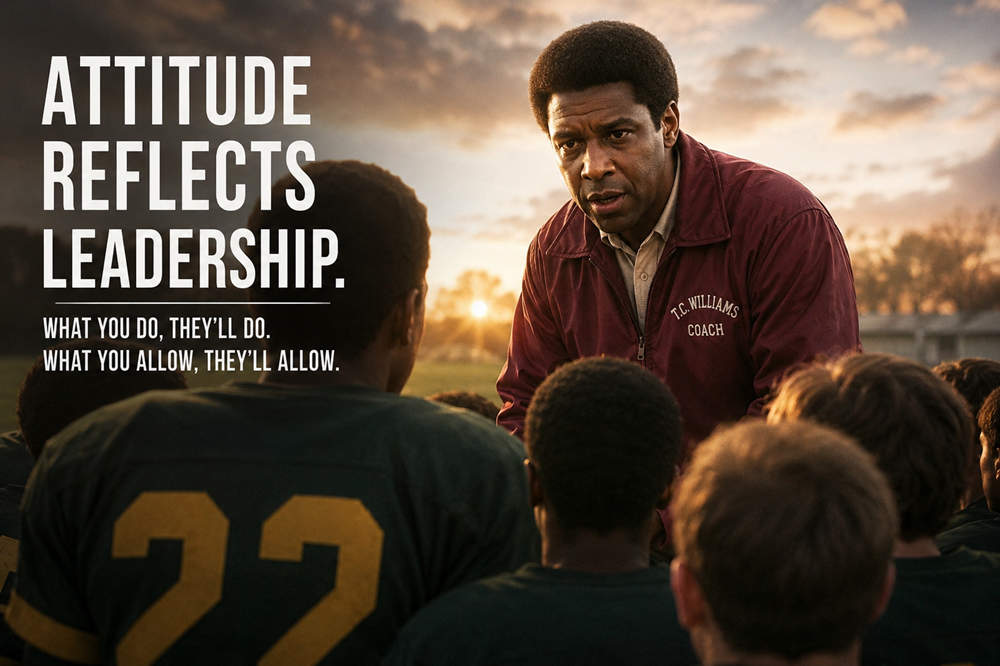
The line comes from the 2000 sports drama Remember the Titans. Set in 1971, the film follows a newly integrated high school football team whose players and coaches must overcome racial hostility and deep distrust.
Julius Campbell delivers the line during a confrontation with team captain Gerry Bertier. Gerry accuses Julius of playing selfishly and failing to give his full effort. Julius responds that several white players are not properly blocking for Rev, a Black quarterback, and that Gerry has done nothing to address it.
When Gerry criticizes Julius’s attitude, Julius answers:
“Attitude reflects leadership, captain.”
The final word gives the line its force. Julius is not merely arguing with another player. He is challenging Gerry in his role as captain.
Gerry expects commitment from Julius, but Julius sees standards being applied unevenly. From his perspective, the team’s lack of unity is not simply the result of individual selfishness. It also reflects Gerry’s unwillingness to hold his friends accountable.
The exchange changes Gerry’s understanding of leadership. Being captain is not only about performing well or giving instructions. It means confronting conduct that harms the group, including conduct by people close to the leader.
What Does “Attitude Reflects Leadership” Mean?
“Attitude reflects leadership” means that the outlook and behavior of a group can reveal what its leaders consistently model, permit, and prioritize.
Leaders communicate through more than speeches and instructions. Every decision provides information about how the group truly operates.
A manager may say that collaboration matters, but employees will draw a different conclusion if promotions consistently go to people who compete with colleagues or protect information. A supervisor may request honest opinions, but team members will stop offering them if disagreement is met with irritation. A project leader may emphasize accountability while repeatedly making excuses for personal mistakes.
In each case, employees learn more from the leader’s behavior than from the stated value.
The phrase does not mean leaders control every emotion or action within a team. Employees have different personalities, experiences, and motivations. However, leaders hold enough authority to shape many of the conditions under which those individual attitudes develop.
Before describing a team as negative, resistant, careless, or unmotivated, a leader should therefore ask what people have learned from working in that environment.
How Leadership Attitudes Spread Through a Team
Leadership influences a team through several related processes. Emotions shape the immediate atmosphere, visible behavior establishes examples, consequences create informal rules, and interpersonal safety affects whether people participate honestly.
Emotional Contagion Shapes the Atmosphere
People naturally respond to the emotions expressed by those around them. Because leaders are highly visible and hold decision-making authority, their reactions receive particular attention.
Research on emotional contagion between leaders and followers found relationships between leaders’ emotions, followers’ emotions, and workplace outcomes.
During a difficult project, a calm leader can help the team concentrate on the next decision. A leader who becomes visibly panicked, hostile, or defeated can make the same problem feel less manageable.
This does not require leaders to hide frustration or pretend every situation is positive. Forced enthusiasm can appear dishonest when serious difficulties are obvious. Emotional leadership is better understood as regulation: acknowledging the problem without allowing the leader’s first reaction to take over the group.
Employees Learn From Visible Behavior
Team members watch how leaders achieve results, respond to setbacks, and interact with others. Those observations help them decide which behaviors are likely to succeed within the group.
A leader who regularly interrupts people signals that status matters more than listening. One who withholds information encourages employees to protect their own knowledge. A leader who openly corrects an error shows that admitting a mistake does not have to damage a person’s credibility.
Research drawing on social learning theory has also found that dominant leadership can encourage employees to view success as a competition, reducing their willingness to help colleagues.
Leaders may not intend to teach these lessons. Employees nevertheless notice which methods appear to bring influence, recognition, and protection.
Consequences Create Informal Rules
Formal values describe what an organization says it believes. Consequences reveal which standards actually govern the team.
Suppose a high performer repeatedly treats colleagues disrespectfully without correction. The practical lesson is that strong results excuse harmful behavior. If missed commitments are accepted without discussion, deadlines gradually lose meaning. If employees who hide problems avoid criticism while those who report them early receive blame, transparency becomes personally risky.
Inaction sends a message as well. A behavior does not need explicit approval to become accepted. Repeatedly overlooking it can produce the same result.
Over time, these decisions form an unwritten code. Employees use it to determine what they must do, what they can avoid, and what the organization values most.
Psychological Safety Determines Who Speaks
Psychological safety is a shared belief that a team is safe for interpersonal risk-taking. Amy Edmondson’s foundational research connected it with learning behaviors such as asking for help, discussing errors, and seeking feedback.
Leaders influence that belief through their reactions.
When someone identifies a risk, asks a basic question, or admits uncertainty, the leader’s response becomes evidence for everyone watching. A thoughtful response suggests that candor is useful. Ridicule, impatience, or retaliation suggests that silence is safer.
A team without psychological safety may appear agreeable because meetings contain little disagreement. In reality, employees may be withholding information that leaders need to make sound decisions.
What a Team’s Attitude May Reveal About Its Leadership
A team’s attitude should be treated as evidence rather than a final verdict. Recurring patterns can point leaders toward parts of the working environment that deserve closer attention.
Cynicism Can Signal Broken Credibility
Employees often become cynical after hearing promises that are not supported by action.
Leaders may announce an important initiative and quietly abandon it a few weeks later. They may request employee feedback but never explain whether it influenced a decision. Priorities may change repeatedly without any acknowledgment of the disruption created.
Eventually, employees protect themselves by assuming that the latest message will not last. Their skepticism may sound dismissive, but it can be a learned response to inconsistency.
Silence Can Reveal Restricted Communication
Leaders should pay attention to where and when concerns appear.
If employees speak candidly only in private, wait until a project has failed before mentioning known risks, or rely on one outspoken colleague to deliver bad news, the formal communication process may not be working.
A lack of public disagreement does not necessarily indicate support. The timing and location of employee comments can reveal more than the amount of conversation in a meeting.
Blame Can Indicate Defensive Leadership
A culture of blame frequently develops when people believe mistakes will be used against them.
If leaders consistently distance themselves from failed decisions, employees may begin doing the same. They document colleagues’ errors, conceal weak results, and avoid responsibility for uncertain work.
The problem then becomes larger than an occasional excuse. Protecting oneself begins to take priority over understanding what happened and preventing it from happening again.
Low Initiative Can Point to Limited Authority
Leaders sometimes ask employees to take ownership while continuing to control every meaningful decision.
When people need approval for routine choices, independent action becomes inefficient and potentially dangerous. Waiting for instructions is safer than acting and later being criticized for exceeding authority.
Low initiative may therefore indicate that responsibility and control have been separated. Employees are expected to deliver outcomes but are not trusted with the judgment needed to produce them.
Division Can Expose Unequal Standards
Teams quickly notice when rules depend on a person’s status, performance, or relationship with the leader.
Unequal access to information, flexibility, recognition, or protection can turn colleagues into competing groups. People stop seeing the team as a shared effort because they no longer believe everyone is participating under the same conditions.
This is the failure Julius identifies in Remember the Titans. Gerry asks for loyalty without first addressing conduct that makes loyalty difficult.
Fairness does not require identical treatment in every situation. It requires understandable principles, relevant explanations, and standards that do not disappear when enforcement becomes uncomfortable.
Ownership Can Reflect Clarity and Support
A team that accepts responsibility, adapts to setbacks, and helps colleagues is also communicating something about its environment.
Employees are better able to take ownership when goals are understandable, decision authority is clear, and support is available when the work becomes difficult.
A longitudinal study of 1,048 employees across 90 teams found that engaging leadership was associated with stronger personal resources and later work engagement. Shared perceptions of engaging leadership were also associated with greater team effectiveness.
Positive team attitudes are not created by enthusiasm alone. They are more likely when employees have reasons to believe their effort can produce meaningful results.
How Leaders Can Improve the Attitude of a Team
Leaders cannot order a team to become trusting, cooperative, or engaged. They can change the experiences that currently reinforce withdrawal, frustration, or defensiveness.
Examine Recent Leadership Decisions
Self-reflection is more useful when it focuses on observable behavior rather than broad questions about personality.
A leader can review several recent situations:
- How did I respond when someone challenged my proposal?
- Did I apply the same standard to different employees?
- Have I delayed a decision while continuing to demand progress?
- What behavior have I tolerated because confronting it would be uncomfortable?
- Did my actions support the priorities I communicated?
This exercise is not about accepting blame for everything that goes wrong. It identifies choices within the leader’s control.
Ask Questions That Produce Specific Feedback
“Is everything okay?” is easy to answer politely. More focused questions make useful feedback more likely.
A leader might ask:
- Which part of our approval process creates the most delay?
- When did our priorities become unclear?
- What information are you receiving too late?
- Which issue is difficult to raise in our meetings?
- What is one leadership decision that needs more explanation?
After listening, the leader should distinguish between changes that can be made, constraints that cannot be removed, and issues that require further investigation. Explaining that distinction shows employees that speaking honestly leads to a considered response.
Correct the Conditions Behind the Behavior
A discouraged team does not always have a motivation problem.
Employees may be responding to contradictory priorities, unresolved conflict, inadequate staffing, unclear responsibilities, or repeated interruptions. A speech about positivity will not correct those conditions.
Leaders should identify the practical experience behind the attitude. If employees appear reluctant to cooperate, examine whether their goals or incentives place them in competition. If they resist a new process, determine whether it adds unnecessary work or solves a problem they do not understand.
Addressing the cause does not require accepting disrespectful conduct. It allows leaders to respond to inappropriate behavior while still taking legitimate concerns seriously.
Choose a Small Set of Visible Standards
Broad values become useful only when people can connect them to everyday behavior.
A leader might define accountability as reporting delays before they become emergencies. Respect could mean allowing a colleague to finish explaining a disagreement. Collaboration could require sharing information that affects another person’s work.
Once these standards are clear, leaders should refer to them when making decisions and demonstrate them consistently. A small number of visible practices is more credible than a long list of values that rarely enters daily conversation.
Clarify Authority Alongside Responsibility
Employees need to know which decisions they can make independently, which require consultation, and which remain with the leader.
Without those boundaries, people either escalate every choice or take risks without understanding the consequences. Both outcomes create frustration.
Clarifying authority also makes accountability fairer. Leaders can evaluate employees according to decisions they were genuinely empowered to make rather than outcomes they had little ability to influence.
Make Recognition Specific and Useful
Recognition has more value when it identifies the behavior that strengthened the team.
Instead of offering general praise, a leader might acknowledge that an employee raised a risk early enough for the plan to change, shared information that prevented duplicated work, or disagreed respectfully while keeping the discussion productive.
Specific recognition helps other employees understand what constructive behavior looks like. It also prevents praise from appearing arbitrary or limited to the most visible performers.
Recognition should not replace fair pay, manageable workloads, or development opportunities. Its purpose is to make valuable contributions visible, not to compensate for unresolved working conditions.
The Lasting Leadership Lesson From the Quote
“Attitude reflects leadership” does not provide a complete explanation for every problem within a team. It provides a place to begin looking.
A team’s behavior contains information about the environment in which people work. Cynicism, silence, blame, division, and passivity may reveal that employees have adapted to inconsistent standards or restrictive conditions. Ownership, honesty, and cooperation may indicate that people have clarity, support, and room to contribute.
Leaders who study these patterns can discover where their decisions are producing effects they never intended.
The enduring lesson from Remember the Titans is not that a leader must manufacture a positive mood. It is that leadership becomes credible when the example, standards, and responsibility expected from the team are also visible in the person leading it.