Gordon Growth Model Formula Explained With Examples, Key Assumptions, Uses, and Limitations
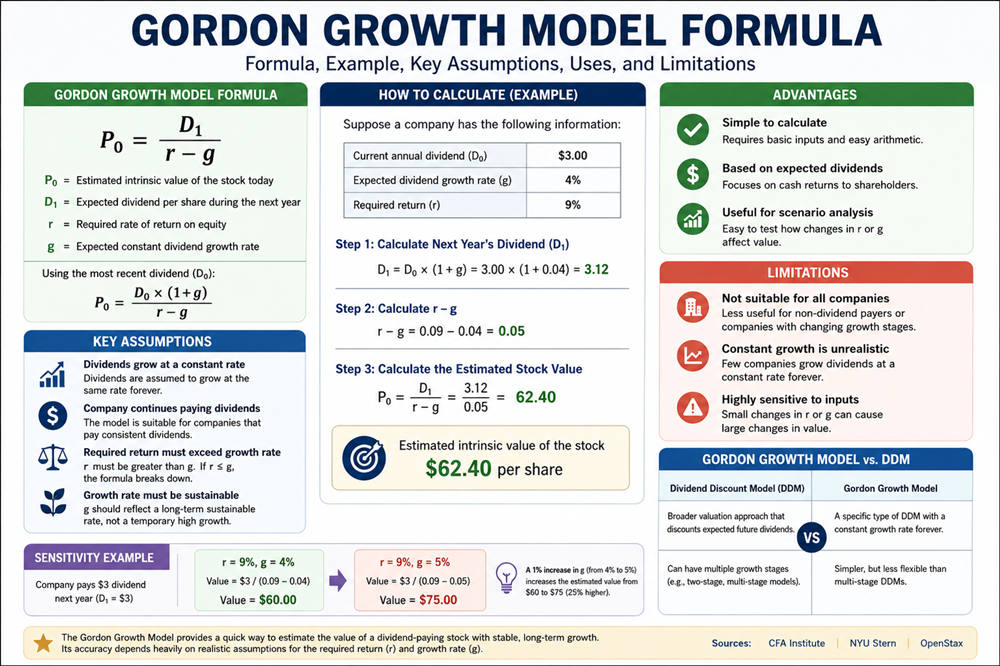
The Gordon Growth Model formula estimates the intrinsic value of a dividend-paying stock by assuming its dividends will grow at a constant rate indefinitely. It is one of the simplest versions of the Dividend Discount Model and is generally most suitable for mature companies with relatively stable dividend growth.
The formula is:
P₀ = D₁ ÷ (r − g)
Although the calculation is simple, choosing realistic values for the required return and long-term growth rate is essential.
What Is the Gordon Growth Model?
The Gordon Growth Model values a stock based on the present value of the dividends investors expect to receive in the future.
Unlike a multistage valuation model, it does not assume that a company goes through several different growth periods. Instead, the Gordon Growth Model assumes dividends increase at the same percentage rate every year indefinitely.
That makes the model most useful when a company’s dividend policy and long-term growth are reasonably stable. A fast-growing company whose dividend growth is likely to slow significantly may require a multistage Dividend Discount Model instead.
Gordon Growth Model Formula
The standard Gordon Growth Model formula is:
P₀ = D₁ / (r − g)
Where:
- P₀ = estimated intrinsic value of the stock today
- D₁ = expected dividend per share during the next year
- r = required rate of return on equity
- g = expected constant dividend growth rate
You can also express the formula using the current dividend:
P₀ = [D₀ × (1 + g)] / (r − g)
Here, D₀ is the dividend that has most recently been paid.
Because the Gordon Growth Model uses the next expected dividend, you first calculate:
D₁ = D₀ × (1 + g)
For example, if a company currently pays a $3 annual dividend and dividends are expected to grow by 4%:
D₁ = $3 × 1.04 = $3.12
You would use $3.12 in the Gordon Growth Model rather than $3.
Understanding r and g
The required return (r) is the rate of return equity investors require for taking the risk of owning the stock.
The growth rate (g) is the rate at which dividends are assumed to grow every year indefinitely. NYU Stern’s stable-growth dividend model describes this as the annual growth rate in dividends forever.
Both rates should be written as decimals when you use the formula. For example:
9% = 0.09
4% = 0.04
One rule is especially important:
r must be greater than g.
If the required return is equal to or below the perpetual growth rate, the standard Gordon Growth Model does not produce a meaningful valuation.
How to Calculate the Gordon Growth Model
Suppose you are looking at a company with the following numbers:
| Variable | Value |
|---|---|
| Current annual dividend (D₀) | $3.00 |
| Expected dividend growth rate (g) | 4% |
| Required return (r) | 9% |
Step 1: Calculate Next Year’s Dividend
The model requires D₁, so start with:
D₁ = D₀ × (1 + g)
Insert the numbers:
D₁ = $3.00 × 1.04
D₁ = $3.12
Step 2: Calculate r − g
Convert the percentages to decimals:
r = 0.09
g = 0.04
Then subtract:
0.09 − 0.04 = 0.05
Step 3: Calculate the Estimated Stock Value
Now use the Gordon Growth Model:
P₀ = $3.12 / 0.05
P₀ = $62.40
Under these assumptions, the estimated intrinsic value of the stock is $62.40 per share.
You can compare that figure with the stock’s market price as part of a broader equity valuation. However, a calculated value of $62.40 does not prove that the stock is worth exactly that amount. The result depends heavily on the assumptions used for r and g.
Key Assumptions of the Gordon Growth Model
The Gordon Growth Model becomes much easier to use once you understand what the formula assumes.
Dividends Grow at a Constant Rate
The biggest assumption is that dividends grow at the same annual rate indefinitely.
If you enter 4% for g, the model assumes dividends will continue growing at 4% year after year. This is why the model is also known as a constant-growth dividend model.
Actual companies may raise dividends faster in some years, slower in others, or occasionally cut them. The model simplifies those changes into one long-term growth rate.
The Company Continues Paying Dividends
The formula values a stock through its expected dividend stream. It is therefore much more useful for companies that pay dividends consistently than for companies that do not distribute dividends to shareholders.
The Required Return Must Exceed the Growth Rate
The formula requires:
r > g
Suppose:
r = 8%
and:
g = 8%
The denominator would become:
0.08 − 0.08 = 0
That makes the formula unusable.
The problem also becomes important when r and g are very close because the estimated valuation becomes extremely sensitive to small changes in either number.
The Growth Rate Must Be Sustainable
Using a company’s recent high-growth period as its perpetual growth rate can produce unrealistic valuations.
A business might increase dividends by 15% for several years, but assuming that rate continues forever is much harder to justify. A perpetual growth assumption needs to represent a sustainable, mature growth rate rather than temporary expansion.
NYU Stern’s discussion of stable growth explains why a company’s perpetual growth assumption needs to remain consistent with realistic long-term economic growth.
Advantages of the Gordon Growth Model
The Gordon Growth Model remains popular because it makes dividend valuation straightforward.
Simple to Calculate
Once you know the expected dividend, required return, and long-term growth rate, the calculation requires only basic arithmetic.
That makes it useful for quickly testing valuation assumptions without building a large financial model.
Based on Expected Dividends
The formula focuses directly on dividends expected to be distributed to shareholders.
For companies with long histories of consistent dividend payments, that can provide a practical way to estimate value.
Useful for Scenario Analysis
You can change r or g and immediately see how different assumptions affect the estimated stock value.
That is particularly helpful because the Gordon Growth Model should rarely be treated as producing one unquestionably correct number.
Limitations of the Gordon Growth Model
Its simplicity also creates several weaknesses.
It Does Not Fit Every Company
The model is less useful for companies that pay no dividends or whose dividend policies do not reflect their ability to distribute cash to shareholders.
It can also be a poor fit for companies experiencing several distinct growth stages. Multistage Dividend Discount Models are designed to handle changing growth patterns more effectively.
Constant Growth Is Rare in Practice
Few companies increase dividends by exactly the same percentage every year forever.
The constant-growth assumption is a valuation simplification, not a prediction that dividend payments will follow a perfectly smooth path.
Small Changes Can Produce Large Valuation Differences
Consider a company expected to pay a $3 dividend next year.
With a 9% required return and 4% growth:
Value = $3 / (0.09 − 0.04)
Value = $60
Now increase the expected growth rate by only one percentage point:
Value = $3 / (0.09 − 0.05)
Value = $75
A change in g from 4% to 5% raises the estimated value from $60 to $75.
This sensitivity becomes even stronger as g moves closer to r, which is why realistic assumptions matter so much.
Gordon Growth Model vs. Dividend Discount Model
The Gordon Growth Model is not separate from the Dividend Discount Model. It is one specific form of it.
The Dividend Discount Model is the broader valuation approach that values equity using the present value of expected future dividends.
The Gordon Growth Model is the constant-growth version of the DDM:
Gordon Growth Model = DDM with one perpetual dividend growth rate
A two-stage DDM, by comparison, might assume a company grows quickly for several years before settling into a lower long-term growth rate. Other multistage models can accommodate additional changes in growth.
The Gordon model is therefore attractive because it is simple, while multistage models are more flexible when a company’s future is unlikely to follow one stable growth rate.
Final Takeaway
The Gordon Growth Model formula is:
P₀ = D₁ / (r − g)
It provides a simple way to estimate the value of a dividend-paying stock when dividends are expected to grow at a sustainable constant rate.
The formula itself is easy. The difficult part is choosing realistic assumptions. A small change in the required return or perpetual growth rate can significantly change the result, so the Gordon Growth Model is best treated as one valuation tool rather than a precise prediction of a stock’s future market price.