
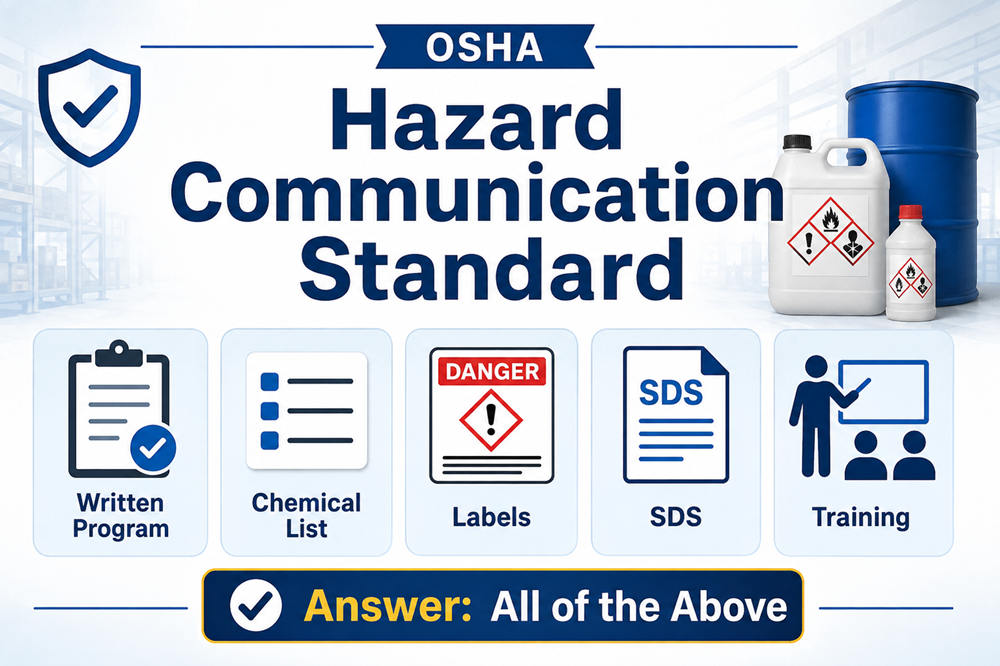
The Hazard Communication Standard Includes Which of the Following Workplace Safety Requirements?
The question “The Hazard Communication Standard includes which of the following?” may come with these options:
A. A written hazard communication program
B. Labels and other workplace warnings
C. Safety Data Sheets
D. Employee information and training
E. All of the above
The correct answer is E. All of the above.
OSHA’s Hazard Communication Standard requires employers to inform workers about hazardous chemicals through a written program, proper labels, accessible Safety Data Sheets, and effective employee training.
What Is the Hazard Communication Standard?
The Hazard Communication Standard, often called HazCom or HCS, is an OSHA workplace safety rule found in 29 CFR 1910.1200.
Its purpose is to make sure employees understand the chemical hazards they may face at work. Workers must know which hazardous chemicals are present, how those chemicals can affect them, and what steps they should take to prevent exposure.
HazCom applies to many workplaces where employees use or may be exposed to hazardous chemicals. These may include factories, warehouses, construction sites, laboratories, healthcare facilities, repair shops, and cleaning businesses.
The standard creates a system for communicating chemical information. Its main parts include:
- A written hazard communication program
- A hazardous chemical inventory
- Container labels and warnings
- Safety Data Sheets
- Employee information and training
Each part supports the others. Labels provide quick warnings, Safety Data Sheets offer detailed information, and training teaches employees how to use that information safely.
A Written Hazard Communication Program
Employers covered by the standard must create and maintain a written hazard communication program.
This document explains how the employer will manage chemical safety in the workplace. It should reflect the chemicals, tasks, and hazards employees actually encounter rather than being a generic safety document.
A written program normally explains:
- How hazardous chemicals are identified
- How containers are labeled
- How Safety Data Sheets are obtained and maintained
- How employees receive information and training
- Who is responsible for each part of the program
- How chemical hazards are communicated at multi-employer workplaces
- How employees are informed about nonroutine tasks
For example, a workplace may identify one employee to maintain the chemical inventory and another to organize training. The written program should clearly explain these responsibilities.
Employees must also know where the written program is kept and how they can review it.
A List of Hazardous Chemicals
The written HazCom program must include a list of hazardous chemicals known to be present in the workplace.
This list is often called a chemical inventory or hazardous chemical inventory. It helps employers confirm that every covered chemical has an appropriate label and an available Safety Data Sheet.
Depending on the workplace, the inventory may include:
- Cleaning chemicals
- Paints
- Solvents
- Fuels
- Adhesives
- Compressed gases
- Acids
- Disinfectants
- Lubricants
- Welding products
The name or product identifier on the inventory should match the identifier used on the label and Safety Data Sheet. This makes it easier for employees to locate the correct information quickly.
The chemical inventory should be reviewed regularly. When a new hazardous product enters the workplace, it should be added to the list and included in the employer’s HazCom system.
Labels and Workplace Warnings
Hazardous chemical containers must have labels or other appropriate warnings.
Labels allow employees to recognize a chemical and understand its main dangers before using, moving, or storing it. Employers must not remove or damage the labels placed on incoming chemical containers.
A standard chemical label may include the following information:
Product Identifier
The product identifier is the name, number, or code used to identify the chemical. It should match the product identifier on the Safety Data Sheet.
Signal Word
The signal word shows the seriousness of the hazard.
The two signal words are:
- Danger for more severe hazards
- Warning for less severe hazards
A label will generally use only one signal word.
Hazard Statements
Hazard statements describe the nature of a chemical’s risks.
Examples may include:
- Causes serious eye damage
- Harmful if inhaled
- Highly flammable liquid and vapor
- May cause skin irritation
- Contains gas under pressure
Pictograms
Hazard communication pictograms use symbols to communicate specific types of hazards. They can warn workers about risks such as flammability, corrosion, toxicity, compressed gases, or serious health effects.
Employees should understand what each pictogram means and what precautions it requires.
Precautionary Statements
Precautionary statements explain how to prevent or reduce harm.
They may provide instructions about:
- Wearing protective equipment
- Storing the product safely
- Responding to a spill
- Providing first aid
- Handling the product correctly
- Disposing of the chemical
Supplier Information
The label may also identify the chemical manufacturer, importer, or other responsible party, along with contact information.
Workplace containers must remain properly identified. If a chemical is transferred into another container, that secondary container may also need a label unless a specific limited-use exception applies.
Safety Data Sheets
A Safety Data Sheet, commonly shortened to SDS, provides detailed information about a hazardous chemical.
An SDS gives employees more information than can fit on a container label. It explains the chemical’s hazards, safe handling procedures, required protective equipment, storage requirements, and emergency response steps.
Safety Data Sheets follow a standard 16-section format:
- Identification
- Hazard identification
- Composition and ingredient information
- First-aid measures
- Firefighting measures
- Accidental-release measures
- Handling and storage
- Exposure controls and personal protection
- Physical and chemical properties
- Stability and reactivity
- Toxicological information
- Ecological information
- Disposal considerations
- Transportation information
- Regulatory information
- Other information
An employee may check an SDS to find out:
- Which gloves or protective clothing to wear
- Whether ventilation is needed
- How to respond to a chemical spill
- What to do after skin or eye contact
- Whether the substance is flammable
- Which chemicals should not be stored together
Employers must keep Safety Data Sheets for covered chemicals and make them readily accessible during each work shift.
The SDS may be stored electronically or on paper. However, employees must be able to access it quickly, including during an emergency. An electronic system is not useful if workers do not know how to use it or cannot access it during a power or network failure.
Employee Information and Training
Employers must provide information and training to employees who work with or may be exposed to hazardous chemicals.
Training should take place when employees are first assigned to the work area and when a new chemical hazard is introduced.
Effective HazCom training should explain:
- Which hazardous chemicals are present
- The physical and health hazards of those chemicals
- How workers can detect a chemical release
- Where the written HazCom program is located
- Where Safety Data Sheets are kept
- How to read labels and SDSs
- What chemical pictograms mean
- Which protective measures workers should use
- What to do during a spill, leak, or exposure
Training should relate directly to the employee’s job.
For example, a cleaner who uses disinfectants needs information about safe mixing, ventilation, skin protection, and eye exposure. A warehouse employee handling compressed gas cylinders needs different information about storage, movement, pressure hazards, and damaged containers.
Employers may train workers about individual chemicals or groups of chemicals with similar hazards. However, employees must understand which products the training covers.
Simply giving workers a safety handout or access to an SDS binder is not enough. Employees should receive explanations they can understand and be able to apply during their work.
Who Is Responsible for Hazard Communication?
HazCom responsibilities are divided among chemical manufacturers, importers, distributors, and employers.
Chemical Manufacturers and Importers
Manufacturers and importers evaluate chemical hazards and classify their products. They are also responsible for preparing appropriate labels and Safety Data Sheets.
Distributors
Distributors pass required labels and Safety Data Sheets to employers and other customers receiving hazardous chemical products.
Employers
Employers are responsible for applying the HazCom system in the workplace.
Their duties may include:
- Maintaining a written program
- Creating a chemical inventory
- Keeping labels in place
- Labeling workplace containers
- Obtaining Safety Data Sheets
- Making SDSs accessible
- Training employees
- Updating the program when workplace hazards change
Employees also have responsibilities. They should follow safety procedures, attend training, read labels, use required protective equipment, and report missing or damaged labels.
However, the employer remains responsible for establishing and maintaining the workplace hazard communication program.
Common HazCom Mistakes
A workplace does not meet the standard simply because it has a collection of Safety Data Sheets.
The system must work as a whole. Common problems include:
- Missing chemical labels
- Outdated chemical inventories
- Safety Data Sheets that employees cannot access
- Workers who do not understand pictograms
- Generic training that does not match workplace hazards
- Secondary containers without identification
- New chemicals introduced without additional training
Another common mistake is treating personal protective equipment as the entire safety program. Gloves, goggles, and protective clothing may reduce exposure, but they do not replace labels, Safety Data Sheets, training, or safe handling procedures.
HazCom is about giving workers enough information to recognize hazards and make safe decisions before an accident or exposure occurs.
Why Every Part of HazCom Matters
Each part of the Hazard Communication Standard serves a different purpose.
The chemical inventory identifies what is present in the workplace.
The label gives an immediate warning about the product and its hazards.
The Safety Data Sheet provides detailed information about handling, storage, exposure controls, and emergencies.
The training teaches employees how to understand and use that information.
The written program connects everything and explains how the employer manages chemical safety.
A label alone may tell an employee that a product is corrosive, but it may not provide every first-aid or storage instruction. An SDS may contain those details, but it cannot help if the employee does not know where to find it. Training makes the entire system practical.