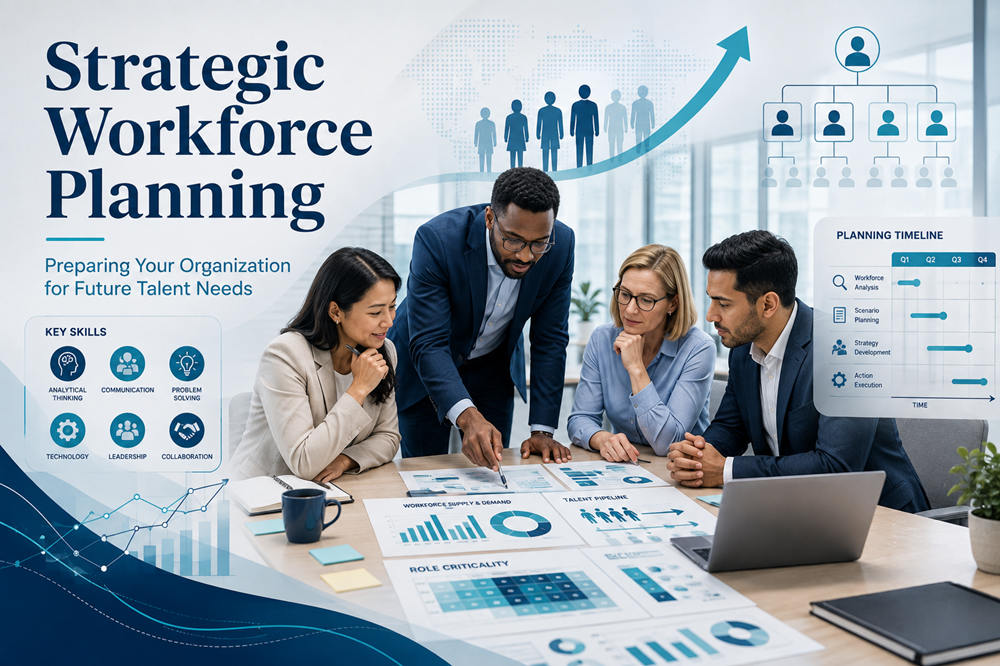
Strategic Workforce Planning: Preparing Your Organization for Future Talent Needs
Strategic workforce planning helps an organization prepare for the people and skills it will need in the future. Instead of hiring only when a position becomes vacant, leaders look ahead and connect workforce decisions to business goals.
A company planning to enter a new market, for example, may need regional managers, sales professionals, language skills, and additional customer support. A business introducing automation may need fewer employees doing repetitive tasks but more people who can manage technology, analyze data, and improve processes.
By identifying these needs early, an organization can train employees, recruit for critical roles, prepare future leaders, and avoid rushed staffing decisions.
What Is Strategic Workforce Planning?
Strategic workforce planning is the process of assessing an organization’s current workforce, predicting future talent needs, identifying gaps, and deciding how to address them.
It considers both the number of people required and the abilities they need. A company may have enough employees overall but still lack important skills in leadership, cybersecurity, project management, sales, or data analysis.
A useful workforce plan answers questions such as:
- What work will the organization need to perform over the next few years?
- Which roles and skills will become more important?
- Which positions may change or disappear?
- Are current employees ready to take on future responsibilities?
- Which roles will be difficult to fill?
- Should the organization hire, train, redeploy, outsource, or automate?
The purpose is not to predict the future perfectly. It is to help the organization prepare for likely changes before they create serious problems.
Strategic vs. Traditional Workforce Planning
Traditional workforce planning often focuses on immediate staffing needs. A manager loses an employee, notices that a team is overloaded, and requests approval to hire someone new.
Strategic workforce planning takes a broader view. It examines how business growth, technology, employee turnover, retirement, customer expectations, and market conditions could affect the workforce over several years.
Traditional planning may ask:
How many customer service representatives do we need next quarter?
Strategic planning asks:
How will automation, self-service tools, and changing customer expectations affect customer service roles over the next three years?
Organizations still need short-term staffing plans. However, long-term planning reduces the chances that every vacancy, expansion, or skills shortage will become an emergency.
Why Strategic Workforce Planning Matters
Business plans depend on people. A company can have funding, technology, and strong ideas, but it may still struggle if it does not have employees with the right capabilities.
Strategic workforce planning helps organizations prepare for growth and change in several ways.
It Identifies Talent Risks Early
Some positions are difficult to fill, while certain skills take years to develop. Waiting until an experienced employee retires or a major project begins can leave the organization with few good options.
Early planning gives leaders time to train internal candidates, recruit carefully, transfer knowledge, or build relationships with schools and professional networks.
It Supports Employee Growth
When an organization understands which skills it will need, it can offer more useful training and career opportunities. Employees can prepare for changing roles instead of being surprised by them.
Internal development may also improve retention. People are more likely to stay when they can see a future for themselves within the organization.
It Improves Succession Planning
Important knowledge is often concentrated in a small number of experienced employees. If one of them leaves unexpectedly, projects may slow down and teams may struggle to replace their expertise.
Workforce planning helps leaders identify critical positions, prepare possible successors, and document knowledge before it is lost.
It Helps Control Costs
Hiring is only one way to solve a workforce problem. An organization may also retrain employees, move people between departments, use contractors, redesign a process, or automate part of the work.
Comparing these options helps leaders choose an approach that fits both the organization’s needs and its budget.
The Strategic Workforce Planning Process
The exact process may vary by organization, but most workforce plans follow seven main steps.
1. Define the Business Goals
Workforce planning should begin with the organization’s strategy rather than its current list of vacancies.
Leaders first need to clarify what the organization expects to achieve. Possible goals include entering a new market, launching a product, reducing costs, expanding production, improving customer service, or adopting new technology.
Each goal creates different workforce needs. International expansion may require language skills and regional experience. A digital transformation may require software, cybersecurity, data, and change-management expertise.
The clearer the business goal, the easier it is to determine what kind of workforce will support it.
2. Assess the Current Workforce
The organization then needs an accurate picture of the people it already has.
This assessment may examine:
- Current roles and responsibilities
- Employee skills and qualifications
- Performance and experience levels
- Turnover and retirement risk
- Promotion readiness
- Hard-to-fill positions
- Use of contractors and temporary workers
Headcount alone is not enough. Leaders also need to know which skills are available, where those skills are located, and whether employees are interested in future roles.
For example, a department may appear fully staffed but still depend heavily on one person who understands a critical system.
3. Forecast Future Needs
The next step is to estimate what the organization may need over the next few years.
Forecasts should consider expected growth, new technology, changing workloads, employee turnover, regulations, customer demand, and possible changes to the way work is performed. Public resources such as national employment projections can also provide useful context about changing occupations and skill demand.
Because the future is uncertain, organizations can develop several scenarios. One may assume rapid growth, another moderate growth, and another an economic slowdown. Leaders can then decide how staffing needs would change under each situation.
This approach is more useful than relying on a single prediction that may quickly become outdated.
4. Identify Workforce Gaps
A workforce gap is the difference between the organization’s current capabilities and its future needs.
Common gaps include:
- Too few employees to handle future workloads
- Missing technical or professional skills
- Too few employees ready for leadership roles
- Critical knowledge held by employees nearing retirement
- A shortage of workers in certain locations
- New roles that do not yet exist within the organization
Not every gap deserves the same level of attention. Leaders should focus first on positions and skills that have the greatest effect on revenue, safety, operations, customers, or long-term growth.
5. Choose the Right Workforce Strategies
Once the gaps are clear, leaders can decide how to address them. The best solution may involve several approaches.
Build
Train and develop current employees through courses, mentoring, job rotations, apprenticeships, and challenging assignments.
This approach helps the organization retain experience and company knowledge, but it requires time. It works best when future needs are identified early.
Buy
Hire people from outside the organization.
External recruitment may be necessary when the company needs expertise that is not available internally. New employees can also bring different ideas and industry experience.
However, recruiting can be costly, especially when the organization is competing for scarce skills.
Borrow
Use contractors, consultants, freelancers, temporary workers, or outsourcing partners.
Borrowed talent can be useful for short-term projects, specialized work, or temporary increases in demand. It gives the organization flexibility without requiring every position to become permanent.
Move
Redeploy employees from one part of the organization to another.
For example, workers in an area with declining demand may be able to move into growing departments after receiving additional training. This can reduce layoffs while helping the organization retain reliable employees.
Retain
Protect the employees and skills that are most important to the organization.
Retention may require better career opportunities, supportive management, competitive pay, recognition, flexible working arrangements, or more manageable workloads.
Organizations should pay particular attention to employees whose departure would create a serious knowledge or leadership gap.
Automate or Redesign
Use technology or process improvements to reduce repetitive work.
Automation does not always replace an entire job. It often changes the role by allowing employees to spend less time on routine tasks and more time on decision-making, customer service, problem-solving, or creative work.
6. Create a Practical Action Plan
A workforce strategy becomes useful only when it leads to specific action.
The plan should clearly state:
- Which workforce gap is being addressed
- What action will be taken
- Who is responsible
- What resources are needed
- When the work should be completed
- How progress will be measured
Suppose several senior managers are expected to retire within three years. The action plan might include identifying possible successors, providing leadership training, assigning mentors, and reviewing each candidate’s progress twice a year.
Clear ownership and deadlines prevent the plan from becoming a report that no one uses.
7. Monitor and Adjust
Workforce plans need to change as the organization changes.
Leaders can track measures such as employee turnover, time to fill vacancies, internal promotion rates, training progress, succession readiness, skills coverage, productivity, and reliance on contractors.
The plan should be reviewed whenever business priorities, technology, budgets, or workforce conditions shift. Fast-growing organizations may review it quarterly, while more stable organizations may update it once or twice a year.
Regular reviews help leaders respond to new information without starting the entire planning process again.
Who Should Be Involved?
Human resources often coordinates workforce planning, but it should not work alone.
Senior leaders explain the organization’s direction. Finance helps evaluate budgets and costs. Department managers understand daily operations, workloads, performance problems, and emerging skill needs.
Learning and development teams can design training programs, while employees can provide information about their abilities, interests, and career goals.
This shared approach produces a more realistic plan. HR may manage the process, but managers and business leaders are responsible for turning it into action.
Common Workforce Planning Mistakes
Several problems can weaken an otherwise useful plan.
Using Inaccurate Data
Outdated job titles, incomplete employee records, and missing skills information can lead to poor decisions. Organizations should improve their workforce data before building detailed forecasts.
Focusing Only on Employee Numbers
A department can have the correct headcount and still lack the skills it needs. Planning should examine experience, qualifications, leadership ability, and future potential as well as the number of employees.
Trying to Predict Too Far Ahead
Long-term thinking is helpful, but detailed predictions become less reliable over time. A flexible three-year plan with several scenarios may be more useful than a rigid ten-year forecast.
Ignoring Employee Goals
A manager may see someone as a future leader, but that employee may not want a management role. Career conversations help ensure development plans match employees’ interests.
Treating Every Role as Equally Important
Some positions are much harder to replace than others. The organization should give greater attention to critical roles, scarce skills, and areas where a vacancy could seriously disrupt operations.
Failing to Follow Through
A detailed plan achieves little without funding, responsible owners, and deadlines. Leaders should connect workforce planning to recruitment, training, budgeting, and performance discussions.
Strategic Workforce Planning Example
Consider a manufacturing company that plans to introduce automated equipment over the next three years.
Its workforce review shows that many machine operators understand production well but have limited experience with digital control systems. Several maintenance specialists are also approaching retirement.
Instead of waiting until the new equipment arrives, the company could:
- Train operators to use and monitor automated systems
- Recruit technicians with robotics experience
- Create apprenticeships for maintenance positions
- Pair experienced specialists with newer employees
- Document repair, maintenance, and safety procedures
- Work with local colleges to develop a talent pipeline
- Update job descriptions to reflect new responsibilities
This plan combines training, recruitment, succession planning, and knowledge transfer. It gives the company time to prepare its employees while reducing the risk of production delays.
Final Thoughts
Strategic workforce planning helps an organization prepare for future work rather than reacting to every staffing problem after it appears. By connecting business goals with skills, roles, development, recruitment, and technology decisions, leaders can build a workforce that is better prepared for growth and change.