Communication Accommodation Theory Explained With Convergence, Divergence, Examples, and Practical Everyday Applications
Communication accommodation theory explains something you probably do every day without thinking about it: adjust how you communicate depending on who you’re talking to. You might use simpler language with a child, become more formal with your boss, or gradually pick up expressions used by close friends.
Known as CAT, the theory focuses on how these changes can improve understanding, build connection, preserve identity, or create social distance.
What Is Communication Accommodation Theory?
Communication accommodation theory is a framework for understanding how people adjust their communication during interpersonal and group interactions.
The theory grew from research by social psychologist and communication scholar Howard Giles, whose work has focused extensively on language, social identity, intergroup communication, and communication across generations.
Early versions of the theory focused heavily on speech, particularly the way people changed accents and speaking patterns around others. It later expanded to cover a much wider range of communication behaviors.
Accommodation can involve changing your:
- Tone of voice
- Vocabulary
- Speaking speed
- Accent or pronunciation
- Volume
- Level of formality
- Gestures
- Facial expressions
- Posture
- Eye contact
You may make these changes deliberately, but many happen naturally.
Think about how differently you might explain the same problem to your best friend, a new coworker, your manager, and a young child. You are still yourself in each conversation, but you adapt your delivery to the person and situation.
That is communication accommodation in action.
The Three Main Communication Accommodation Strategies
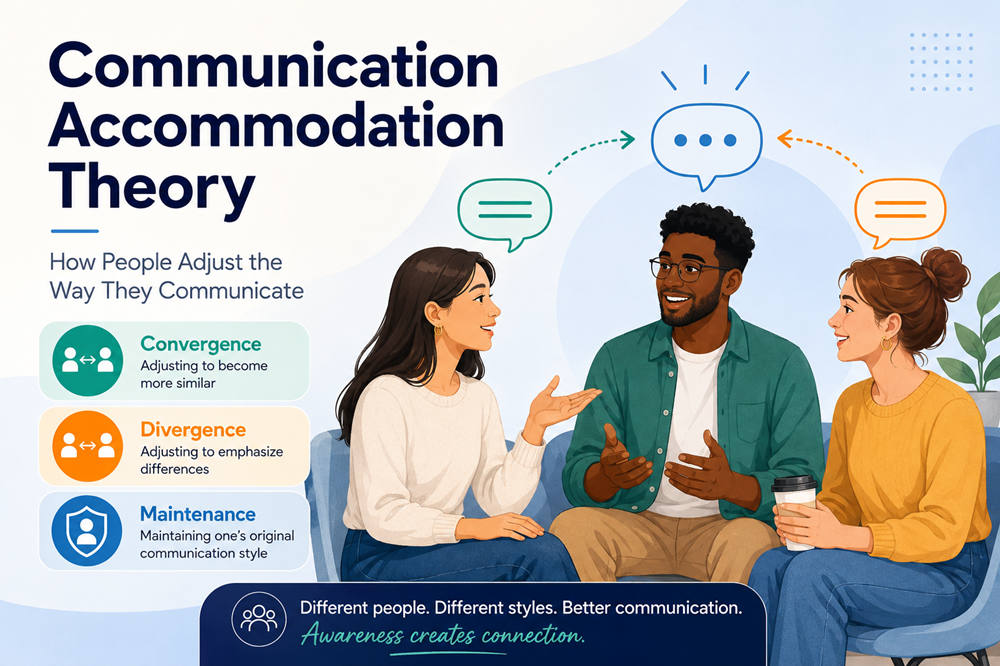
Three ideas make CAT much easier to understand: convergence, divergence, and maintenance.
1. Convergence
Convergence happens when your communication becomes more similar to another person’s.
You may begin matching their speaking pace, vocabulary, level of formality, gestures, or conversational style.
Suppose a customer asks an IT specialist why their laptop cannot connect to Wi-Fi. The specialist could give a highly technical explanation involving network protocols and IP configuration.
Instead, they might say:
“Your computer isn’t getting the information it needs to connect to the network.”
The specialist has adjusted the explanation to make it easier for the customer to understand.
People may converge to:
- Make communication clearer
- Build rapport
- Show friendliness
- Reduce social distance
- Fit comfortably into a group
- Help someone understand unfamiliar information
Convergence also develops naturally in close relationships.
Friends who spend a lot of time together often start using similar expressions or jokes. Coworkers may develop shared abbreviations. Couples may even create phrases that make little sense to anyone outside the relationship.
None of this requires deliberate imitation. Communication patterns often become more alike simply because people interact regularly.
2. Divergence
Divergence moves in the opposite direction.
It happens when someone maintains or emphasizes differences between their communication style and another person’s.
Imagine someone from Louisiana moves to another part of the country but continues speaking with their natural regional accent. They may have no interest in changing it simply because the people around them sound different.
Their accent is part of how they communicate and possibly part of their regional identity.
People may use divergence to:
- Maintain cultural or regional identity
- Express individuality
- Show group membership
- Establish authority
- Signal disagreement
- Create social distance
Divergence can also appear at work.
A manager who normally jokes casually with employees might switch to a noticeably more formal tone during a disciplinary meeting. That difference signals that the conversation should be taken seriously.
Divergence is not automatically negative. Sometimes maintaining differences is important because effective communication should not require everyone to sound or behave alike.
3. Maintenance
Maintenance happens when you continue communicating in your normal way without moving noticeably closer to or farther from the other person’s style.
Two coworkers, for example, may have very different conversational habits but communicate successfully without either changing much.
Maintenance becomes a problem only when sticking with your usual style makes communication unnecessarily difficult.
If an accountant explains a tax issue to a client entirely through specialized financial terminology the client does not understand, refusing to adjust is unlikely to help either person.
Why Do People Change the Way They Communicate?
Accommodation is not simply about wanting someone to like you. People adjust their communication for several practical and social reasons.
To Make Things Easier to Understand
One of the most common reasons is clarity.
What makes sense to an expert may be confusing to a beginner.
A mechanic talking to another mechanic can comfortably discuss technical components by name. A customer may need a more straightforward explanation of what failed, why it matters, and what needs to be repaired.
Changing the explanation does not mean changing the facts.
It means making the facts usable for the person receiving them.
To Build Connection
People often begin communicating more similarly when they feel comfortable together.
You may unconsciously match another person’s pace, energy, expressions, or humor. These small changes can make conversations feel less awkward and more natural.
To Protect Identity
Accommodation has limits.
Language and communication can be closely tied to where you grew up, the communities you belong to, your profession, or your cultural background.
Someone may therefore choose to keep an accent, dialect, expression, or communication habit even when others around them communicate differently.
The goal of good communication is understanding, not making everyone identical.
To Respond to Social Roles
You probably do not talk to every person in your life exactly the same way.
You might say to a friend:
“Yeah, that sounds good. I’m in.”
In a professional email, the same basic response might become:
“That approach works for me. I’m happy to move forward.”
Neither version is more correct. Each fits a different relationship and setting.
Verbal and Nonverbal Accommodation
CAT applies to more than spoken words.
Verbal Accommodation
Verbal accommodation includes changes in things such as:
- Vocabulary
- Sentence complexity
- Accent
- Speaking speed
- Volume
- Pronunciation
- Formality
A teacher, for example, may explain the same scientific concept differently to elementary school students and university students.
The underlying idea stays the same. The language changes to fit the audience.
Nonverbal Accommodation
Communication also happens through your body.
Nonverbal accommodation may involve:
- Eye contact
- Posture
- Facial expressions
- Gestures
- Personal space
- Head movements
- Physical orientation
During a relaxed conversation, two people may gradually begin sitting in similar positions or leaning toward each other.
These changes are often subtle enough that neither person realizes they are happening.
Communication Accommodation Theory Examples
CAT becomes much easier to recognize when you look at familiar situations.
Workplace Communication
Imagine joining a team where everyone communicates through short, direct messages.
At first, you send long and formal emails:
“Good afternoon. I wanted to reach out regarding the document you requested earlier today.”
After a few weeks, you might start writing:
“Here’s the document you asked for. Let me know if anything needs changing.”
You have not become less professional. You have learned the communication norm of the group and adjusted accordingly.
That is convergence.
The same process happens with meeting styles, workplace terminology, response times, and even humor.
Healthcare
Healthcare offers an especially clear example because professionals often need to translate complex information into understandable language.
A physician speaking with another medical professional may use terminology that would be completely appropriate between experts. A patient may need the same information explained in everyday words.
The CDC’s health literacy guidance emphasizes communication practices such as plain language and choosing communication methods appropriate for the audience.
Good accommodation does not mean hiding important details. It means explaining them so the patient can actually understand what they mean.
Intercultural Communication
Different cultures may have different expectations around directness, politeness, silence, personal space, eye contact, or conversational pacing.
For example, one person may be accustomed to very direct requests:
“Send me the report by Thursday.”
Someone else may naturally soften the request:
“Would you be able to send the report by Thursday?”
Neither approach has to be wrong.
Recognizing these differences can help people adjust without assuming their own communication style is the only appropriate one.
The goal is not to imitate another culture. It is to notice differences and communicate with enough flexibility to avoid unnecessary misunderstandings.
Friendships and Relationships
Close relationships often create their own language.
Friends and couples may develop:
- Nicknames
- Inside jokes
- Shared expressions
- Similar humor
- Familiar gestures
- Unique texting habits
Over time, this shared communication can become part of the relationship itself.
Accommodation does not mean both people have to lose their individual styles. They simply learn how to communicate in ways that make sense to each other.
Text Messages and Online Communication
CAT also applies to digital conversations.
Think about the people you message regularly.
With one person, you may send:
“Okay.”
With another:
“okkk 😂😂”
And with someone else:
“Sounds good, thank you.”
Your use of punctuation, emojis, message length, capitalization, abbreviations, and response style often changes depending on the person.
People frequently begin matching these habits naturally over time.
Communication Accommodation and Social Identity
One of the more interesting parts of communication accommodation theory is its connection to identity.
The way you speak can tell other people something about the communities you belong to.
Accents may reflect where you grew up. Professional vocabulary can show experience within an industry. Certain expressions may be common within a generation, culture, profession, or social group.
That helps explain why convergence has limits.
Suppose someone moves from Scotland to the United States. They may adjust certain expressions when American coworkers do not understand them, but that does not mean they need to erase their Scottish accent.
They can accommodate enough to communicate clearly while still maintaining an important part of their identity.
This balance is central to CAT: effective communication involves adaptation, but adaptation does not have to mean assimilation.
When Communication Accommodation Goes Wrong
Changing the way you communicate is not always helpful.
Accommodation can create problems when you adjust too much or fail to adjust when the situation clearly calls for it.
Overaccommodation
Overaccommodation occurs when someone changes their communication more than necessary, often because of assumptions about the other person.
A common example is speaking extremely slowly and loudly to an older adult who has no hearing or comprehension difficulty.
Research on communication with older adults has examined how overly simplified or patronizing speech can communicate a lack of respect even when the speaker believes they are being helpful.
Other examples of overaccommodation include:
- Explaining very basic concepts unnecessarily
- Repeating yourself when the listener understood the first time
- Using an exaggeratedly simple tone
- Speaking much louder than needed
- Assuming someone’s accent means they cannot understand you
- Deliberately copying another person’s accent
Intentions matter, but so does how your communication is received.
The safer approach is to respond to the person’s actual needs rather than assumptions based on age, accent, culture, appearance, or background.
Underaccommodation
Underaccommodation happens when you fail to make a useful adjustment.
Suppose a financial adviser tells a first-time investor:
“You should consider rebalancing your asset allocation to reduce concentration risk and account for your current risk tolerance.”
A person already familiar with investing may understand that immediately.
A beginner may not.
The adviser could instead explain:
“You currently have too much of your money in one type of investment. Spreading it across different investments could reduce the damage if one performs badly.”
The second explanation gives the listener something they can understand and use.
That is the difference between displaying expertise and communicating expertise.
Communication Accommodation Theory in the Workplace
CAT has practical value at work because workplaces bring together people with different personalities, roles, cultures, ages, expertise, and communication preferences.
Managers and Employees
Good managers rarely communicate every message in exactly the same way.
One employee may want detailed instructions before starting a project. Another may work better with the desired outcome, deadline, and freedom to choose the process.
Adjusting how instructions are communicated does not necessarily mean changing expectations.
It means making those expectations clear.
Teams
Teams naturally create shared communication habits.
Over time, coworkers may develop:
- Common abbreviations
- Internal terminology
- Preferred meeting styles
- Shared project language
- Informal ways of asking for help
That convergence can make collaboration faster.
The downside appears when internal language becomes so familiar that team members forget outsiders do not understand it.
A phrase that makes perfect sense inside the marketing department may mean nothing to someone who joined the company yesterday.
Remote Work
Remote work adds another layer because you must also choose the right communication channel.
A quick question may work best in chat.
Complex feedback may need a call.
Detailed information that people will need later may belong in an email or shared document.
Effective accommodation sometimes means changing not just how you say something, but also where you say it.
How to Use Communication Accommodation Effectively
You do not need to consciously analyze every conversation or copy the way other people talk.
A few basic habits can make accommodation more useful.
Listen Before You Adjust
Pay attention to the person rather than immediately deciding what they need.
If they understand you perfectly well, there may be nothing to change.
If they look confused or repeatedly ask for clarification, try another explanation.
Match Knowledge, Not Stereotypes
Someone’s age, accent, job title, or background does not tell you everything about what they understand.
Adjust based on evidence from the conversation.
Use Jargon Only When It Helps
Specialized terminology is useful between people who understand it.
When jargon creates an extra barrier, use ordinary language instead.
Respect Differences
Different does not automatically mean ineffective.
A quiet person is not necessarily unconfident. A direct communicator is not necessarily rude. A formal communicator is not necessarily unfriendly.
Accommodation works better when it starts with curiosity instead of judgment.
Stay Natural
Trying too hard to match someone’s speech, slang, gestures, or accent can feel artificial.
You do not need to imitate another person.
Usually, small changes in clarity, pace, vocabulary, tone, or detail are enough.
Convergence vs. Divergence vs. Maintenance
Here is the simplest way to compare the three major CAT strategies:
| Strategy | What Happens | Simple Example |
|---|---|---|
| Convergence | Your communication becomes more similar | You simplify technical language for a beginner |
| Divergence | You maintain or emphasize a difference | You keep your regional accent in a new environment |
| Maintenance | You continue communicating in your usual style | Two coworkers keep different speaking styles without adjusting |
A single conversation can involve more than one strategy.
You might converge by using vocabulary the other person understands while maintaining your own accent. You could also use a more formal tone to create professional distance while slowing down your explanation to improve clarity.
CAT is therefore less about putting every conversation into one category and more about noticing how communication shifts as relationships and situations change.
Why Communication Accommodation Theory Matters
Communication accommodation theory gives you a useful way to understand why you rarely communicate exactly the same way with everyone.
Your tone with a close friend may not work in a job interview. Technical language that is useful between experts may confuse a customer. A familiar joke that works within your team may leave a new employee wondering what everyone is talking about.
The practical lesson is simple: adjust enough to make communication clearer and more respectful, but do not assume effective communication requires another person—or you—to give up individual identity.
Good accommodation is not imitation. It is paying attention, recognizing differences, and choosing a communication style that helps both people understand each other.