Linear Model of Communication Explained With Examples, Elements, Benefits, and Limitations
The linear model of communication explains communication as a one-way process in which a sender delivers a message to a receiver through a specific channel. It is one of the simplest ways to understand how information moves from one source to an audience.
You can see this model in television broadcasts, emergency alerts, public speeches, advertisements, road signs, and recorded messages. It works best when the goal is to deliver information rather than create an immediate back-and-forth conversation.
What Is the Linear Model of Communication?
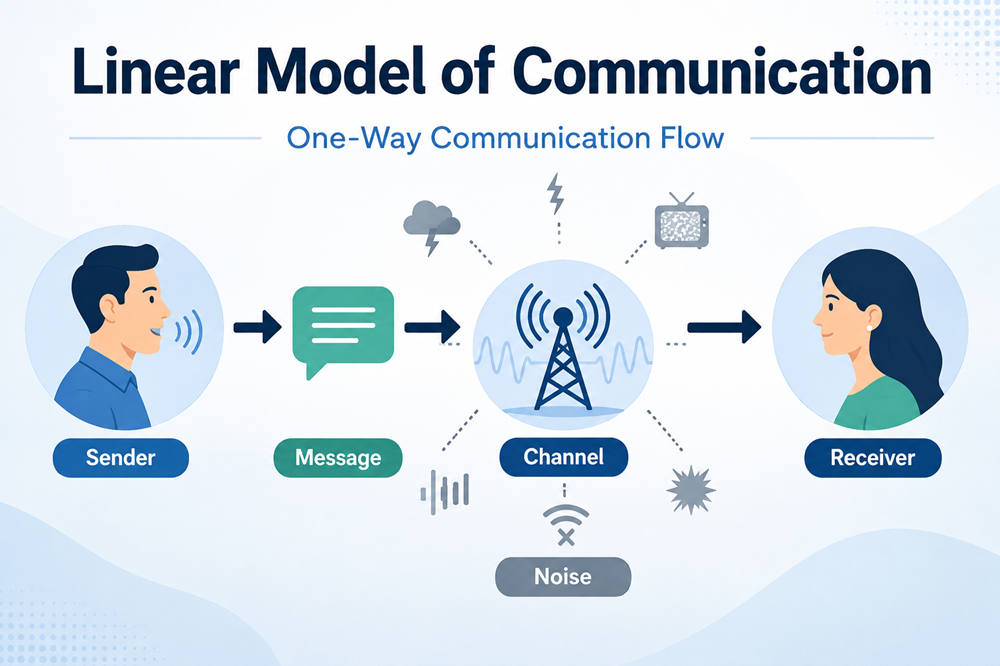
The linear model presents communication as a direct flow:
Sender → Message → Channel → Receiver
The sender creates the message, chooses a channel, and sends the information to the receiver. The receiver then interprets what was communicated.
It is called “linear” because the message mainly travels in one direction. Immediate feedback is not a central part of the basic model.
For example, when a radio station broadcasts a weather warning, the station sends information to listeners. The audience receives the message, but the broadcast does not depend on each listener responding.
This makes the model especially useful for understanding one-way and mass communication.
Elements of the Linear Model of Communication
Several parts work together to move a message from its source to its audience.
Sender
The sender is the person, group, business, or organization that starts the communication.
A sender could be a teacher giving instructions, a government agency issuing an alert, a company running an advertisement, or a television station broadcasting the news.
Encoding
Encoding is the process of turning an idea into a form that can be communicated.
The sender may use spoken words, written text, images, sounds, gestures, or symbols.
A road authority, for example, can communicate an instruction through a traffic sign instead of writing a full sentence.
Message
The message is the information being sent.
It might be a warning, instruction, announcement, advertisement, lesson, opinion, or piece of news.
Clear communication matters because confusing wording, unfamiliar terms, or unnecessary complexity can make information harder for an audience to understand.
Channel
The channel is the medium used to carry the message. Choosing suitable communication channels helps information reach the intended audience in an appropriate form.
Common channels include:
- Television
- Radio
- Newspapers
- Websites
- Signs
- Posters
- Video
- Printed documents
- Public-address systems
The best channel depends on the audience and purpose. An emergency warning, for example, may need to reach people through several channels rather than relying on a single method.
Receiver
The receiver is the person or audience that gets the message.
A receiver may be one individual, such as someone reading an instruction manual, or a large audience watching the same television broadcast.
Decoding
Decoding happens when the receiver interprets the message.
People may understand the same information differently because of their knowledge, language, experience, culture, or expectations. This is why the sender needs to consider the intended audience when creating a message.
Noise
Noise is anything that interferes with communication.
It can include:
- Background sounds
- Poor phone or radio reception
- Internet problems
- Unclear language
- Technical jargon
- Distractions
- Stress or lack of attention
Noise matters because successfully sending a message does not guarantee that the receiver will receive or understand it exactly as intended.
Common Examples of Linear Communication
Linear communication appears in many everyday situations where information mainly travels from a source to an audience.
1. Television Broadcasts
Traditional television sends news, entertainment, educational programs, and advertisements from broadcasters to viewers.
The audience receives the content without taking part in the original transmission.
2. Radio Broadcasts
Radio stations send music, news, weather reports, interviews, and other information to listeners.
Although listeners may contact the station separately, their response is not required for the original broadcast.
3. Newspaper Articles
A newspaper publishes information that readers consume later.
Readers can form opinions, discuss the article, or contact the publication, but those responses happen after the original message has been delivered.
4. Public Speeches
A speaker delivering a prepared speech to an audience is often using a mostly linear form of communication.
The speaker controls the message while the audience listens. If the event later moves into a question-and-answer session, the communication becomes more interactive.
5. Advertisements
Television commercials, billboards, print ads, and prerecorded online advertisements send planned messages to an audience without requiring an immediate response.
6. Road Signs
Traffic signs communicate rules, instructions, and warnings using words, colors, shapes, and symbols.
A speed-limit sign, stop sign, or road-work warning is a straightforward example of one-way communication.
7. Emergency Alerts
Weather warnings, evacuation notices, and public-safety announcements send urgent information from authorities to people who may be affected.
The priority is fast, clear delivery rather than starting a conversation.
8. Recorded Videos
A prerecorded tutorial or educational video sends information from its creator to viewers who may watch it hours, months, or even years later.
9. Instruction Manuals
An instruction manual communicates directions from a manufacturer or writer to the person using a product.
The user receives the instructions without communicating directly with the person who created them.
10. Traditional Lectures
A lecture can fit the linear model when a teacher presents information while students mainly listen.
Once students begin asking questions and the teacher responds, the communication shifts away from a purely linear process.
Major Linear Models of Communication
Several well-known communication models use a mostly one-way structure. Aristotle’s model, Lasswell’s model, and the Shannon-Weaver model are among the most widely discussed.
Aristotle’s Model of Communication
Aristotle’s model focuses on public speaking and persuasion.
Its basic structure is:
Speaker → Speech → Audience
The speaker prepares and delivers a message with the goal of influencing an audience.
The model is particularly useful for understanding speeches, debates, presentations, and persuasive messages because it places strong emphasis on the speaker and the way a message is delivered.
Lasswell’s Model of Communication
Harold Lasswell described communication through five questions:
Who → Says What → In Which Channel → To Whom → With What Effect
The Lasswell model of communication examines the sender, message, channel, audience, and effect of communication.
It is especially useful for examining mass communication because it looks beyond the delivery of a message and asks what effect that message has on the audience.
Shannon-Weaver Model of Communication
The Shannon-Weaver model pays more attention to how information moves through a communication system.
A simplified version looks like this:
Sender → Encoder → Channel → Decoder → Receiver
One of its most important ideas is noise, which can interfere with information while it travels through a channel.
Static during a radio broadcast is a simple example. If the interference is strong enough, some of the information may not reach the listener clearly.
The work of Claude Shannon became foundational to modern information and communication theory, particularly in the study of how information is transmitted through communication systems.
Advantages of the Linear Model of Communication
The linear model remains useful because it turns a complicated process into something easy to examine.
Easy to Understand
The model gives you a clear picture of information moving from a source to an audience.
Its simple structure makes it particularly helpful when you are first learning how communication works.
Useful for Mass Communication
Television, radio, advertisements, speeches, recorded content, and public announcements often involve one source addressing many people.
The linear model fits these situations well because immediate individual feedback is not necessary for the original message to be delivered.
Helps Identify Communication Problems
Separating communication into a sender, message, channel, receiver, and noise makes potential problems easier to find.
If communication fails, you can examine whether the message was unclear, the wrong channel was chosen, technical interference occurred, or the audience had difficulty interpreting the information.
Useful for Planning Messages
The model can also help when preparing announcements, warnings, instructions, and other planned communication.
Thinking about the audience, message, and channel before sending information can make the final message more useful and easier to understand. The CDC’s guidance on communication materials, for example, emphasizes identifying the intended audience, key message, format, and distribution method when developing public information.
Limitations of the Linear Model of Communication
The simplicity that makes the linear model useful is also its biggest weakness. Most everyday communication is more complicated than information moving in a straight line.
It Does Not Show Immediate Feedback
The model does not adequately represent feedback.
During a normal conversation, people ask questions, request clarification, disagree, and adjust what they say in response to each other.
That back-and-forth process is missing from a basic linear model.
The Receiver Appears Too Passive
People do not simply absorb information exactly as it is given to them.
Receivers interpret messages through their own experiences, knowledge, expectations, language, and culture. As a result, two people can receive the same message and understand it differently.
It Oversimplifies Human Communication
Face-to-face communication is rarely completely one-way.
While one person is speaking, another may already be communicating through facial expressions, eye contact, posture, gestures, or other nonverbal signals.
These reactions can influence the speaker before the listener says anything.
It Gives Limited Attention to Context
The meaning of a message depends partly on where communication happens, who is involved, and the relationship between them.
A statement made casually between friends may carry a different meaning when the same words are used between an employee and a manager.
Basic linear models do not fully show these social and situational influences.
When Is the Linear Model of Communication Useful?
The linear model works best when the primary purpose is to deliver information rather than create an immediate conversation.
Common situations include:
- Television and radio broadcasts
- Emergency warnings
- Public announcements
- Advertising
- Recorded messages
- Speeches
- Signs and notices
- Instruction manuals
- Prerecorded educational content
- Public information campaigns
It can also provide a simple framework for planning a message. You can identify who is sending the information, what the audience needs to know, which channel is most appropriate, and what could interfere with understanding.
The linear model of communication does not describe every type of human interaction, but it does not need to. Its value comes from showing the basic movement of information from a sender to a receiver. For broadcasts, warnings, speeches, advertisements, signs, and other primarily one-way messages, that simple structure remains useful.