Kohlberg’s Stages of Moral Development Explained With Examples, Levels, and Key Criticisms
Why would one person follow a rule because they fear punishment while another person questions the same rule because it seems unjust? Kohlberg’s stages of moral development offer one explanation.
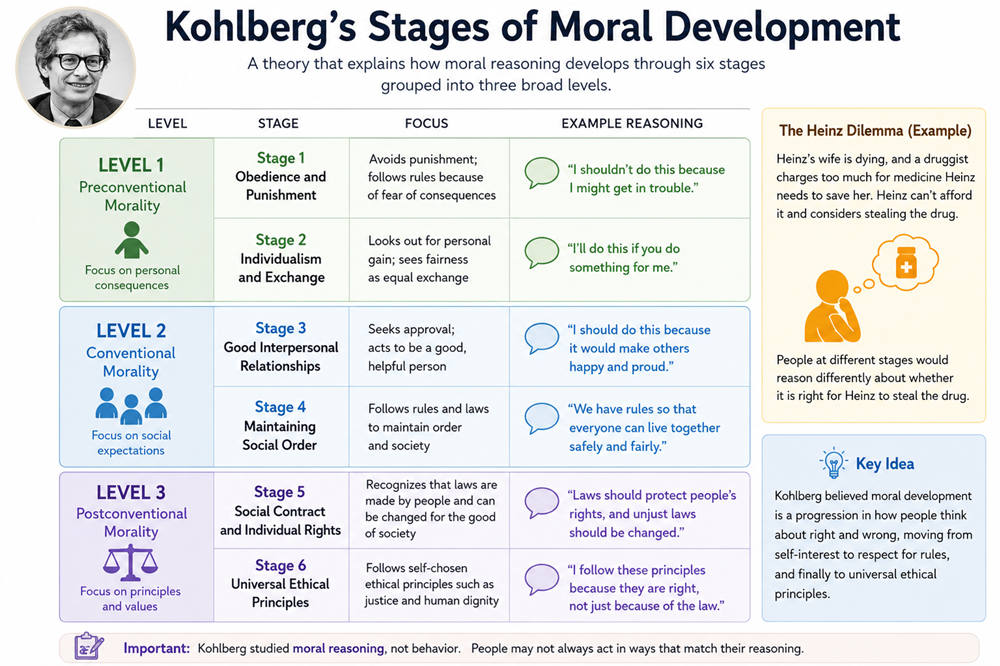
Psychologist Lawrence Kohlberg proposed that moral reasoning develops through three levels and six stages. His theory is less concerned with whether you make a particular choice and more concerned with why you believe that choice is right or wrong.
What Are Kohlberg’s Stages of Moral Development?
Kohlberg’s theory of moral development describes how the reasoning behind moral decisions can become more complex over time. Building on Jean Piaget’s work on cognitive development, Kohlberg organized moral reasoning into three broad levels:
- Preconventional morality
- Conventional morality
- Postconventional morality
Each level contains two stages.
At the earliest level, decisions tend to revolve around consequences such as punishment or personal reward. Conventional reasoning gives more weight to relationships, rules, duties, and social expectations. Postconventional reasoning asks whether laws and rules themselves are fair and consistent with broader ethical principles.
Kohlberg was studying moral reasoning rather than simply moral behavior. Two people can make the same decision for very different reasons, and those reasons are what matter in his framework.
The Three Levels and Six Stages of Kohlberg’s Theory
Level 1: Preconventional Morality
Preconventional morality focuses mainly on the direct consequences an action has for the individual. Punishment, reward, and personal interests play a large role in deciding what is right.
Stage 1: Obedience and Punishment
In Stage 1, rules are often followed because breaking them can lead to punishment.
The thinking is simple:
“I shouldn’t do this because I might get in trouble.”
Imagine a child who wants to take another child’s toy. They decide not to because a teacher might punish them.
The child reaches the correct behavioral outcome—leaving the toy alone—but the reasoning centers on avoiding punishment rather than fairness or respect for another person’s property.
A student at this stage might avoid cheating because:
“If the teacher catches me, I’ll fail the test.”
The consequence matters more than the broader principle of honesty.
Stage 2: Individualism and Exchange
Stage 2 focuses more on personal interests and exchanges between people.
Someone begins to recognize that other people have their own needs, but moral decisions are still often approached in terms of practical benefit:
“What do I get in return?”
A child might agree to help a sibling with chores because the sibling promises to share a snack later.
The reasoning is not necessarily selfish in the everyday sense. The person understands cooperation, but tends to view fairness as an exchange: you do something for me, and I do something for you.
Level 2: Conventional Morality
At the conventional level, moral reasoning expands beyond immediate personal consequences. Relationships, social approval, laws, duties, and expectations become more important.
Stage 3: Good Interpersonal Relationships
Stage 3 centers on relationships and being viewed as a good, caring, or trustworthy person.
Instead of asking only what will happen to them personally, someone may think about how their actions affect others or whether people they respect would approve.
A teenager might return money they found because:
“Keeping it would be dishonest, and I want to be someone people can trust.”
Intentions also matter more at this stage. A person may judge an action partly by whether someone was trying to help, hurt, deceive, or support another person.
Stage 4: Maintaining Social Order
Stage 4 shifts attention from close relationships to society as a whole.
Rules, laws, authority, and duties matter because they help communities function. Someone reasoning at this stage may ask:
“What would happen if everyone ignored this rule?”
Consider a driver who stops at a red light late at night even though no other cars or police officers are around.
Stage 1 reasoning might be, “I don’t want a ticket.”
Stage 4 reasoning is different: “Traffic laws exist to keep roads orderly and safe, so drivers have a responsibility to follow them.”
The behavior is identical, but the reasoning has changed.
Level 3: Postconventional Morality
Postconventional morality involves evaluating laws and social rules rather than automatically accepting them.
Rules still matter, but a person may ask whether those rules protect basic rights, promote fairness, and serve the wider good.
Stage 5: Social Contract and Individual Rights
At Stage 5, laws are understood as agreements created by people to help society function.
Because people create laws, people can also change them when they become unfair or fail to protect important rights.
Someone reasoning at this stage might say:
“We should generally respect the law, but an unjust law should be challenged and changed.”
This thinking balances social order with individual rights.
For example, if a law unfairly excludes a group of citizens, a Stage 5 response would not simply accept it because “the law is the law.” Instead, the person would consider whether the rule serves society fairly and respects people’s basic rights.
Stage 6: Universal Ethical Principles
Stage 6 is the highest stage in Kohlberg’s classic model.
At this stage, moral reasoning is guided by broad principles such as justice, equality, human dignity, and respect for life.
A person may follow those principles even when doing so creates personal risk or conflicts with an existing law.
For example, someone might peacefully resist a deeply unjust policy because they believe protecting human dignity matters more than simply obeying authority.
Stage 6 remains part of the classic six-stage theory, although research on moral development has found more consistent evidence for the earlier stages than for the highest stages.
Kohlberg’s Stages of Moral Development Examples
One situation can show the differences between all six stages.
Imagine finding a wallet containing $200 and the owner’s identification.
Here is how the reasoning might change:
Stage 1 — Obedience and punishment:
“I should return it because I could get caught if I keep it.”
Stage 2 — Individualism and exchange:
“I should return it because I’d want someone to return mine if I lost it.”
Stage 3 — Good interpersonal relationships:
“I should return it because an honest person wouldn’t keep someone else’s money.”
Stage 4 — Maintaining social order:
“I should return it because taking someone else’s property is wrong and society depends on people respecting rules.”
Stage 5 — Social contract and rights:
“I should return it because the owner has a right to their property.”
Stage 6 — Universal ethical principles:
“I should return it because honesty and respect for another person are principles worth following regardless of whether anyone is watching.”
In every case, the wallet gets returned. What changes is the reasoning.
That difference is the heart of Kohlberg’s theory.
The Heinz Dilemma and Kohlberg’s Research
The Heinz dilemma is the best-known example used to explain Kohlberg’s approach.
In the classic scenario, a woman is seriously ill. A drug may save her, but the druggist charges much more than her husband, Heinz, can afford. Heinz tries to raise the money and asks the druggist to lower the price or allow him to pay later, but the druggist refuses.
Heinz eventually steals the drug.
The question is:
Was Heinz right or wrong to steal it?
The interesting part is not simply whether you answer yes or no. Kohlberg was interested in the reasoning behind your answer. The American Psychological Association’s moral development teaching materials use the Heinz dilemma to demonstrate how people can approach the same moral problem from different stages of reasoning.
Someone using Stage 1 reasoning might say Heinz should not steal because he could go to jail.
A Stage 4 response might argue that theft is wrong because laws need to be respected for society to function.
A Stage 5 response could argue that protecting a human life may outweigh property rights in an extreme case.
Those people are considering the same problem but applying different moral frameworks.
Strengths and Criticisms of Kohlberg’s Theory
Kohlberg’s theory became influential because it gave psychologists and educators a structured way to examine how people think through moral problems instead of judging morality only by outward behavior.
However, the model also has important limitations.
Gilligan’s Critique and the Ethics of Care
One of the best-known critiques came from psychologist Carol Gilligan.
Gilligan argued that moral development should not focus so heavily on justice, rules, and individual rights. She emphasized another approach to moral thinking that gives more attention to care, relationships, responsibility, and responding to other people’s needs.
Her work raised an important question: does sophisticated moral reasoning always have to look like abstract reasoning about justice?
The debate is more nuanced than simply saying men think about justice while women think about care. A meta-analysis of gender differences in moral orientation found only small average differences in care and justice reasoning and did not strongly support a simple gender divide.
Gilligan’s critique remains valuable because it broadened the discussion of what moral reasoning can involve.
Culture Can Shape Moral Reasoning
Another criticism concerns culture.
Kohlberg proposed a general developmental sequence, but moral reasoning does not develop in a cultural vacuum. Families and societies can differ in how strongly they emphasize individual rights, family responsibilities, community obligations, authority, relationships, or collective well-being.
Cross-cultural research on moral socialization has found both similarities and differences in how parents from different cultures discuss moral situations with children. This suggests that culture can influence which aspects of a moral event receive the most attention.
Kohlberg’s stages can therefore be useful without assuming that every society defines advanced moral thought in exactly the same way.
Moral Reasoning Is Not the Same as Moral Behavior
Being able to give an impressive moral explanation does not guarantee that someone will behave morally.
A person may strongly defend honesty in a hypothetical discussion and still lie when telling the truth becomes inconvenient.
Fear, peer pressure, money, emotions, habits, and self-interest can all affect real decisions.
Kohlberg’s theory therefore works best as an explanation of moral judgment and reasoning, not as a complete prediction of how someone will behave.
People Do Not Always Fit Neatly Into One Stage
Real moral decisions are messy.
A person may think mainly about rules in one situation but focus on relationships or individual rights in another. Age and education also do not automatically place everyone at the same stage.
The six stages are most useful as a framework for identifying different patterns of reasoning rather than as rigid boxes that perfectly classify every person.
Why Kohlberg’s Theory Still Matters
Kohlberg’s theory remains useful because it encourages you to ask a deeper question about moral choices.
Instead of stopping at:
“What did this person decide?”
you also ask:
“Why did they believe that decision was right?”
That distinction has practical value in education. Moral-dilemma activities can encourage students to explain their reasoning, listen to competing viewpoints, and consider consequences, relationships, laws, rights, and principles rather than simply memorizing which answers adults consider correct.
Kohlberg’s stages should not be treated as a scorecard for deciding whether one person is morally superior to another. They are better understood as a way to examine how moral reasoning can become broader and more complex.
The basic progression is easy to remember: three levels, six stages, moving from concern about personal consequences toward consideration of relationships, society, rights, and ethical principles.