Startup Booted Fundraising Strategy: How Founders Raise Capital Without Losing Control Too Early
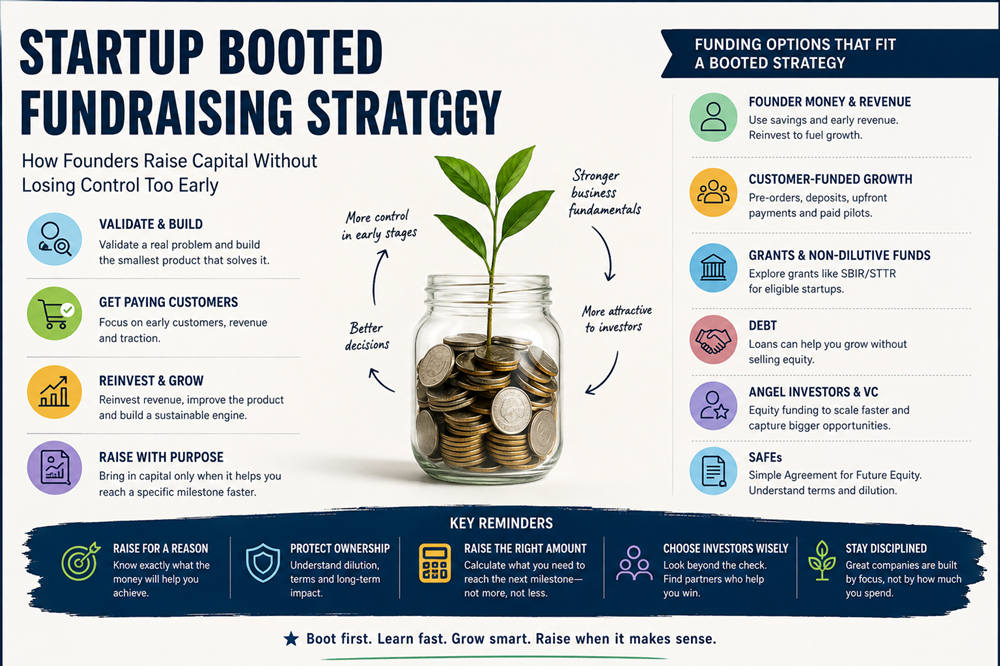
A startup booted fundraising strategy means building as much of your company as practical with founder money, customer revenue, and lean spending before bringing in outside investors. You are not avoiding fundraising forever. You are trying to reach a point where you know what works, what needs funding, and what the next investment should accomplish.
Done well, this approach can help you protect ownership, understand your customers, and enter fundraising conversations with real traction instead of an idea alone.
What Is a Startup Booted Fundraising Strategy?
In this article, a booted fundraising strategy means bootstrapping first and raising outside capital selectively later.
You may begin with savings, consulting income, early sales, pre-orders, or other resources you control. As revenue grows, you reinvest part of it into the business. Outside investment becomes an option when your existing resources can no longer support an opportunity that has already shown promise.
The U.S. Small Business Administration describes self-funding, or bootstrapping, as using your own financial resources to support a business. The main advantage is control, while the downside is that you take on the financial risk yourself.
A booted strategy therefore is not about proving you can build a company without investors. It is about being deliberate about when investor money becomes useful enough to justify its cost.
Why Founders Bootstrap Before Raising Money
One of the biggest advantages of bootstrapping is that you do not have to give up ownership before you understand the potential value of the company.
Venture capital usually involves exchanging part of the business for funding, and investors can also receive an active role in the company.
Bootstrapping first gives you room to answer basic questions before making that trade.
You Learn Whether Customers Will Actually Pay
A promising idea is not the same as a working business.
Early sales help you test whether customers value the product enough to spend money on it. They also reveal which features matter, what customers will pay, and what needs to change.
That information can prevent you from raising a large amount of money to scale something customers never strongly wanted.
You Build With More Discipline
When cash is limited, every expense has to earn its place.
You are more likely to question unnecessary software, premature hiring, expensive office space, and marketing that produces little return.
That financial discipline can remain useful even if the company later raises a substantial round.
You Have More Evidence for Investors
Investors generally want more than enthusiasm. Depending on the stage and business model, they may look for a working product, customer adoption, growth, or other evidence that the opportunity is becoming real.
Y Combinator’s seed fundraising guide emphasizes presenting a believable company story and tying fundraising to the progress the money is expected to create.
A founder with paying customers and measurable growth can have a very different fundraising conversation from one who is still testing the basic idea.
Build Traction Before You Fundraise
There is no single traction number every startup must reach.
What counts as meaningful evidence depends on your business. A SaaS company may focus on recurring revenue and retention, while an e-commerce company may care more about repeat purchases, margins, and customer acquisition costs.
Useful signs can include:
- Consistent paying customers
- Growing revenue
- Repeat purchases or renewals
- Increasing product usage
- Successful paid pilots
- Strong customer retention
- A growing sales pipeline
- Customer referrals
- Improving unit economics
Focus on numbers that tell you whether the business is becoming healthier.
A large number of free users may look impressive, but it tells you less if almost none of them convert. Likewise, rapidly growing sales can still hide a weak business if acquiring and serving customers costs more than the revenue they generate.
Bootstrapping Is Not Right for Every Startup
A bootstrap-first approach works best when you can reach customers without enormous upfront spending.
Some companies cannot.
Hardware, manufacturing, biotechnology, deep technology, and other capital-intensive businesses may need equipment, research, inventory, regulatory work, or specialized employees long before meaningful customer revenue appears.
YC’s fundraising guidance specifically recognizes that startups such as hardware companies may need additional financing to reach their next fundable milestone.
The goal should not be bootstrapping at all costs. The goal is to avoid raising money earlier than the business genuinely requires it.
Funding Options That Fit a Booted Strategy
You have more choices than simply using your savings or immediately approaching venture capital firms.
Founder Money and Revenue
Many founders begin with personal savings and then reinvest early revenue.
This keeps financing simple and lets you retain control, but personal financial limits matter. The SBA’s self-funding guidance warns against committing more personal resources than you can afford to lose and urges particular care when retirement funds are involved.
Set a clear limit on how much personal money you are prepared to put into the company.
Customer-Funded Growth
Customers can sometimes help finance expansion before investors are needed.
Depending on the business, this might include:
- Pre-orders
- Deposits
- Paid pilot programs
- Setup fees
- Annual plans paid upfront
- Advance purchase agreements
Customer funding is useful because the money comes with evidence of demand.
The catch is that accepting payment creates an obligation. Do not sell far ahead of your ability to deliver.
Grants and Non-Dilutive Funding
Certain startups may qualify for grants or other funding that does not require founders to give investors equity.
For qualifying U.S. technology companies, the SBIR and STTR programs offer non-dilutive funding for research, technology development, and commercialization. The programs state that the government takes no equity or intellectual-property ownership through these awards.
These programs will not apply to every startup, but they can be valuable when your company meets the eligibility requirements.
Debt
Loans can provide capital without requiring you to sell part of the company.
The trade-off is repayment.
Debt is generally easier to manage when you already have reasonably predictable cash flow. Borrowing to increase production for confirmed demand is very different from borrowing heavily to find out whether a market exists.
Angel Investors and Venture Capital
Equity financing can make sense when the business has an opportunity that cannot be captured efficiently with existing cash.
You might raise to:
- Expand into a proven market
- Increase production
- Hire a critical team
- Scale a customer acquisition channel that already works
- Complete expensive product development
- Move faster against strong competition
The question is not whether investor funding is good or bad. It is whether the value you expect the capital to create justifies the ownership and control you give up.
SAFEs
Early-stage startups also frequently raise through a SAFE, or simple agreement for future equity.
The SEC’s guide to common startup securities explains that a SAFE gives an investor the right to a future ownership interest if specified triggering events occur. Unlike a traditional convertible note, a SAFE generally does not operate as ordinary debt requiring repayment.
SAFEs may simplify an early financing round, but founders still need to understand how they affect future ownership.
Several SAFEs can eventually convert into significant equity. Before signing them, understand the valuation cap, conversion terms, and potential dilution.
When Should a Bootstrapped Startup Start Fundraising?
A useful fundraising trigger is reaching a point where you can identify a real opportunity and explain exactly how additional money helps you capture it.
For example, suppose customers are asking for your product faster than your team can deliver it. Hiring additional staff could allow you to serve that demand and increase revenue.
That is a specific use of capital.
Compare it with raising simply because the company is struggling to attract customers. If the underlying product or market is still uncertain, more money may only extend the uncertainty.
Fundraising may make sense when:
- Demand is growing beyond your capacity.
- A proven marketing channel could scale with additional spending.
- Hiring would remove a measurable bottleneck.
- You need inventory to fulfill existing demand.
- Product development requires resources you cannot fund internally.
- There is a time-sensitive market opportunity.
- Additional funding can get you to a clearly defined next milestone.
You should be able to finish this sentence:
“If we raise this money, we will use it to reach ______.”
If you cannot fill in that blank clearly, your fundraising plan may need more work.
How Much Money Should You Raise?
Work backward from what the company needs to accomplish.
Start by identifying the next important milestone. Then calculate the people, product development, marketing, inventory, infrastructure, and operating expenses needed to reach it.
Include enough room for normal setbacks rather than assuming everything will happen perfectly.
Y Combinator’s seed fundraising guidance recommends tying the amount raised to a believable plan while considering how much progress the funding can purchase and how much dilution the round creates.
This gives you a more useful fundraising target than simply asking for the largest round investors will offer.
Protecting Ownership and Control
If one goal of bootstrapping is maintaining control, you need to understand what changes when you accept outside investment.
Keep Your Cap Table Current
Your capitalization table shows who owns the company.
Do not look only at your ownership percentage today. Model what could happen after SAFEs convert, employee options are issued, and future fundraising rounds occur.
The SEC’s information on startup securities and capitalization tables explains that investor ownership may be represented as a percentage or number of shares or units on a company’s cap table.
Understand Dilution Before Signing
Dilution means your percentage of the company decreases as new ownership interests are issued.
Dilution is not automatically a bad outcome. Giving up part of the company may make sense if the investment helps create a much larger business.
What matters is understanding the trade before you agree to it.
Look Beyond the Valuation
A high valuation can be attractive, but it is only part of an investment deal.
Different securities can come with different economic and voting rights. The SEC notes in its startup securities overview that common and preferred stock can carry different voting and economic rights.
Review investment documents carefully and use qualified legal and financial professionals when appropriate.
Choose Investors Carefully
The highest check is not necessarily the best money.
Consider whether an investor:
- Understands your market
- Has compatible expectations for growth
- Can help with future fundraising
- Has useful customer or hiring connections
- Has worked constructively with founders during difficult periods
- Expects a level of involvement you are comfortable with
Once an investor is on your cap table, that relationship may last for years.
Common Booted Fundraising Mistakes
Raising Without a Clear Purpose
Do not raise because fundraising feels like the next required startup milestone.
Know exactly what the money is supposed to accomplish.
Giving Up Too Much Too Early
The earlier you raise, the less evidence you may have about the company’s potential.
Understand how much ownership you are giving away and what future rounds could do to your stake.
Spending Faster Just Because Money Arrives
A funding round can create the temptation to expand the team, increase marketing, and add expenses immediately.
Keep the spending discipline that helped you survive before the raise.
Ignoring Business Economics
Revenue alone does not tell you whether growth is healthy.
Track the costs of acquiring customers, serving them, producing the product, and operating the company.
Starting the Raise When Cash Is Almost Gone
Fundraising can take time, and running low on cash reduces your flexibility.
If outside funding is likely to become necessary, prepare before the situation becomes an emergency.
Choosing Investors Only by Valuation
Compare the whole deal.
Ownership, investor rights, expectations, reputation, expertise, and long-term fit can matter as much as the headline valuation.
A Simple Startup Booted Fundraising Strategy
You can reduce the strategy to a straightforward sequence:
- Validate a real customer problem.
- Build the smallest product that solves it.
- Get paying customers as early as practical.
- Reinvest revenue into the parts of the business that are working.
- Track traction, cash flow, margins, retention, and other relevant metrics.
- Identify the specific constraint holding back growth.
- Decide whether money is actually the solution.
- Compare revenue, grants, debt, angels, SAFEs, and equity financing.
- Calculate what it will cost to reach the next meaningful milestone.
- Raise only when the expected benefit justifies the financial and ownership trade-offs.
Final Takeaway
A startup booted fundraising strategy is not about avoiding investors. It is about raising with more information and a clearer purpose.
Build what you can with the resources available. Find customers. Learn which parts of the business work. Then, if outside funding can help you reach a specific opportunity faster, decide how much you need and what you are willing to give up for it.
That approach keeps fundraising where it belongs: supporting the business rather than becoming the business.