What Is a Sales Closing Strategy and How Can It Win More Deals?
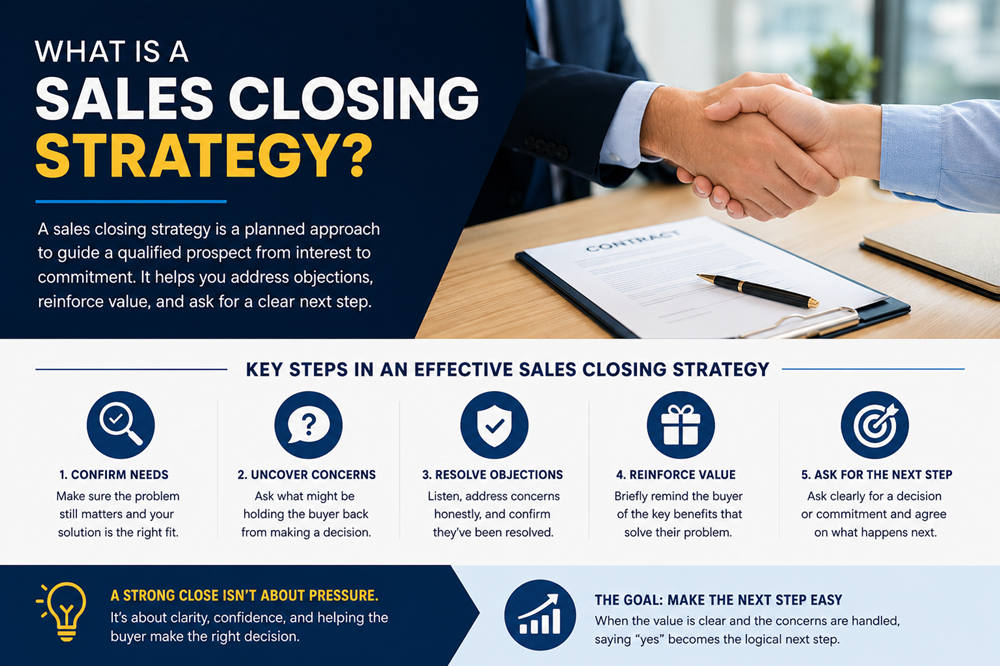
A sales closing strategy is a planned way to help a qualified prospect make a final buying decision. Instead of pushing someone to say yes, you confirm that your offer fits their needs, clear up remaining concerns, and ask for a specific commitment.
The best closes often feel simple because most of the important work has already happened. The buyer understands the problem, sees the value of the solution, and knows what happens next.
What Is a Sales Closing Strategy?
A sales closing strategy is the approach you use to move a prospect from serious interest to a decision. Closing the deal is generally considered the point in the sales process where a prospective customer commits and makes a purchase.
Depending on what you sell, closing could mean:
- Making a payment
- Signing a contract
- Approving a proposal
- Choosing a service package
- Starting a subscription
- Scheduling implementation
Closing is not just the last sentence of a sales call. It is the process of finding out whether the buyer is ready and dealing with anything that is still preventing a decision.
A useful closing strategy answers three questions:
- Does the buyer believe the offer solves the right problem?
- Is anything still stopping them from moving forward?
- What specific action should happen next?
If you cannot answer those questions, asking for the sale may be premature.
Why a Sales Closing Strategy Matters
Interest does not automatically become a sale.
A prospect may like your product but still hesitate because of price, timing, risk, approval requirements, or uncertainty about what happens after they buy.
A closing strategy helps you uncover that hesitation instead of ending the conversation with something vague such as:
“Think about it and let me know.”
A clearer approach might be:
“You said reducing processing time is your biggest concern. Does this plan solve that well enough for you to move forward?”
That question gives the buyer an opportunity to make a decision or explain what is still holding them back.
A good closing strategy also makes the buying process clearer. The prospect should understand what they are agreeing to and what happens immediately afterward. Different buyers may require different sales closing techniques, so there is rarely one closing line that works in every situation.
Key Steps in an Effective Sales Closing Strategy
You do not need a complicated script. In most situations, a strong close comes down to a few practical steps.
Confirm What the Buyer Needs
Before asking for a commitment, make sure the problem you are solving still matters.
You might ask:
“Is reducing administrative work still your main priority?”
Or:
“Has anything changed since we discussed what your team needs?”
This is especially important in longer sales cycles. Priorities, budgets, and timelines can change between the first conversation and the final decision.
Find Out What Is Holding the Buyer Back
If someone seems interested but has not committed, there is usually a reason.
Ask directly rather than guessing:
“Is there anything you’re still unsure about before moving forward?”
The answer may reveal concerns about:
- Price
- Implementation
- Contract terms
- Product features
- Timing
- Internal approval
- Switching from another provider
Once you know the actual concern, you can respond to it.
Resolve Important Objections
Do not treat an objection as something you need to defeat. Effective objection handling starts with understanding the concern and giving the prospect room to explain it.
For example, “It’s too expensive” could mean the buyer genuinely lacks the budget. It could also mean they have not seen enough value to justify the cost.
Those are two different problems and require different responses.
Answer the concern honestly, then check whether it has been resolved:
“Does that address your concern about the setup process?”
If it does not, keep discussing the issue instead of rushing toward the close.
Briefly Reinforce the Value
Near the end of the conversation, remind the buyer how the offer connects to their priorities.
Keep it short.
For example:
“You wanted to reduce manual reporting, give all 15 team members access, and stay within your current software budget. This plan covers those three needs.”
There is usually no reason to repeat your entire presentation.
Focus on the benefits the buyer has already said matter.
Ask Clearly for the Next Step
At some point, you have to ask for a decision.
The question does not need to sound clever:
- “Would you like to move forward?”
- “Should I prepare the agreement?”
- “Are you ready to get started?”
- “Would you like the monthly or annual option?”
- “Should we schedule onboarding?”
Then allow the buyer to answer.
Talking too much after asking can make a clear moment unnecessarily awkward.
Common Sales Closing Strategies
There are many ways to close a sale, and the right approach depends on how interested the prospect is, what has already been discussed, and whether any concerns remain.
Assumptive Close
With an assumptive close, you move naturally toward the next step because the buyer has already shown strong intent.
For example:
“Would Tuesday or Thursday work better for onboarding?”
Or:
“Which email should I send the agreement to?”
This approach can work when the prospect has already agreed that the solution fits and is discussing practical details.
Used too early, however, it can feel pushy.
Summary Close
A summary close reminds the prospect of the main value they are getting before asking for a commitment.
For example:
“You’ll get automated reporting, access for the whole team, and the support package we discussed. Would you like me to prepare the order?”
This can be useful when the conversation has covered several needs and the buyer would benefit from seeing the main points brought together.
Alternative Close
An alternative close gives the prospect two reasonable ways to move forward.
For example:
“Would you prefer the monthly plan or the annual plan?”
Or:
“Would you rather begin implementation this month or next month?”
The choices should be genuine. This technique should simplify the decision, not hide the option of saying no.
Trial Close
A trial close helps you find out how ready the prospect is without asking for a final commitment yet.
You might ask:
“How does this option sound so far?”
“Would this solve the scheduling problem you mentioned?”
“If we can meet that deadline, would you be comfortable moving forward?”
The response can tell you whether it is time to close or whether another issue needs attention first.
Urgency Close
An urgency close gives the buyer a real reason to make a decision within a certain timeframe.
For example:
“The current pricing ends Friday.”
Or:
“We have one implementation opening left this month.”
Urgency should always be genuine. Inventing a fake deadline may put pressure on the buyer, but it can also damage trust.
Example of a Sales Closing Strategy
Imagine you sell scheduling software to a medical clinic.
The clinic manager has told you that employees spend hours every week making appointment reminder calls. She likes your software but worries that moving to a new system will disrupt the office.
You first confirm that the problem still matters:
“Reducing the time your staff spends making reminder calls is still one of your main goals, correct?”
She agrees.
You address the concern:
“Our onboarding team imports your current schedule and helps your staff set up the automated reminders, so you won’t need to rebuild everything manually.”
Then you check:
“Does that make the changeover feel more manageable?”
She says yes.
Now you can bring the important points together:
“You’ll be able to automate reminders, cut down on manual calls, and get help moving your existing schedule.”
Then you ask:
“Would you like to start onboarding next Monday?”
The close works because each part of the conversation relates directly to what the buyer cares about. There is no need for an elaborate sales trick.
How to Improve Your Sales Closing Strategy
You can improve your closing results without memorizing dozens of closing lines.
Don’t Rush the Decision
If major questions are still unanswered, asking repeatedly for the sale will not make them disappear.
Pay attention to where the buyer actually is in the decision process.
Someone asking basic introductory questions may need more information. Someone asking about payment terms and implementation dates may be much closer to making a choice.
Closing works better when the request matches the buyer’s level of readiness.
Make Buying Easy
A buyer should not reach the final stage and suddenly become confused about what happens next.
Make important details clear, including:
- What they are buying
- How much it costs
- What is included
- When it begins
- What paperwork is required
- What happens after they say yes
Removing unnecessary friction can be just as important as the words you use to ask for the sale.
Learn Why You Lose Deals
When a prospect says no, find out what happened when possible.
Look for patterns.
Maybe buyers frequently hesitate over price. Perhaps deals stall because the right decision-maker was not involved. Maybe prospects reach the closing stage without fully understanding the value of the offer.
Reviewing lost opportunities and recording what happened can help you improve future deals, a practice also reflected in guidance on learning from unsuccessful sales.
Those patterns can reveal that the problem starts earlier than the final sales conversation. Improving your close sometimes means improving qualification, discovery, or communication before you ever ask for a commitment.
A Sales Close Should Feel Like the Logical Next Step
A sales closing strategy gives you a clear way to move a qualified prospect from interest to commitment.
You do not need to pressure the buyer or rely on a perfect closing phrase. Confirm what they need, deal with the concern that is still holding them back, remind them of the value that matters, and ask clearly for the next step.
When the offer genuinely fits the buyer’s needs and the important questions have been answered, closing should feel less like persuasion and more like making the decision clear.