Difference Between Strategy and Tactics and How Both Help You Reach Goals
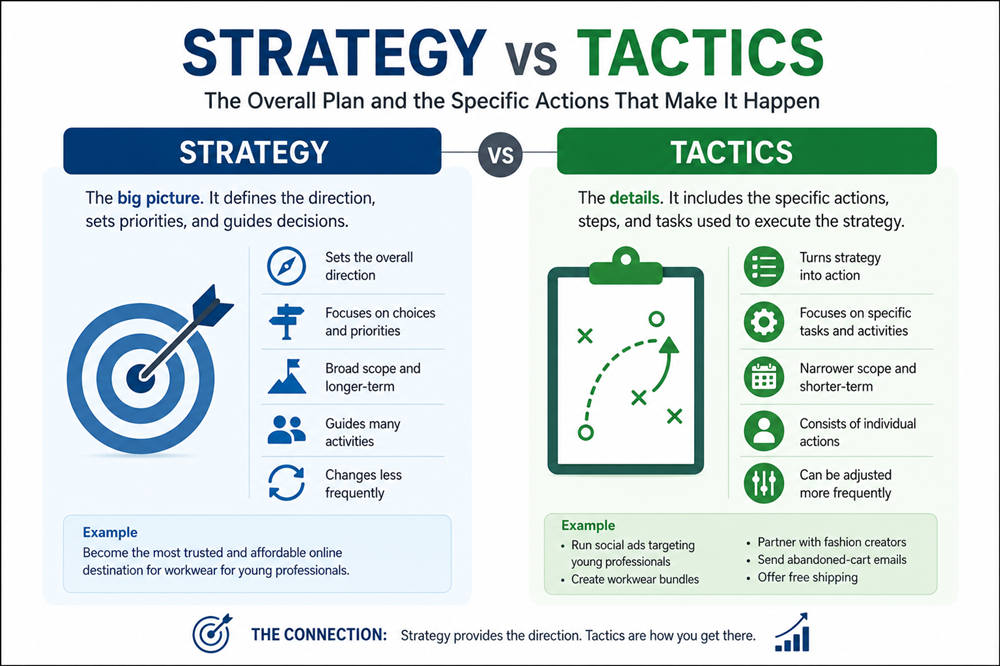
Strategy and tactics are closely connected, but they are not the same thing. Strategy is the overall approach you choose to reach a goal, while tactics are the specific actions you use to carry that approach out.
You need both. Strategy keeps your efforts pointed in the right direction, while tactics turn that direction into practical work.
What Is a Strategy?
A strategy explains how you intend to achieve a goal. It establishes priorities and helps you decide where to focus your time, money, and effort.
Good strategy also involves choices. Harvard Business Review describes strategy in terms of an integrated set of choices rather than simply a collection of goals and projects.
Imagine an online clothing company wants to increase revenue.
Its goal might be:
Increase online sales by 25% over the next year.
Its strategy could be:
Focus on becoming an affordable workwear brand for young professionals who prefer shopping online.
That strategy gives the company something useful to work from. It identifies the audience that matters most and influences decisions about products, pricing, advertising, and customer experience.
A strategy should help answer questions such as:
- Who are we trying to serve?
- Where should we concentrate our resources?
- How are we going to compete?
- What should we prioritize?
- What are we choosing not to pursue?
A statement such as “increase sales” is not really a strategy. It is a goal. The strategy explains the approach you will take to produce those sales.
What Are Tactics?
Tactics are the specific actions used to execute a strategy.
Using the clothing company example, its tactics could include:
- Create a dedicated workwear section on the website.
- Run social ads targeting young professionals.
- Partner with creators who make office-fashion content.
- Introduce workwear bundles.
- Send abandoned-cart emails.
- Offer free shipping above a certain order amount.
These are concrete activities that can be assigned, scheduled, measured, and changed.
A similar distinction appears in management planning. OpenStax’s explanation of tactical planning describes tactical plans as more specific and generally shorter-term than strategic plans, with tactical objectives supporting broader strategic goals.
That does not mean every short-term activity is automatically a tactic. A useful tactic should connect directly to the strategy you have chosen.
What Is the Difference Between Strategy and Tactics?
The simplest difference is direction versus execution.
| Strategy | Tactics |
|---|---|
| Sets the overall approach | Turns the approach into action |
| Focuses on priorities and choices | Focuses on specific activities |
| Usually broader in scope | Usually narrower in scope |
| Often covers a longer period | Often operates over a shorter period |
| Helps decide where to focus | Explains what will actually be done |
| Changes less frequently | Can be adjusted more frequently |
| Guides many activities | Consists of individual actions |
This is also how the distinction is commonly presented in practical project management: strategy provides broader direction while tactics are the actions used to execute it.
One thing to avoid is reducing the difference to long term versus short term.
That distinction is useful, but it does not tell the whole story. Strategy is mainly about your approach and the choices behind it. Tactics are about the actions used to execute those choices.
A tactic might continue for months, while a strategy could need revision sooner if conditions change.
Strategy vs. Tactics Examples
Examples make the distinction easier to see because the same goal can often be pursued through several different strategies.
Marketing Example
Goal: Generate more qualified leads.
Strategy: Build trust with small-business owners by becoming a useful source of beginner-friendly information.
Tactics:
- Publish practical guides.
- Create short educational videos.
- Hold educational webinars.
- Build an email course.
- Publish customer case studies.
The strategy is not “write blog posts.” Blogging is one tactic. The larger strategic choice is to use education and trust to attract potential customers.
Business Example
Goal: Increase customer retention.
Strategy: Make the company easier to do business with than competing brands.
Tactics:
- Simplify checkout.
- Add live-chat support.
- Make returns easier.
- Create self-service account tools.
- Shorten customer-service response times.
Each tactic supports the same idea: removing friction from the customer experience.
Career Example
The same distinction works for personal goals.
Goal: Move into a management role.
Strategy: Build leadership experience before applying for management positions.
Tactics:
- Volunteer to lead a project.
- Mentor a newer employee.
- Take management training.
- Ask for more responsibility.
- Keep records of measurable results from projects you lead.
Without the strategy, you might take random courses or apply for roles without developing the experience employers want. The strategy helps you choose actions that support the same objective.
How Strategy and Tactics Work Together
Strategy and tactics should form a clear chain:
Goal → Strategy → Tactics → Results
Suppose a company wants to increase annual revenue by 20%.
It has several possible approaches. It could find more customers, raise prices, enter a new market, introduce new products, or increase spending among existing customers.
The company chooses this strategy:
Generate more revenue from existing customers.
Its tactics might include:
- Launching a loyalty program
- Creating product bundles
- Offering subscriptions
- Sending personalized recommendations
- Re-engaging previous buyers through email
Those actions belong together because they support the same strategic choice.
In management terms, strategy implementation means translating broader direction into plans and activities that guide what an organization actually does.
This connection matters because it is possible to have plenty of tactics without much strategy.
A business might run ads, post on social media, attend events, offer discounts, start a podcast, and publish a newsletter. Each activity could be useful, but doing all of them does not automatically create a strategy.
They need a common purpose.
The opposite problem happens when a company develops a strategy but never turns it into specific work. Strategy only becomes useful when people know what actions they need to take.
How to Make Sure Your Tactics Support Your Strategy
You do not need a complicated planning system. You mainly need a clear connection between the result you want, your chosen approach, and your daily activities.
1. Start With a Clear Goal
Your goal should describe the result you want.
Instead of:
Improve marketing.
Use something more useful:
Increase qualified website leads by 30% over the next 12 months.
A specific goal makes it easier to judge whether your strategy and tactics are producing results.
2. Choose Your Approach
Next, decide how you intend to reach the goal.
If you want more leads, you might focus on:
- Search traffic
- Paid advertising
- Referral partnerships
- Educational content
- A new audience segment
You cannot pursue every opportunity with equal attention or resources. Strategy requires deciding where to focus.
3. Select Tactics That Match the Strategy
Suppose you decide to attract leads through educational content.
Publishing tutorials, creating videos, offering downloadable guides, and hosting webinars would all make sense.
A simple question can help:
How does this activity support our strategy?
If there is no clear answer, reconsider whether the activity is worth doing.
4. Make the Tactics Specific
“Improve social media” is too vague.
“Publish three educational LinkedIn posts each week for the next three months” gives you something you can actually execute and measure.
Useful tactics make it clear what will happen and, when relevant, who is responsible and when it needs to be completed.
5. Measure What Happens
Track results that connect to your original goal.
Depending on the situation, useful measures might include:
- Revenue
- Leads
- Conversion rate
- Repeat purchases
- Customer retention
- Cost per acquisition
- Website signups
- Customer response times
You do not need to measure everything. Focus on the numbers that tell you whether your chosen approach is moving you toward the goal.
6. Change Tactics When They Stop Working
Tactics should be flexible.
Suppose your strategy is to attract potential customers through educational content. You begin by hosting weekly webinars, but few people attend.
You could replace the webinars with short videos or downloadable guides.
The tactic changed, but the strategy stayed the same.
Changing an unsuccessful tactic is not the same as abandoning your strategy.
Common Strategy and Tactics Mistakes
Some planning problems come from confusing goals, strategies, and tactics rather than from choosing obviously bad ideas.
Calling a Tactic a Strategy
“Post on Instagram five times a week” is a tactic.
“Use visual educational content to become the most trusted beginner-friendly brand in our category” is closer to a strategy.
Putting the word strategy after an activity does not automatically make it strategic.
Using a Goal as a Strategy
Statements such as:
Grow revenue.
Gain more customers.
Improve brand awareness.
describe desired outcomes.
They do not explain how you intend to achieve them.
A useful strategy provides enough direction to influence the choices you make afterward. The Strategy Choice Cascade illustrates this idea through connected choices about where to play and how to win.
Choosing Too Many Unconnected Tactics
More activity does not always mean more progress.
You can run advertisements, post videos, attend conferences, offer discounts, redesign your website, and start a newsletter at the same time. If those activities are aimed at unrelated objectives, your resources can become scattered.
Your tactics should reinforce one another rather than compete for attention.
Treating the Original Tactics as Permanent
Your first ideas will not always work.
If a tactic performs poorly, examine it before assuming the entire strategy has failed.
You may need a different channel, message, format, audience, timing, or offer.
A good strategy provides direction without forcing you to repeat an ineffective action forever.
Strategy Gives Direction and Tactics Create Action
The difference between strategy and tactics is straightforward: strategy defines the approach you will use to reach a goal, while tactics are the specific actions that put that approach into practice.
Strategy without tactics stays theoretical. Tactics without strategy can become disconnected busywork.
When the two are aligned, your larger priorities guide the smaller decisions you make every day.