Understanding the Relationship Between a Subculture and a Dominant Culture in Society
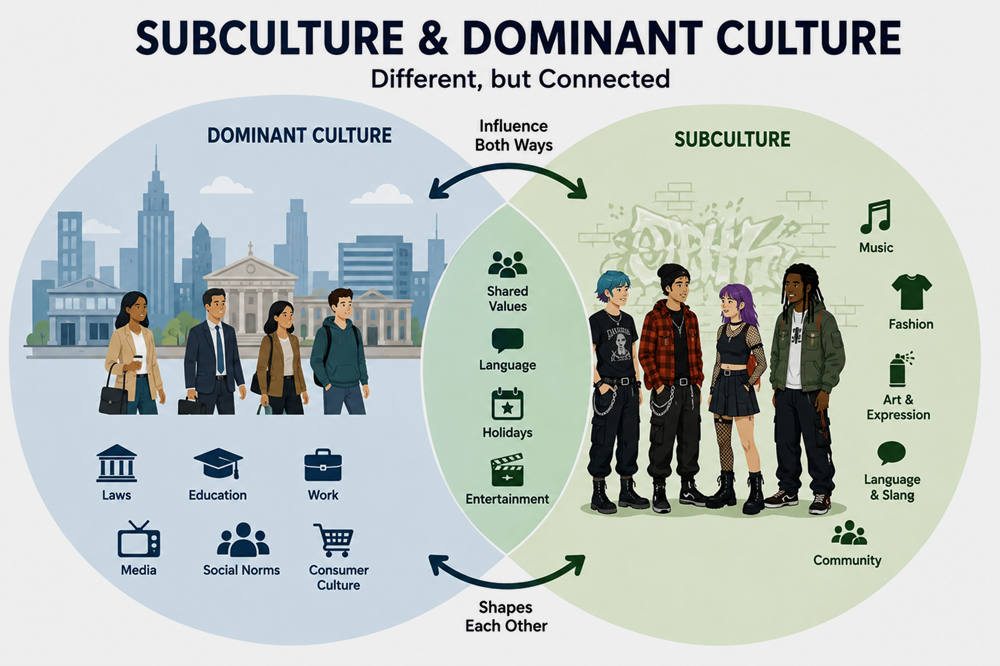
A subculture is a smaller cultural group that exists within a dominant culture but has some beliefs, behaviors, interests, styles, or traditions of its own. Members usually share much of the surrounding culture while also identifying with a more specific community.
That means subcultures and dominant cultures are connected rather than completely separate. They overlap, influence each other, and sometimes come into conflict.
What Is a Dominant Culture?
A dominant culture is the set of cultural practices, values, beliefs, and expectations that has the strongest influence within a society. Its customs and behaviors are often treated as mainstream or normal.
You can see dominant culture in everyday expectations surrounding communication, clothing, work, education, entertainment, manners, and public behavior.
“Dominant” does not mean that every person follows the same customs or agrees with the same values. A society can have broadly recognized cultural norms while also containing many smaller groups with their own identities.
Those smaller groups may form subcultures.
What Is a Subculture?
A subculture is a group within a larger culture whose members share something that sets them apart from the wider population.
That shared identity might involve:
- Music
- Clothing
- Hobbies
- Language or slang
- Religious practices
- Occupations
- Traditions
- Shared experiences
- Values or beliefs
Someone does not need to separate from society to belong to a subculture.
A person can follow mainstream laws, work in an ordinary workplace, attend public schools, enjoy popular entertainment, and participate in common traditions while also belonging to a group with distinctive customs.
That combination of participation and difference is the key to understanding how a subculture relates to a dominant culture.
How Does a Subculture Relate to a Dominant Culture?
A subculture exists within the larger cultural environment rather than replacing it.
Members share many elements of the dominant culture but also develop certain behaviors, interests, symbols, or beliefs that give their smaller group a recognizable identity.
Sociologists generally describe subcultures as groups that remain part of the larger culture while differing from it in meaningful ways.
Subcultures Share Much of the Larger Culture
Members of a subculture usually participate in the same society as everyone else.
They may speak the same language, follow the same legal system, work in the same economy, attend the same schools, and use the same technology.
Consider someone who belongs to a particular music scene. That person might dress differently at concerts, use slang associated with the community, and spend time with people who share similar musical interests.
Outside that setting, the person may work, study, shop, socialize, and handle everyday responsibilities just like other members of society.
The subculture adds another part to the person’s identity rather than replacing their connection to the larger culture.
Subcultures Develop Their Own Cultural Features
Subcultures become recognizable because their members share certain practices or symbols.
Some are easy to see, such as:
- Fashion
- Hairstyles
- Tattoos
- Accessories
- Music preferences
Others are less obvious. A subculture may have its own humor, vocabulary, traditions, values, or unwritten social rules.
These features can strengthen a sense of belonging.
A hobby community, for example, may use specialized terms that experienced members immediately understand but outsiders do not. A professional community may develop jokes, routines, abbreviations, and expectations based on experiences unique to that type of work.
The group remains part of the wider society while creating its own cultural identity within it.
The Relationship Can Change Over Time
The boundary between subculture and mainstream culture is not permanent.
Music, fashion, expressions, hobbies, and behaviors that begin within smaller communities can eventually become popular with a much larger audience.
This process is related to cultural diffusion, where cultural ideas or practices spread between individuals and groups.
Once a subcultural practice becomes widely adopted, it may no longer strongly identify the original group.
Subcultures also change in response to the dominant culture. Technology, media, social attitudes, and economic changes can affect how members communicate and express their identity.
Influence therefore works in both directions.
Does a Subculture Oppose the Dominant Culture?
Not necessarily.
This is an important distinction because being different from mainstream culture does not automatically mean rejecting it.
A subculture may have different fashion, music, hobbies, beliefs, or social customs while accepting most of the larger society’s basic institutions and expectations.
That is different from a counterculture.
According to OpenStax’s explanation of subcultures and countercultures, a counterculture rejects important values or norms of the dominant culture and develops alternatives.
The difference can be summarized simply:
| Cultural Group | Relationship With the Larger Society |
|---|---|
| Dominant culture | Represents widely influential or mainstream cultural expectations |
| Subculture | Shares much of the larger culture but has distinctive characteristics |
| Counterculture | Rejects important dominant values or norms and favors alternatives |
A group can look unusual to outsiders without actually opposing society.
Examples of Subcultures Within a Dominant Culture
Real-world examples make the relationship easier to understand.
Cosplay Communities
Cosplayers create costumes, attend conventions, participate in online communities, and often share terminology connected with fictional characters, games, movies, comics, or anime.
These activities give the community a recognizable identity. OpenStax uses cosplayers as an example of a distinct subculture within a larger culture.
Cosplayers still participate in the wider society. Their interest in cosplay is simply one part of their lives and identities.
Biker Communities
Some motorcycle communities have their own clothing, symbols, events, traditions, vocabulary, and social expectations.
These practices can create a strong group identity without separating members completely from mainstream society.
A biker may have an ordinary career, family, and daily routine while also being deeply involved in motorcycle culture.
Music-Based Subcultures
Music can become the foundation of a subculture when people build a wider identity around a particular genre or scene.
Members may share fashion, slang, venues, attitudes, online spaces, and social customs in addition to enjoying similar music.
Their music community gives them a smaller cultural identity while they continue participating in the dominant culture.
Occupational Subcultures
Subcultures can also develop around occupations.
Healthcare workers, military personnel, emergency responders, construction workers, technology professionals, and other occupational groups can develop specialized language, humor, routines, and expectations.
Someone outside the profession may not understand certain jokes or expressions, while people within the group immediately recognize them.
This is another example of a smaller culture developing inside a larger one.
Can Subcultures and the Dominant Culture Come Into Conflict?
Yes, although conflict is not required for a subculture to exist.
Tension can develop when members of the dominant culture misunderstand a group’s clothing, language, beliefs, lifestyle, or behavior.
Subculture members may also feel pressure to hide certain parts of their identity or conform to mainstream expectations.
Power can affect this relationship. A culture may become dominant because groups with greater political, social, or economic influence have more ability to establish their practices as normal. Discussions of dominant culture and cultural power are therefore often connected to broader questions about social influence.
Still, disagreement with mainstream society does not automatically turn a subculture into a counterculture.
A subculture may question specific customs or seek greater acceptance without rejecting the larger cultural system.
How Subcultures Can Influence Dominant Culture
Subcultures are shaped by the society around them, but they can also influence mainstream culture.
Fashion is an easy example. Clothing or styles once strongly associated with a small community can eventually appear in mainstream stores and media.
The same thing can happen with:
- Music
- Slang
- Food
- Art
- Entertainment
- Technology
- Hobbies
As cultural ideas spread, something that once seemed unusual may become ordinary.
This does not mean every subculture eventually becomes mainstream. It simply shows that cultures continuously interact and change.
Why the Relationship Matters
Subcultures show that people do not have to choose between belonging to the larger society and having a more specific cultural identity.
A person can belong to several smaller cultural communities at the same time.
Someone might identify with a professional community, a religious group, a sports fandom, and a particular music scene while also participating in the wider dominant culture.
Each community can shape a different part of that person’s identity.
This helps explain why a society can have recognizable mainstream cultural patterns without everyone living, thinking, or behaving exactly the same way.
The Relationship Between a Subculture and a Dominant Culture in Simple Terms
The relationship is straightforward: a subculture exists within a dominant culture, shares many aspects of that larger culture, and maintains some distinctive characteristics of its own.
Members participate in mainstream society while also sharing interests, traditions, language, styles, beliefs, or experiences associated with their smaller group.
The dominant culture influences the environment in which subcultures develop, while subcultures can introduce ideas and practices that later spread into mainstream life.
Most importantly, being different from the dominant culture does not automatically mean opposing it. A subculture can remain part of the wider society while preserving an identity of its own.