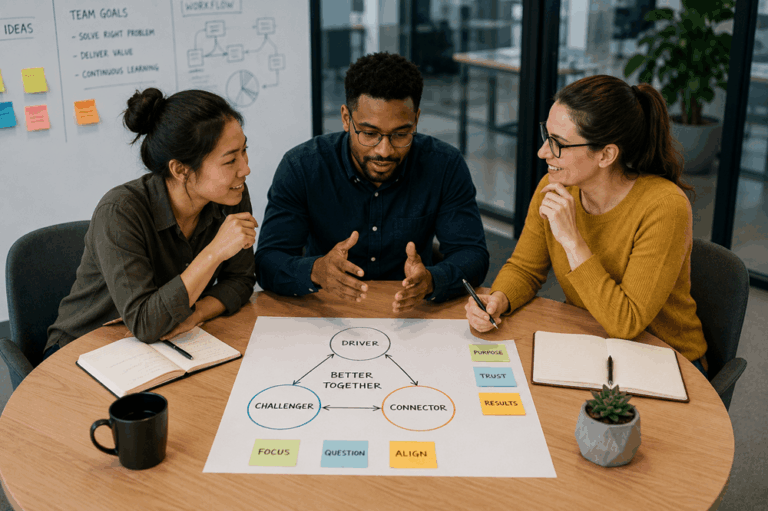

What Is Teamwork? Definition, Core Elements, and Examples
Teamwork is the coordinated effort of people who combine their skills, responsibilities, and decisions to achieve a shared goal. It happens when individual contributions connect, allowing people to accomplish something they could not produce as effectively on their own.
Teamwork can occur in a workplace, classroom, hospital, restaurant, sports club, volunteer organization, or family. Although the setting and responsibilities may differ, the central principle remains the same: people organize their efforts around a common result.
What Is the Definition of Teamwork?
Merriam-Webster defines teamwork as work performed by a group acting together, with each member contributing to the effectiveness of the whole.
In practical terms, teamwork means that people do not merely complete separate tasks under the same group name. They understand how their responsibilities connect, exchange relevant information, and adjust their actions when the needs of the team change.
Consider a team developing a new product. Researchers study customer needs, designers shape the user experience, engineers build the product, and marketers prepare its launch. Each person performs different work, but the final result depends on those contributions fitting together.
Teamwork can be formal or informal. A formal team may have assigned roles, a manager, deadlines, and a written objective. An informal team may form when coworkers respond to an unexpected problem or neighbors organize a community event. In both cases, teamwork is defined by the connection between people’s efforts rather than by job titles or organizational charts.
The Core Elements of Effective Teamwork
Shared purpose and interdependence are two features that distinguish a team from a collection of individuals. Other qualities—including communication, role clarity, accountability, trust, and adaptability—determine how effectively that team works.
A review of how teams are defined identifies shared goals and interdependence among their central characteristics. It also notes that teams develop relationships and working patterns that change over time. These features explain why creating a team involves more than assigning several people to the same project.
A Shared Goal
Team members need a common result that gives direction to their separate responsibilities. The goal helps them decide what deserves attention, how priorities should be balanced, and what success should look like.
A goal may appear shared while still being interpreted differently. One member may prioritize speed, another quality, and another cost. Unless those priorities are discussed, people can work diligently while pulling the project in different directions.
Effective teamwork therefore requires more than announcing an objective. Members need a reasonably consistent understanding of what the team is trying to accomplish.
Interdependent Contributions
Interdependence means that one person’s work affects what others can do. Team members may rely on one another for information, decisions, materials, expertise, or completed tasks.
On a construction project, for example, several specialists may need to complete their work in a particular sequence. A delay or change in one area can affect the schedule and responsibilities of several others.
Interdependence may be immediate, as it is among players during a sports match, or spread across weeks and departments. In either form, it creates a need for coordination.
Clear Roles and Responsibilities
People work more effectively when they understand what they are responsible for, which decisions they can make, and where their work connects with someone else’s.
Clear roles reduce duplicated effort and make neglected tasks easier to identify. They also prevent uncertainty about who should make a decision or respond when a problem appears.
Roles do not have to remain rigid. Team members may step outside their usual responsibilities when circumstances change. What matters is that those adjustments are communicated rather than assumed.
Communication and Coordination
Communication allows members to share information, explain decisions, ask questions, and raise concerns. Coordination turns that information into organized action.
A team can communicate frequently and still coordinate poorly. Meetings, messages, and reports have limited value when people remain uncertain about priorities, timing, ownership, or the next step.
Useful communication helps members understand what has happened, what has changed, and what others need from them. Coordination then aligns tasks, resources, deadlines, and decisions with that shared understanding.
Mutual Accountability
Team members remain responsible for their individual work, but they also pay attention to the collective result. Completing an assigned task is not enough when a person knows that the larger project is moving toward failure.
Mutual accountability does not mean that everyone has equal authority or responsibility for every outcome. It means that members recognize the effect of their work on the team and do not treat preventable problems as someone else’s concern.
Trust and Adaptability
Trust allows people to exchange information, acknowledge mistakes, question assumptions, and ask for help without constantly protecting themselves. It grows when members communicate honestly and follow through on reasonable commitments.
Trust does not require constant agreement. A team can disagree strongly and still work well when members address the issue directly and remain focused on the shared objective.
Adaptability is equally important because plans rarely unfold exactly as expected. New information, changing priorities, and unexpected obstacles may require members to revise decisions or temporarily adjust their roles.
Teamwork Is More Than Working in a Group
A group brings people together. A team connects their responsibilities around a shared result.
People may belong to the same department, attend the same meetings, or report to the same manager while performing largely independent work. They are part of an organizational group, but their daily tasks may require little teamwork.
For example, several sales representatives may work in the same regional office while managing separate clients and being evaluated on individual results. They may exchange advice and cooperate occasionally, but their responsibilities are not necessarily interdependent.
A project team may look quite different. Its members can come from separate departments and report to different managers, yet still depend on one another to deliver a single outcome.
- A group is primarily defined by its membership.
- A team has a shared purpose and connected responsibilities.
- Teamwork describes how members coordinate those responsibilities.
Teamwork, Cooperation, and Collaboration
Teamwork, cooperation, and collaboration overlap, and people often use the terms interchangeably. Still, each word can emphasize a different part of working with others.
Cooperation
Cooperation emphasizes helpful behavior and common effort. It may involve sharing information, providing assistance, following an agreed process, or avoiding actions that interfere with another person’s work.
People can cooperate without forming a team. Two departments might exchange records or coordinate schedules even though they have separate leaders, responsibilities, and measures of success.
Collaboration
Collaboration emphasizes active joint work on a task, problem, decision, or outcome. The APA Dictionary of Psychology describes it broadly as two or more people working together to obtain an outcome desired by all.
Designers may collaborate on a visual identity, researchers may collaborate on a study, or community organizations may collaborate on an event. The participants contribute directly to the same process or result.
Teamwork
Teamwork is the broader pattern through which team members coordinate interdependent roles around a shared goal. It can include cooperation and collaboration, along with role clarity, timing, communication, accountability, and adaptation.
These are practical distinctions rather than rigid categories. The terms can overlap, especially when people work closely together for an extended period.
What Does Good Teamwork Look Like?
Good teamwork is visible in the way people exchange information, anticipate dependencies, and respond when another part of the team encounters difficulty. The exact behavior depends on the setting.
A Product Team
A product team may include researchers, designers, engineers, marketers, and customer-support specialists. Its members need to share what they learn rather than allowing important knowledge to remain within one specialty.
Customer feedback may lead to a design change, which can affect the engineering schedule and marketing message. Good teamwork allows the team to examine those consequences together instead of letting each department proceed with outdated information.
A Hospital Handoff
During a patient handoff, responsibility moves from one healthcare professional or team to another. The incoming staff need an accurate understanding of the patient’s condition, treatment, recent changes, and potential risks.
The Agency for Healthcare Research and Quality’s TeamSTEPPS framework focuses on communication, team leadership, situation monitoring, and mutual support. These skills are particularly important in healthcare because one missed detail can influence several connected decisions.
A Restaurant During a Rush
A restaurant crew may begin a shift with clearly assigned roles, but an unexpected rush can quickly change what is needed. Servers, cooks, hosts, and managers must share information and adjust priorities as conditions develop.
A host may help clear tables, a manager may explain delays to customers, or kitchen staff may reorganize the order of preparation. The roles remain distinct, but members adapt their actions to support the same result.
Across these examples, good teamwork follows a consistent pattern: people make different contributions, understand their dependencies, and respond to one another rather than treating each task as isolated work.
What Poor Teamwork Looks Like
Poor teamwork often appears through small coordination failures rather than one dramatic event. Common signs include:
- Members have conflicting understandings of the main goal.
- Roles overlap or leave important work uncovered.
- Relevant information reaches people too late.
- Individuals protect their own targets at the expense of the team’s result.
- Decisions are made without involving those responsible for carrying them out.
- Members continue following an outdated plan after circumstances change.
A team can appear busy while showing several of these signs. Long hours, frequent meetings, and constant messages do not necessarily indicate that people are coordinating effectively.
Disagreement is not automatically a sign of poor teamwork. Members may need to question assumptions, identify risks, or propose competing solutions. Disagreement becomes harmful when attention shifts from solving the problem to protecting status, assigning blame, or attacking individuals.
Friendliness should not be confused with teamwork either. Members may enjoy one another’s company while avoiding difficult conversations, ignoring missed commitments, or leaving important decisions unresolved. Positive relationships can support teamwork, but they cannot replace clarity and accountability.
A Practical Definition to Remember
Teamwork does not require people to possess the same skills, think alike, or agree on every decision. It requires them to understand how their contributions connect and to act with the shared result in mind.
Teamwork is the coordinated effort of people who depend on one another and combine different contributions to reach a shared goal.
A group brings people together; teamwork connects their efforts.