What Is Teamwork in School? Meaning, Examples, and Importance
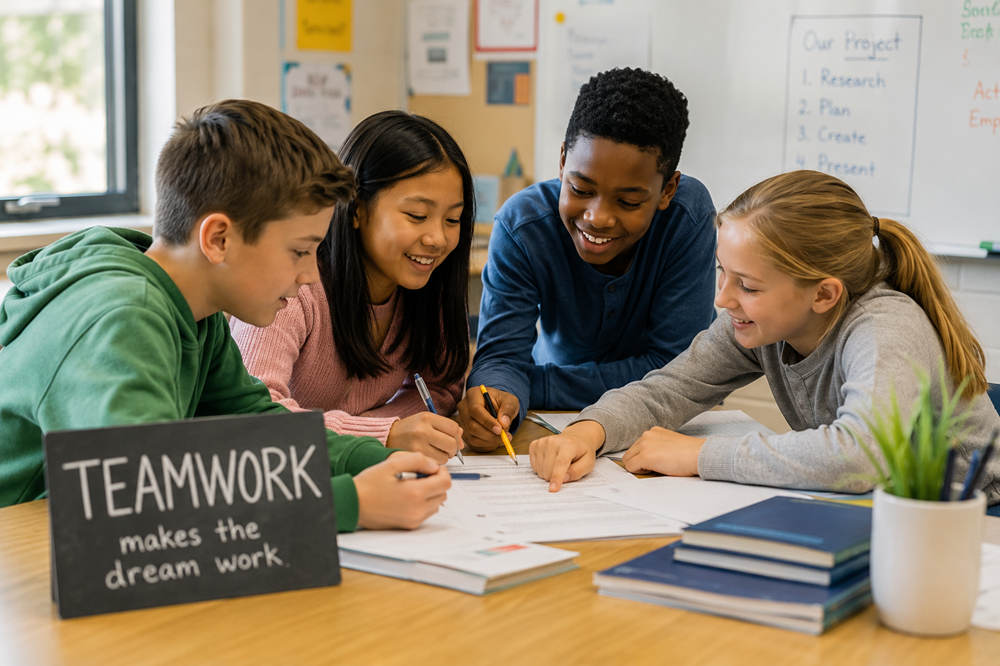
Teamwork in school is the coordinated effort of students who share a goal, communicate with one another, and combine their contributions to complete a learning task or activity. It can take place during a classroom project, science experiment, sports match, musical performance, club activity, or community event.
Being placed in a group does not automatically create teamwork. Students may sit together while working independently or allow one person to make every decision. Genuine teamwork requires coordination, shared responsibility, and meaningful participation.
What Does Teamwork in School Mean?
Teamwork in school means that two or more students coordinate their ideas, responsibilities, and efforts to achieve a shared learning or activity goal.
Members do not have to perform identical tasks. During a class presentation, for example, one student might research the topic, another might organize the findings, and another might design the visual materials. Their work becomes teamwork when they communicate, make connected decisions, and ensure that the separate contributions support one complete result.
One useful framework comes from the OECD’s description of collaborative problem-solving. It emphasizes shared understanding, coordinated effort, and the pooling of knowledge and skills. Collaborative problem-solving is only one form of school teamwork, but the framework captures an important distinction: students are working with one another, not merely beside one another.
Teamwork can also occur among teachers, administrators, counselors, support staff, and families. They may coordinate lessons, respond to a student’s needs, or plan a school-wide initiative. This article focuses mainly on teamwork among students.
The Main Elements of School Teamwork
Although teams differ by activity and age group, effective school teamwork usually rests on five elements.
- A shared goal: Members understand what they are trying to accomplish and what a successful result should involve.
- Coordinated responsibilities: Students know what they will contribute and how their work connects with the rest of the task.
- Open communication: Members exchange ideas, ask questions, provide updates, and discuss decisions.
- Mutual support: Students help the team move forward rather than focusing only on their own part.
- Individual and collective accountability: Each member is responsible for contributing, while the team shares responsibility for the complete result.
These elements allow students to contribute different strengths without losing sight of their common purpose.
School Teamwork vs. Loosely Structured Group Work
Group work can support teamwork, but the two terms are not interchangeable. A group describes several people placed together. A team describes how those people coordinate their work.
In a loosely structured assignment, students may divide the task immediately, complete separate sections, and combine them near the deadline. There may be little discussion about whether the sections agree or form a coherent final product.
Effective teamwork involves more interaction. Students plan how their contributions will connect, discuss important choices, respond to problems, and review the complete work together.
| Loosely Structured Group Work | Effective School Teamwork |
|---|---|
| Students complete separate pieces with little coordination. | Students plan how their contributions will connect. |
| One person may make most of the decisions. | Decision-making is reasonably shared. |
| Interaction may be limited. | Members discuss ideas and exchange feedback. |
| Attention is placed mainly on finishing. | Members consider both the process and the result. |
| Sections are combined near the deadline. | The team reviews the complete work together. |
Dividing responsibilities is not a sign of weak teamwork. It is often necessary. The important question is whether students understand one another’s contributions and coordinate them toward the same outcome.
Examples of Teamwork in School
Teamwork appears throughout school life, from short classroom discussions to activities that continue for an entire semester.
Classroom Teamwork
A science experiment is a clear example. Students may prepare materials, follow the procedure, record observations, and interpret the results. Each person has a different responsibility, but everyone depends on accurate communication because an error in one stage can affect the whole experiment.
Other classroom examples include:
- Researching and delivering a group presentation
- Solving a multistep mathematics problem
- Discussing a text in a literature circle
- Designing and testing a model
- Planning and completing a shared research project
Classroom teamwork does not have to involve a major assignment. It can also occur when students compare answers, review one another’s drafts, or discuss possible solutions before sharing their conclusions with the class.
Extracurricular Teamwork
On a sports team, players coordinate their positions and respond to changing conditions. Individual ability matters, but it must support the team’s strategy.
A school play requires a different form of coordination. Actors, stage crews, costume teams, and lighting technicians perform separate jobs, yet each role contributes to the same production.
Other examples include:
- Performing in a band, choir, or orchestra
- Participating in robotics, debate, or academic competitions
- Producing a school newspaper or yearbook
- Planning an activity through student government
- Organizing a service project or fundraising event
These activities show why equal contribution does not always mean identical work. A strong team combines different abilities in a way that supports a shared purpose.
Why Is Teamwork Important in School?
Well-designed teamwork can strengthen academic learning while helping students develop skills that are difficult to practice through individual work alone. Its value depends on the task, the structure of the group, and the support students receive.
It Can Deepen Learning
Students often understand an idea more clearly when they have to explain it. Putting their reasoning into words may reveal assumptions, missing information, or parts of the topic they do not yet understand.
Classmates can also introduce different methods. One student may notice a pattern that another overlooked, offer an alternative interpretation of a text, or suggest a more efficient way to solve a problem.
The Education Endowment Foundation reports a positive average effect from collaborative learning approaches, but it rates the strength of the supporting evidence as limited. It also notes that results vary and that carefully designed tasks produce better learning than simply asking students to sit together.
Teamwork should therefore be treated as a teaching approach, not a guaranteed solution. Students need a worthwhile reason to collaborate.
It Develops Communication, Responsibility, and Leadership
Team activities require students to listen, explain ideas, ask questions, negotiate responsibilities, and provide feedback. These abilities improve through repeated use rather than through instructions alone.
Students also experience the practical meaning of responsibility. When someone misses a deadline or arrives unprepared, the consequences can affect the entire group. A team makes the connection between personal choices and shared outcomes more visible.
Leadership can emerge in several ways. It may involve organizing tasks, keeping the discussion focused, asking for another person’s opinion, or helping the team make a difficult decision. The student who speaks the most is not necessarily the person providing the most useful leadership.
It Exposes Students to Different Perspectives
Students may approach the same task differently because of their experiences, interests, knowledge, or ways of thinking. Teamwork gives them a reason to compare those approaches rather than relying only on their first idea.
Hearing a different perspective does not mean accepting it without question. Students must consider the evidence, explain their reasoning, and decide which ideas best support the task.
Thoughtful collaboration can also create a sense of belonging. Students may recognize abilities in classmates that are less visible during individual lessons, and quieter students may find it easier to contribute in a small group than before an entire class.
Inclusion is not automatic, however. A group can make students feel excluded when a few members dominate or when responsibilities are assigned without considering how everyone can participate.
It Prepares Students for Life Beyond School
Many adult responsibilities depend on cooperation. Employees coordinate projects, families divide tasks, community groups organize events, and public decisions involve people with different priorities.
School gives students an environment in which to practice these interactions with guidance. They can learn how to meet commitments, respond to feedback, revise a plan, and disagree without turning the discussion into a personal conflict.
Cornell University’s guidance on collaborative assignments identifies communication, self-management, leadership, exposure to different perspectives, and preparation for social and employment situations among their potential benefits.
How Teachers Can Support Better Teamwork
Students are more likely to cooperate meaningfully when a task has been designed for collaboration. An assignment that one student can easily complete alone may give other members little reason to participate.
Teachers can support stronger teamwork by:
- Choosing tasks that benefit from several ideas or abilities
- Explaining the learning purpose of collaboration
- Setting a clear outcome, timeline, and standard of work
- Making responsibilities visible without controlling every decision
- Creating checkpoints before the final deadline
- Modeling productive discussion and respectful disagreement
- Monitoring whether all members can participate
- Considering individual contributions as well as the group result
- Giving students time to evaluate their team process
The EEF finds that some of the most promising collaborative approaches use teams of three to five students with responsibility for a shared outcome. That range is useful rather than universal. The best group size also depends on the students’ ages, the complexity of the task, and the amount of guidance available.
Roles may help students organize a project. A team might use a coordinator, researcher, recorder, timekeeper, or presenter. Rotating those roles prevents students from being confined to the same responsibility and gives them opportunities to develop different skills.
How Students Can Be Good Team Members
Being a useful team member does not require an outgoing personality. Dependability, attention, and honest communication are often more important than confidence or popularity.
Students can contribute well by:
- Understanding the goal before beginning
- Completing agreed work by the deadline
- Reporting delays before they become larger problems
- Listening without interrupting or dismissing ideas
- Asking questions when a decision is unclear
- Offering help without taking over another person’s work
- Explaining disagreements calmly and specifically
- Changing their approach when evidence supports a better option
- Giving credit for other people’s contributions
Fairness does not always mean that every student performs the same number of tasks. Responsibilities vary in time, difficulty, and importance. A fair arrangement gives everyone a meaningful role and prevents one person from carrying most of the work.
School Teamwork Is a Learned Skill
Students do not automatically know how to organize shared work, communicate expectations, or handle disagreement. These abilities develop through instruction, practice, feedback, and reflection.
After a project, students can consider what helped the team, where coordination broke down, and what they would change next time. This reflection makes the experience useful even when the final result was imperfect.
At its best, teamwork in school balances personal effort with shared responsibility. Each student contributes to the task while also paying attention to how the group is progressing. That balance can support stronger learning and prepare students to cooperate with others far beyond the classroom.