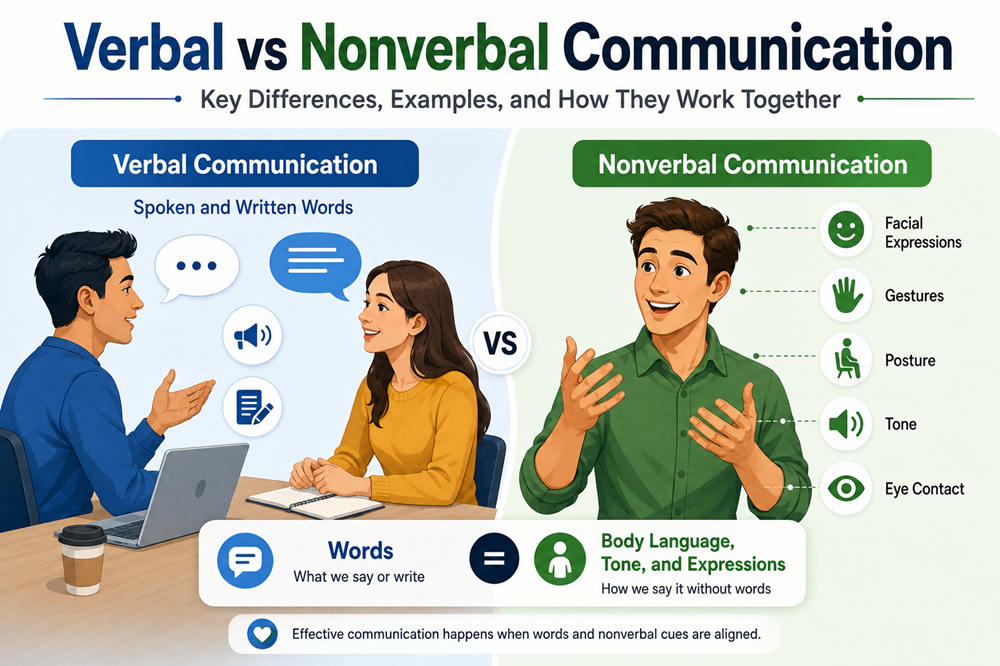
Verbal vs Nonverbal Communication: Key Differences, Examples, and How They Work Together
Communication is more than the words you use. Your facial expressions, tone, gestures, posture, and eye contact can change how another person understands what you are saying.
The main difference between verbal vs nonverbal communication is that verbal communication uses words to share a message, while nonverbal communication relies on cues such as body language, facial expressions, and tone. In most conversations, the two work together.
What Is Verbal Communication?
Verbal communication generally means communicating through words, whether they are spoken or written. Some communication models use the term more narrowly for spoken language, but the broader definition includes both.
You use verbal communication when you:
- Talk with a friend
- Ask a question
- Join a meeting
- Make a phone call
- Give a presentation
- Write an email
- Send a text
- Write instructions
Words are especially useful when you need to communicate specific information. You can explain what happened, give directions, describe an idea, ask for clarification, or tell someone exactly what you need.
Spoken Communication
Spoken communication uses spoken words and includes conversations, phone calls, meetings, interviews, speeches, classroom discussions, and video calls.
The words carry the main message, but how you say them matters too. Pace, volume, pauses, and tone can change how the listener interprets what you mean.
Written Communication
Written communication uses written words to share information.
Common examples include:
- Emails
- Text messages
- Reports
- Letters
- Instructions
- Online messages
- Social media posts
Written communication is particularly useful when information needs to be saved, reviewed later, or explained in detail.
What Is Nonverbal Communication?
Nonverbal communication involves sending or receiving messages without relying on the actual words being spoken.
It can include:
- Facial expressions
- Eye contact
- Gestures
- Posture
- Body movement
- Tone of voice
- Physical distance
- Touch
These signals often add emotional or social meaning to a conversation. The APA Dictionary of Psychology also describes body language as a form of nonverbal communication.
Imagine someone saying, “That’s great,” while smiling and sounding enthusiastic. Their expression and voice support the words.
Now imagine the same words delivered with an eye roll and a flat tone. The sentence has not changed, but the message feels very different.
This is why understanding communication requires paying attention to more than words alone.
Verbal vs Nonverbal Communication: Key Differences
Verbal and nonverbal communication can happen at the same time, but they do not work in exactly the same way.
| Factor | Verbal Communication | Nonverbal Communication |
|---|---|---|
| Main method | Words and language | Expressions, behaviors, and other cues |
| Examples | Conversations, emails, texts, speeches | Gestures, posture, facial expressions |
| Directness | Often more direct | Often requires more interpretation |
| Control | Usually easier to control consciously | Some cues may happen automatically |
| Meaning | Depends heavily on language | Depends heavily on context |
| Best suited for | Detailed information and explanations | Emotion, attitude, emphasis, and feedback |
Words usually allow you to communicate an idea more directly. Nonverbal signals are often less precise and need to be understood within the situation.
For example, crossed arms do not automatically mean that someone is defensive. The person might be cold, comfortable, nervous, or simply resting their arms that way.
A single gesture rarely has one guaranteed meaning.
Examples of Verbal and Nonverbal Communication
Everyday situations make the difference between the two forms easier to see.
Workplace Example
A manager tells an employee:
“Excellent job on the presentation.”
The sentence itself is verbal communication.
If the manager smiles, looks at the employee, and speaks warmly, those nonverbal signals support the praise.
If the same words are delivered while the manager looks at a phone and sounds uninterested, the employee may interpret the message differently.
Relationship Example
Someone says:
“I’m fine.”
Those words suggest that nothing is wrong.
But if the person speaks quietly, looks upset, or avoids engaging in the conversation, their behavior may suggest that something is bothering them.
That does not mean you should assume exactly what they are feeling. A better response may be to ask rather than trying to decode their body language.
Classroom Example
A teacher uses verbal communication while explaining a lesson.
At the same time, pointing to a diagram, changing tone to emphasize an important point, or using hand movements can support the explanation.
Students provide nonverbal feedback too. Nodding, raising a hand, looking confused, or appearing distracted can help a teacher judge whether the class is following along.
How Verbal and Nonverbal Communication Work Together
In a face-to-face conversation, you rarely receive words alone.
You hear what a person says while also noticing how they say it and what they are doing. Research and communication education commonly recognize that nonverbal factors can influence how verbal messages are interpreted.
These different parts of communication can support one another, add information, or occasionally send conflicting signals.
Nonverbal Cues Can Reinforce Words
Suppose you tell someone:
“I’m really happy to see you.”
A smile, warm voice, and natural eye contact reinforce the spoken message.
The verbal and nonverbal signals point in the same direction.
Nonverbal Cues Can Add Information
Sometimes a gesture provides information that the words leave out.
You might say:
“It’s over there.”
The sentence is vague by itself. Pointing toward a door or object gives the listener the missing information.
Words and Behavior Can Conflict
Sometimes a person’s words suggest one thing while their behavior appears to suggest another.
Someone might say:
“I’m not angry.”
Yet their voice sounds tense or unusually loud.
That mismatch may make you uncertain about the message. However, it is better to seek clarification than to assume that one gesture or vocal cue proves what the person is feeling.
Common Types of Nonverbal Communication
Nonverbal communication takes several forms, and each can affect how a message is received.
Facial Expressions
A smile, frown, raised eyebrow, or surprised expression can provide clues about someone’s reaction.
Facial expressions can be useful, but they should not be treated as perfect evidence of a person’s feelings.
Eye Contact
Eye contact can show attention and engagement during a conversation.
The amount that feels natural varies between people, situations, and cultures, so avoiding eye contact does not automatically mean someone is dishonest or uninterested. Guidance on cultural differences in nonverbal communication notes that expectations around eye contact can vary significantly between cultures.
Gestures
Gestures are movements used alongside or instead of words.
Examples include:
- Waving
- Pointing
- Nodding
- Shrugging
- Giving a thumbs-up
Some gestures have widely understood meanings within a particular culture, while others can mean very different things elsewhere.
Posture and Body Movement
The way someone sits, stands, leans, or moves can affect how their behavior is perceived.
Leaning forward may sometimes show interest, for example, but posture alone tells you very little without context.
Tone of Voice
Tone of voice is often described as paralanguage because it concerns how words are spoken rather than the words themselves.
Consider the word:
“Really?”
It can communicate excitement, disbelief, annoyance, curiosity, or sarcasm depending on how it is said.
Tone is one of the clearest examples of how meaning can change even when the words stay exactly the same.
Physical Distance
The space between people can communicate familiarity, formality, or personal boundaries.
You may naturally stand closer to a close friend than to a stranger or coworker.
Comfortable distance also varies considerably across cultures and individuals.
Touch
Touch can communicate affection, reassurance, greeting, or support.
Handshakes, hugs, holding hands, and pats on the shoulder are common examples.
Because people have different boundaries, touch should always be appropriate to the relationship and situation.
How to Improve Verbal and Nonverbal Communication
Better communication does not require memorizing what every gesture supposedly means. It comes from expressing yourself clearly, listening carefully, and paying attention to the larger situation.
Speak Clearly and Directly
When something matters, say what you mean rather than expecting another person to guess.
Instead of:
“Someone should probably take care of that.”
You could say:
“Could you handle that before the meeting?”
The second version makes the request clear.
Listen Before Responding
Good communication is not only about speaking well.
Let the other person finish their thought before deciding how to respond. Listen to their actual words instead of planning your answer while they are still talking.
You can also ask questions when something is unclear.
Pay Attention to Your Tone
A sentence can sound helpful, impatient, sarcastic, or dismissive depending on how you say it.
This matters especially during disagreements, workplace conversations, and discussions about sensitive subjects.
A calm tone can make a direct message easier to receive without weakening what you need to say.
Make Your Actions Match Your Words
Your behavior can undermine your message when the two do not fit together.
For example, saying “I’m listening” while repeatedly checking your phone may make the other person feel ignored.
Putting the phone aside and giving them your attention creates a clearer message.
Look at Context Instead of One Gesture
Avoid trying to interpret a person from a single movement.
Crossed arms, limited eye contact, fidgeting, or a quiet voice can have many explanations. Nonverbal behavior can be ambiguous, which is why body language should be interpreted in context rather than treated like a fixed code.
Pay attention to:
- What is happening in the situation
- The person’s usual behavior
- Their words
- Several cues together
- Cultural and personal differences
When the meaning matters, asking is usually more reliable than guessing.
Remember Cultural Differences
Nonverbal behavior does not mean exactly the same thing everywhere.
Expectations around eye contact, personal space, gestures, touch, and facial expressions differ between cultures and social settings.
Being aware of those differences can help you avoid misinterpreting someone’s behavior.
Final Takeaway
Verbal communication uses words to share ideas and information, while nonverbal communication adds meaning through tone, expressions, gestures, posture, and other cues.
In everyday conversations, both usually work together. The key is not to treat every gesture as a hidden message, but to consider words, behavior, and context together. When something is unclear, direct communication is still the best way to understand what another person means.