How Has the Development of Technology Positively Affected Our Health and Wellness?
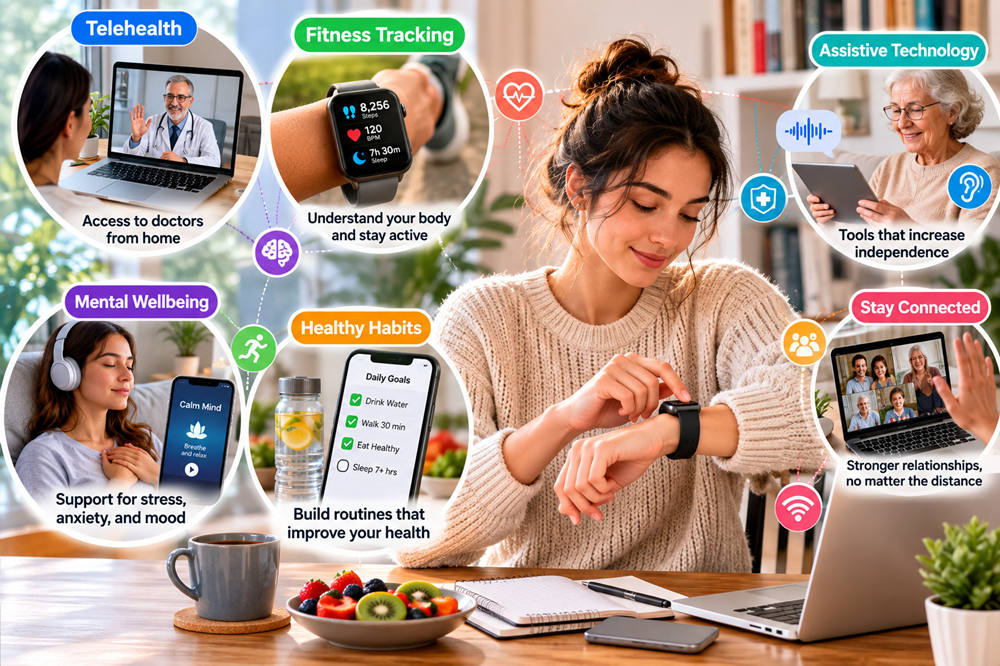
Technology has made taking care of your health more convenient, informed, and personalized. You can talk with a doctor from home, track daily activity on your wrist, find mental health support online, and use assistive devices that make everyday tasks easier.
So, how has the development of technology positively affected our wellness? It has improved access to healthcare, helped us understand our health, supported healthier habits, expanded mental health resources, increased independence, and made it easier to stay connected.
Technology Has Made Healthcare More Accessible
Healthcare no longer has to begin with a trip to a doctor’s office.
Telehealth lets you communicate with healthcare providers by video, phone, or secure messaging. The U.S. Department of Health and Human Services notes that telehealth can save travel time, provide more choices of providers, and sometimes make it possible to get an appointment sooner.
That can make a real difference if you live far from a specialist, have limited transportation, care for children or relatives, or have difficulty leaving home.
Online patient portals have also made routine healthcare simpler. Depending on your healthcare system, you may be able to check test results, request prescription refills, review appointment notes, schedule visits, and send questions to your care team without making a phone call.
You will still need in-person care for many examinations, tests, procedures, and emergencies. The advantage is that technology gives you more ways to reach appropriate care, rather than forcing every medical interaction into the same format.
The World Health Organization’s work on digital health also focuses on using digital technologies to support equitable access to quality health services and strengthen health systems.
Health Tracking Helps You Understand Your Body
Smartwatches, fitness trackers, phones, and other connected devices have made personal health information much easier to follow.
Wearable technology, including smartwatches and fitness trackers, is commonly used to monitor physical activity. Depending on the device, you may also be able to follow other health-related measurements and trends.
Instead of relying only on how active you think you have been, you can see patterns over days and weeks.
You may notice that you barely move on busy workdays, for example. Seeing that pattern could encourage you to take a walk during lunch or spend a few minutes moving between long periods of sitting.
Sleep tracking can also help you notice whether your routine is consistent. An exercise log can show whether you’re gradually becoming more active.
The important benefit is not collecting as much data as possible. It is using useful information to make better decisions.
Consumer trackers are not perfect, and they should not be treated as a replacement for professional medical testing. If a device repeatedly shows something unusual or you have symptoms that concern you, a healthcare professional is a better source of answers.
Technology Can Make Healthy Habits Easier to Maintain
Knowing what you should do for your health is one thing. Doing it consistently is often harder.
Technology can help close that gap.
Fitness apps can give you workouts you can follow at home, outdoors, or at a gym. Activity trackers can show your progress toward a daily or weekly goal. Calendar alerts can remind you about medications, while habit apps can help you keep track of routines such as exercise or sleep.
The value of these tools is often their simplicity.
Instead of telling yourself, “I need to exercise more,” you might set a specific goal to walk for 30 minutes several days this week. A phone or watch can then help you record whether you actually did it.
Digital health tools can also use goal setting, activity tracking, personalized guidance, and reminders. For adults age 55 and older, the Community Preventive Services Task Force recommends certain digital health interventions for increasing physical activity.
Technology does not do the workout or make the healthy choice for you. It simply makes your goals easier to organize, measure, and remember.
Technology Has Expanded Mental Health Support
Technology has also changed the way people find mental health resources.
Virtual therapy and counseling can reduce some of the practical barriers that make getting help difficult. Instead of traveling to an office for every appointment, you may be able to connect with a professional by phone or video when that type of care is appropriate.
There are also digital tools designed to support coping skills, mood tracking, stress management, mindfulness, and other aspects of emotional wellness.
The National Institute of Mental Health explains that technology is being used in mental health care for areas such as symptom tracking, skill development, remote counseling, peer support, and monitoring.
For example, a stress-management tool might guide you through a breathing exercise or help you record situations that tend to increase your stress. Another program might help you practice coping strategies between appointments.
Not every mental health app has strong evidence behind it, though. Researchers are still studying which digital tools work well, who benefits from them, and how they should fit into professional care.
That means digital tools are most useful when you choose them carefully and understand their limits. When professional mental health care is needed, an app should support that care rather than automatically replace it.
Technology Improves Independence and Everyday Safety
Some of technology’s biggest wellness benefits have little to do with fitness trackers or apps.
Assistive technology can help people hear, see, communicate, move, remember information, and complete everyday activities with greater independence.
Examples include:
- Hearing aids
- Wheelchairs and mobility equipment
- Communication devices
- Speech-recognition software
- Captioning
- Memory-support tools
- Vision aids
- Accessible computer controls
The World Health Organization explains that assistive products can help maintain or improve a person’s functioning and independence while supporting health, inclusion, and participation.
Digital technology has expanded those possibilities further.
Some devices can send emergency alerts, while certain phones and watches include safety features such as fall detection. Smart-home controls can make it easier to operate lights, thermostats, doors, and other household equipment. Medication reminders can help people keep track of regular routines.
These tools can be especially valuable for older adults, people with disabilities, and people managing long-term health conditions.
Wellness is not only about exercising more or eating better. Being able to move through daily life with greater independence, comfort, and safety matters too.
Reliable Health Information Is Easier to Find
Technology has also put an enormous amount of health information at your fingertips.
You can learn about nutrition, exercise, preventive care, medications, health conditions, and treatment options without waiting for your next doctor’s appointment. Reputable government health agencies, universities, hospitals, and medical organizations now make large amounts of educational material freely available online.
That access can help you become more involved in your own care.
For instance, you might read about a condition before an appointment so you know which questions to ask. After a visit, you might look up unfamiliar medical terms or review information about a treatment your doctor discussed.
The downside is that inaccurate information is just as easy to publish.
MedlinePlus recommends evaluating health information by checking who provides it, where the evidence comes from, whether it is current, and why the information was published. It also recommends discussing information with a healthcare provider before using it to make important health decisions.
Technology has therefore made health education more accessible, but knowing which information to trust is part of using it well.
Technology Helps Us Stay Connected
Our relationships are another important part of wellness.
Video calls, messaging apps, social platforms, and online communities allow you to maintain relationships even when distance makes face-to-face contact difficult.
You can talk with family members who live in another country, stay close to friends after moving, or connect with a support group made up of people facing similar experiences.
This can be especially meaningful for someone who spends a lot of time at home because of health problems, age, disability, transportation limits, or caregiving responsibilities.
A 2026 systematic review and meta-analysis of technology-based social engagement found that these interventions can help reduce loneliness among older adults, although the researchers cautioned that results varied across studies. Interventions involving interpersonal interaction appeared particularly useful.
That distinction matters.
Simply spending more time online does not guarantee stronger relationships. Technology is most helpful for social wellness when it supports real connection rather than replacing it with passive screen time.
Using Technology Without Letting It Take Over
The fact that technology can support wellness does not mean more screen time is always better.
A fitness watch may encourage you to move, but obsessing over every measurement can make the tool less helpful. Social apps can maintain friendships, but they can also take time away from sleep, exercise, work, or in-person relationships if you use them constantly.
The goal is to make technology work for you.
Use a phone to remind you to take a walk, not to keep you sitting for hours. Use video calls to strengthen relationships when you cannot meet in person. Use trustworthy health websites to become informed while still turning to qualified professionals for personal medical advice.
Healthy technology use is about balance, not avoiding technology altogether.
How Technology Has Changed Wellness for the Better
The development of technology has given us more ways to participate in our own well-being.
Healthcare can be easier to reach. Fitness and health patterns can be easier to understand. Mental health support can be available in more formats. Assistive technology can give people greater independence, while communication tools can help families and friends stay connected across long distances.
Technology cannot replace sleep, movement, nutritious food, healthcare professionals, or meaningful relationships. What it can do is make many of those parts of wellness easier to access, understand, and manage.
That is one of the most important ways technology has positively affected our wellness: it gives us practical tools to make healthier choices and get support when we need it.