How Short-Term Goals Can Help You Accomplish Long-Term Career Goals More Effectively
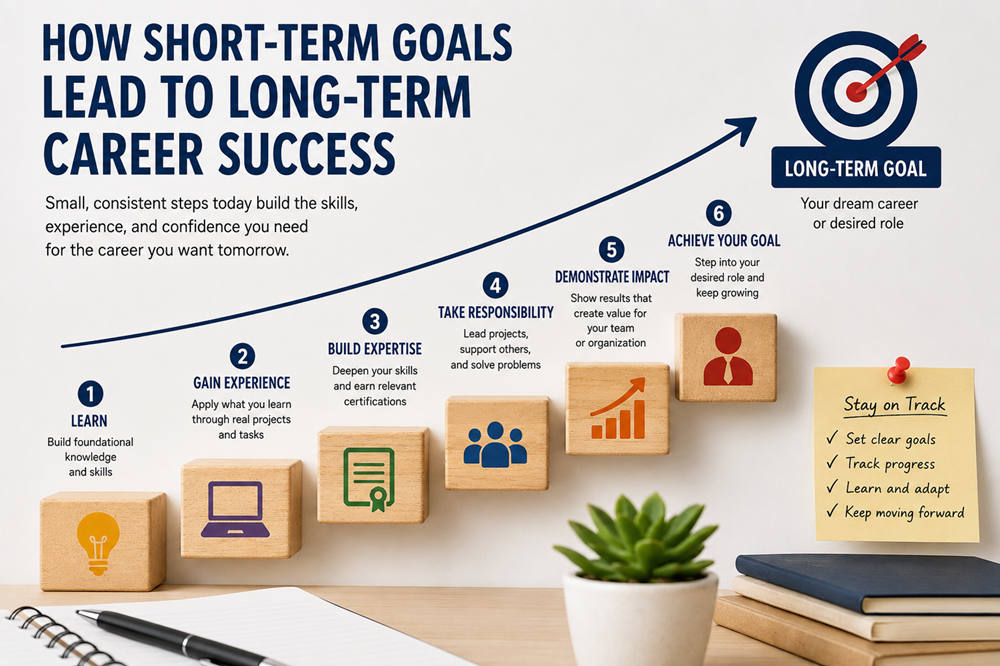
A long-term career goal becomes much easier to reach when you stop treating it as one giant task. Instead, you can break it into smaller goals that build the skills, experience, and confidence you need along the way.
Short-term goals best lead toward accomplishing long-term career goals when each one is specific, realistic, measurable, and connected to the career you want. The goal is not simply to stay busy. Each step should prepare you for the next stage of your career.
How Short-Term Goals Lead to Long-Term Career Goals
Your long-term goal gives you a destination. Short-term goals give you something practical to work on now.
For example, you may want to become a marketing manager within five years. That is a useful direction, but it does not tell you what to do this week or this month.
You could instead set shorter goals such as:
- Learn a digital marketing platform.
- Manage a small campaign.
- Improve your presentation skills.
- Take responsibility for a team project.
- Develop leadership experience.
Each goal gives you something useful that can eventually make you a stronger candidate for management.
CareerOneStop’s career goal guidance recommends identifying where you want to go professionally and then defining the smaller steps that can help you reach that point.
The key is relevance. A short-term goal should solve a real gap between where you are now and where you want to be.
Taking an unrelated course simply because it is available may not help much. Learning software that regularly appears in job descriptions for your target role is much more likely to support your career plan.
Break a Long-Term Career Goal Into Smaller Steps
Start by thinking about the position or career level you eventually want.
Then ask:
What would I need to know, demonstrate, or experience before I would be ready for that role?
Suppose your long-term goal is to become a marketing manager.
A practical progression could be:
- Learn important marketing and analytics tools.
- Complete a useful course or certification.
- Manage a small marketing campaign.
- Build stronger communication and presentation skills.
- Take responsibility for larger projects or coordinate other team members.
- Pursue a team-lead or management opportunity.
You do not necessarily have to follow those steps in that exact order. Your employer, industry, education, and current experience will affect your path.
The important part is that every short-term goal addresses something you will probably need later.
This approach can also expose gaps in your experience.
Maybe you already have excellent technical knowledge but little leadership experience. Instead of taking another technical course, your next goal might be to lead a project, mentor a new employee, or volunteer for an assignment that requires coordinating with other people.
UC Berkeley’s career readiness guidance highlights communication, leadership, teamwork, technology, professional development, and relationship-building among the competencies that can support workplace success.
Make Short-Term Goals Specific and Measurable
Vague goals are difficult to act on because you may not know when you have actually completed them.
Compare these examples:
Vague: Improve my leadership skills.
Specific: Lead one team project within the next six months and ask my manager for feedback afterward.
The second version gives you an action and a deadline.
A simple way to improve short-term goals is to use the SMART framework.
Be Specific
Clearly define what you want to accomplish.
Instead of:
“Improve my resume.”
Try:
“Update my resume with my three most recent projects and their measurable results.”
Make It Measurable
Decide what successful completion looks like.
Instead of:
“Do more networking.”
You could set a goal to attend one professional event each month or connect with two people working in your field.
Keep It Attainable
Your goal should challenge you without depending on an unrealistic jump.
If you recently entered your profession, becoming a department director within three months probably isn’t a useful short-term target. Taking responsibility for a larger assignment may be.
Make Sure It Is Relevant
This is especially important for career goals.
Ask:
How will completing this help me become more qualified for the career I want?
If you cannot identify a useful connection, another goal may deserve your time first.
Give Yourself a Deadline
A reasonable deadline gives the goal structure.
“Learn Excel” can easily be postponed.
“Complete an intermediate Excel course by November 30” gives you a clear target.
The U.S. Office of Personnel Management uses SMART goals built around specific, measurable, achievable, relevant, and time-bound expectations. Its guidance also recommends revisiting goals and adjusting them as needs change.
You do not need to turn every small task into a complicated SMART worksheet. The basic idea is simply to know what you are doing, why it matters, how you will judge completion, and when you intend to finish it.
Use Short-Term Goals to Build Skills and Experience
Wanting a promotion is not enough by itself. You usually need skills, experience, and results that show you are ready for additional responsibility.
Useful short-term career goals might include:
- Completing a relevant certification.
- Learning important software or technical skills.
- Leading a project.
- Improving communication or presentation skills.
- Taking on additional responsibilities.
- Mentoring a colleague.
- Building professional relationships.
Your priorities should depend on your target career.
Someone hoping to move into management may need to develop leadership, decision-making, and project-management skills.
Someone entering a technical field may need more hands-on experience with specific tools or technologies.
A person pursuing marketing or public relations might focus more heavily on communication, analytics, writing, campaigns, and relationship-building.
The Bureau of Labor Statistics skills data covers areas such as adaptability, technology, interpersonal ability, leadership, problem solving, project management, speaking and listening, and writing and reading. The importance of those skills differs across occupations.
That is why your goals should be based on your target role rather than a generic list of skills everyone is supposedly expected to learn.
Look at the qualifications employers regularly request for the position you want. Compare those requirements with your current abilities. The differences can help you decide what your next short-term goals should be.
Track Progress and Adjust Your Goals
Your career plan does not have to remain unchanged for years.
You may discover a different specialty you enjoy more. Your industry may change. A new opportunity may appear. You might also realize that a skill you originally considered important is no longer necessary.
Reviewing your goals occasionally helps you respond to those changes.
Ask yourself:
- What have I completed?
- What skills or experience have I gained?
- Where am I still lacking experience?
- Is my long-term goal still right for me?
- What is the most useful thing to work on next?
You might review your career goals every few months or after major events such as completing a course, finishing an important project, receiving a performance review, or changing jobs.
Regular check-ins also fit with professional-development guidance that treats career growth as an ongoing process rather than something handled only once a year. OPM, for example, recommends regular progress reviews, feedback, and adjustments when priorities or development needs change.
Tracking smaller accomplishments can also make a distant goal feel more manageable.
You may still be several years away from your ideal position, but during the past year you could have:
- Earned a useful certification.
- Led an important project.
- Learned new software.
- Expanded your professional network.
- Taken on greater responsibility.
Those achievements show that you are making progress even though you have not reached the final goal yet.
Example of Short-Term Goals Leading to a Long-Term Career Goal
Imagine that your long-term goal is to become a software development manager.
Moving directly from an entry-level developer position into management is unlikely to be the most practical plan. You would normally need to build both technical experience and the ability to work with people and projects.
Your short-term progression could look like this:
Learn an important programming skill
↓
Use it successfully on real projects
↓
Take responsibility for larger assignments
↓
Help or mentor newer developers
↓
Lead a small project
↓
Strengthen planning and communication skills
↓
Move into a team-lead role
↓
Build leadership experience
↓
Pursue a software development manager position
The early goals strengthen your technical experience. Later ones give you opportunities to demonstrate mentoring, communication, project coordination, and leadership.
Your route may look completely different depending on your profession, but the same test works almost anywhere:
Will completing my next short-term goal leave me better prepared for the long-term role I want?
When the answer is yes, the goal has a clear purpose.
Final Takeaway
Short-term goals work best when they turn a distant career ambition into manageable actions.
Start with the career you want and identify what you will need to reach it. Then create smaller goals that help you build those qualifications one at a time. Keep them specific, measurable, realistic, relevant, and tied to a reasonable deadline.
You do not have to accomplish your entire career plan at once. Focus on the next useful step, complete it, learn from it, and then decide what should come next.